Solving the VoIP and UC Pricing Puzzles -- Part 1
 Solving the VoIP and UC Pricing Puzzles -- Part 1 by Marty Parker
There's a puzzle going around the industry about pricing for the various types of Voice over Internet Protocol (VoIP) and Unified Communications (UC) solutions. Always interested in a good puzzle, my curiousity got me looking. With a bit of research and some analysis, solutions appeared. This is the first part of a three part series:
- Pricing patterns and a forecast for VoIP Solutions
- Pricing patterns and a forecast for UC Solutions
- A forecast to 2010 for pricing of a complete implementation of UC as, "Communications integrated to optimize business processes."
The three articles together will appear as one piece in the September 2007 Business Communications Review magazine.
This all got started by two recent VoiceCon Enews Newsletters Issue 184 and Issue 185, in which Eric Krapf raised a number of questions about the price trends for both Voice over Internet Protocol (VoIP) and Unified Communications (UC) solutions. Actually, based on market information and visible trends, the patterns are very clear, as described below.
To get calibrated, the Newsletters are primarily focusing on VoIP, since they use data from trends in voice communication systems prices and licensing, traditionally comprising voice telephony and voice mail, as will be presented in two separate tutorials by Allan Sulkin and Doug Carolus at VoiceCon San Francisco. These data are very different from and should not be confused with the pricing for Unified Communications (UC) solutions as discussed at UCStrategies.com. Unified Communications solutions are focused on business process improvement and related workplace productivity and incorporate voice communications along with the appropriate selections of other services such as Presence, Instant Messaging, web conferencing (data and applications), peer-to-peer and group audio and video conferencing, e-mail/unified messaging and more, all of which are controllable as software services with or from the business application software.
To keep things simple, let’s evaluate VoIP and UC pricing trends by grouping things into a few specific categories and then looking at three price points:
- IP PBX solutions in 2006-2007
- Desktop PC/Server-based solutions in 2007
- A forecast for 2010
The IP PBX 2006-2007 price points are based on actual list prices and relevant discounting as observed in recent competitive end-customer RFP responses and are consistent with the data so capably offered by Allan Sulkin of the TEQConsult Group.
The Desktop PC/Server-based solutions in 2007 include such options as Microsoft Office Communications Server 2007, IBM Lotus SameTime 7.5, and similar solutions from Radvision, Digium, and others, and are based on list prices less an assumed 20% discount.
The forecast for 2010 is based on the following rules:
- 10% per annum decline in hardware unit prices (servers, phones)
- 15% per annum decline in software unit prices (user and server licenses)
- 5% per annum increase in services rates (installation, maintenance)
Note that future maintenance prices will be a combination of these assumptions. Maintenance prices are assumed to decline proportional to hardware or software prices (i.e. holding a constant ratio to product prices), but will be increased from that baseline in proportion to the labor content of the maintenance services.
With those assumptions, here is a table summarizing per user prices based on a configuration for 1,000 users with 2-line IP phones including at least a gray-scale display and with redundant servers for reliability (all prices are net after discounts):
Per User Pricing
|
|
2007 VoIP
|
2007 PC-based
|
2010 Forecast
|
|
|
IP Display Phone
|
$190
|
$140
|
$102
|
|
User IP Phone License
|
$110
|
$ 90
|
$ 60
|
|
Softphone License
|
$ 50
|
$ 16
|
$INCL
|
|
IP PBX License
|
$ 18
|
$ 4
|
$ 3
|
|
IP PBX Servers (2)
|
$ 26
|
$ 26
|
$ 19
|
|
VM/UM User/Svr Lic’s
|
$ 93
|
$ 30
|
$ 20
|
|
VM/UM Servers (2)
|
$ 26
|
$ 26
|
$ 19
|
|
PSTN/PBX Gateways
|
$ 28
|
$ 35
|
$ 20
|
|
Installation
|
$102
|
$ 60
|
$ 70
|
|
Tot. Acquisition Price
|
$643
|
$427
|
$313
|
If it is of interest to include maintenance pricing, the following shows current and forecasted maintenance fees for hardware and softwarel, as well as a calculation of the three year average price per user per year (excluding any allowance for warranty).
Annual Maintenance
Software $ 83 $ 35 $ 27
Hardware $ 17 $ 17 $ 14
Subtotal Maint/Year $100 $ 52 $ 41
Three Year Average $314 $194 $145
Per User Per Year
The acquisition prices are displayed graphically in Chart 1.
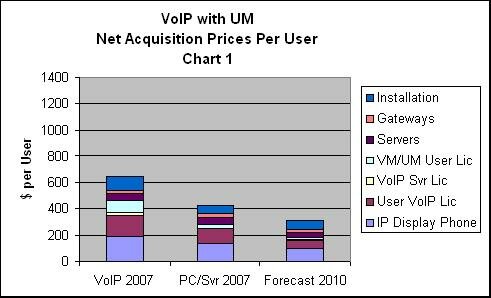
The acquisition price of the 2007 PC-based solution is already 34% below the traditional IP PBX solution. The solution price of $313 in 2010 will be 49% (less than half) of the current IP PBX prices. Note that the 2007 IP PBX price point of $643 is only $7 different from the recent $650 per user that Eric referenced in his article. The big difference for the 2010 Forecast is that the trends are changing from the proprietary product models of telephony to the best-in-class layered model of the computing industry, which leverages volumes across all producers, not just one. Similarly, the license prices are consistent with Eric’s references.
At this point, it is very important to say that the 2007 Desktop PC/Server solutions are certainly not as fully featured as the IP PBX solutions. In fact the price differences in 2007 may be a reasonable reflection of the differences in value of the two solution types on an Enterprise-wide basis. However, it is also important to note that new entrants into a market almost always have this profile of delivering less than the current products, but of delivering enough functionality for some uses. (Excellent reference on this is, “The Innovator’s Dilemma”, by Clayton M. Christensen, Harvard Business School Press, 1997.) We’re already seeing this pattern, as some companies are finding the PC-based VoIP solution is “good enough” for some types of users, especially when there is a close linkage to UC features such as IM, Presence, or peer-to-peer communications.
Looking to the future, it is very possible for both the IP PBX and the PC-based providers to achieve the 2010 price points, as suggested by Mark Straton, Siemens USA marketing vice president, at VoiceCon Spring 2007, when he said that Siemens has strategic planning scenarios that show prices for call control software declining to one-quarter of today’s prices. Mark also indicated that some of the savings would then be available to fund increasing services costs for system integration and new application development. (More on services later in this article.)
To achieve the $313 per user acquisition price in 2010, the IP PBX suppliers will likely need to adopt four practices that the Desktop PC/Server suppliers are already using:
- Support third party SIP and USB phones and let market forces drive the prices down. (A single-line Skype USB phone is already below $70 per user.)
- Support the latest industry standard server technologies to leverage market pricing.
- Drive software volume to allow lowering and bundling of software prices.
- Adopt a software-based maintenance model, with third party maintenance of hardware
Since all these actions are possible, this makes it highly likely that the statement from Jeff Raikes of Microsoft that opened Newsletter 184, i.e. “…the average voice over IP solution will cost half what it does today,” will actually be valid in 2010.
That's the solution to the puzzle on VoIP, from my perspective. Check here in two weeks for the continuing story of pricing for Unified Communications, now and in the future.
Do you agree? Do you have comments, suggestions or other solutions to the puzzle? Please drop me a note at