Microsoft Gets Their “Ménage a Trois”
 Microsoft Gets Their “Ménage a Trois” by Phil Edholm
One area in which I have been keenly interested is the three devices of modern end user computing. I recently put up a new white paper on this subject on the PKE Consulting White Paper Page. Six months ago the only company that had a "ménage a trois" offer of coverage of the pocket-able, carry-able, and desktop market was Apple. From a device and OS perspective they had both the technology and market position in all three areas and were making progress in positioning the applications above the systems as having common value as well. Figure 1 shows the beginning of 2012 positions across the markets by company/coverage. These are shown for pocket-able, carry-able, and desktop, with the desktop showing both VDI and actual desktop systems, while the carry-able includes tablets versus touch screen laptops (I know this is blurring with the Surface). The key point here is that Apple is the only one to truly have the coverage in all three spaces (of course limited in the VDI arena).
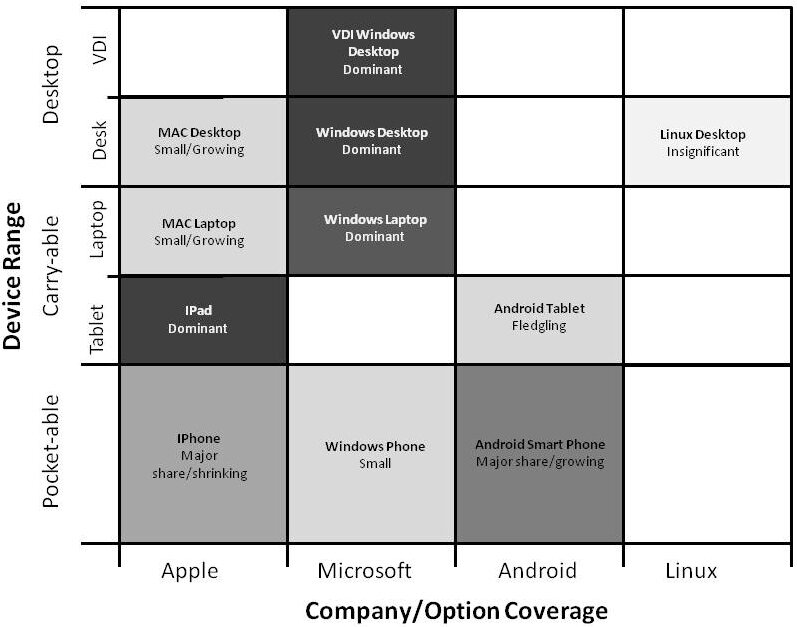
Figure 1. Beginning 2012 Coverage Map
With the combination of the Windows 8 announcements that have coverage from pocket-able to VDI, now Microsoft has leapfrogged into a position to have more complete coverage, and, as shown in Figure 2, the adoption. Integration of a keyboard directly into the Slate concept creates a blurring of the carry-able space, which is probably of high importance to business users.
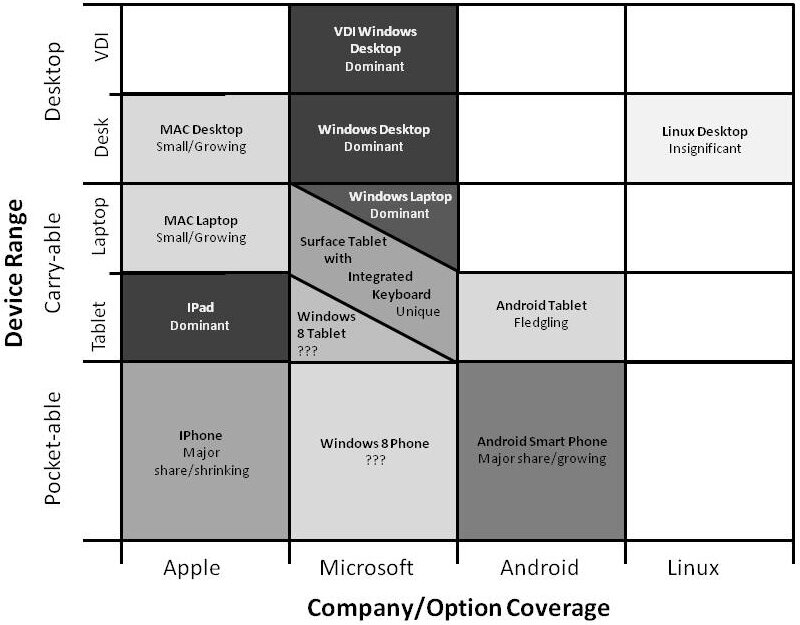
Figure 2. End 2012 Coverage Map
With these changes, Microsoft has clearly positioned itself to take a leadership position in the emerging multi-device market. By leveraging the manufacturing velocity of third parties, it would appear that Microsoft is positioning itself to be very competitive in 2013. A key to this is the adoption of the Windows 8 Smartphone and business acceptance of the Slate as an iPad alternative. Add to that Apple continuing its position of not including keyboards to mar the iPad experience.
The other announcement that Microsoft made was the Office 2013 announcement this week. In many ways this announcement ups the ante by making the user experience common and "transparent" across the ménage a trios. With Office 2013, Microsoft has invested in creating a clear set of tools and capabilities that allows users to access the same application functionality and data, but with the experience optimized for the screen size and user inputs of the different devices. Figure 3 shows how this new coverage compares to the Apple coverage, as the MAC experience really does not extend to the iPad and iPhone for productivity apps as well. The focus of Microsoft to extend over the entire range is obvious. From the Microsoft perspective this makes perfect sense, as the biggest value of computing to the business user are those productivity apps; enabling them on the other devices a user may have is the best way to extend the dominantposition in those apps into new devices. While there has been no clear direction, it will be interesting if Microsoft extends the Office 2013 productivity apps out into the other OS spaces or keeps that capability within the Windows 8 arena. I can imagine the discussions: do we extend and deliver the dominance of Office across all devices, maintaining the dominant Office positions but running the risk of not driving users to Windows 8, or do we limit the new capabilities to Windows 8, opening the potential for alternative productivity suites to win outside of the Windows 8 stack? It will be interesting to see how this plays out over the next few quarters/years.
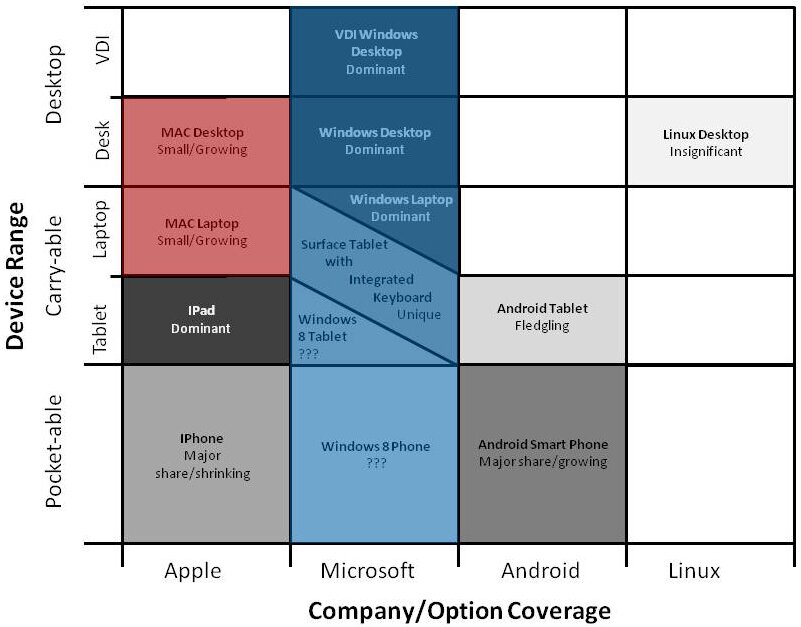
Figure 3. Productivity Suite Coverage
In conclusion, Microsoft has done what they have done in the past when changes in the market threaten their positions. They have adopted the changes (tablets), enhanced the position (Slate/keyboards), and extended from their dominance to re-define the competitive space with their advantage (Office 2013 across the platforms). In the past, this strategy led to continued Microsoft leadership through major technology changes/disruptions, including browser adoption, the web, VDI, collaboration and social with SharePoint, and with Lync in the convergence of real-time into productivity. Based on the Windows 8 and Office 2013 moves, Microsoft is making a real play to repeat the process as the multi-device user moves from being entertained to getting down to work.