Current State of the UC Market – Part 2
 Current State of the UC Market – Part 2 by Blair Pleasant
As I mentioned in my previous post (Current State of the UC Market – Part 1), forecasting the unified communications market is extremely difficult and frustrating. Aside from the fact that many vendors don’t yet provide UC shipment data to analysts, many are including their UC numbers in with their IP PBX numbers and don't break out what is or isn’t UC. Vendors are also bundling the various components as part of packages with either the UC Server, the UC client, or the IP PBX. Measuring the market is further complicated by the fact that we don’t know when individual UC components, such as IM/presence or unified messaging, are being implemented as part of a UC solution or as a stand-alone, non-integrated product. It turns out that just a small portion of the IM/presence servers deployed are being used as part of a UC solution, with an even smaller portion of IP PBXs shipped being deployed this way.
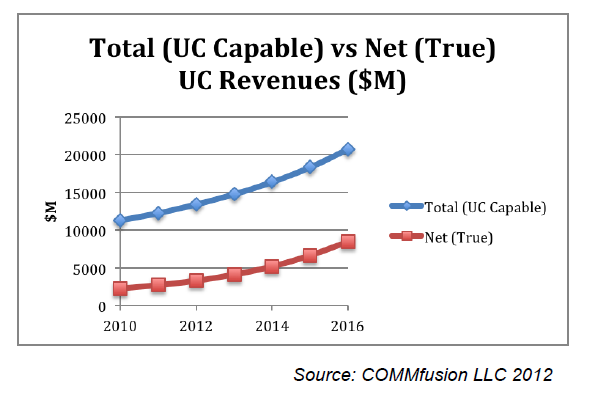
As in the past, I tried to separate out the total or UC-capable revenues from what I call the net or “true” UC revenues – what’s actually attributed to being used as part of a UC solution rather than on a standalone basis. Determining the portion of UC products shipped that are actually being used as part of a UC solution, rather than as a standalone product, is more of an art than a science. As you can see from the diagram below, the net or true portion UC revenues represented only 22% of the total UC-capable revenues in 2011, but this increases to 24.5% in 2012, and is expected to increase to 40.8% by 2016.
As bundled or packaged solutions become the norm, we’ll see more UC solutions being implemented, rather than just standalone, non-integrated components. And as customers get more comfortable with the UC capabilities they’ve deployed, they’ll want to start integrating them together.
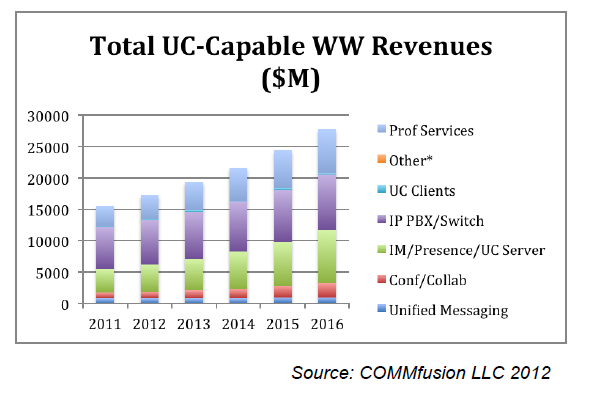
Looking at the breakout by component for the total UC-capable segment of the market, the IP-PBX or telephony switch represents the largest revenue component. While an IP PBX is not necessary for a UC solution, and many companies have deployed and implemented UC without an IP PBX, investment in an IP PBX can often be a starting point for additional UC capabilities and components.
The next largest component is the IM/Presence/UC Server component. The UC Server is an integrated, presence-enabled voice, video and text messaging and conferencing server that can also include call control. IM and presence have infiltrated many organizations, but they are still being used in a standalone manner. We haven’t seen the number of companies integrating IM/presence with call control for capabilities such as click-to-call as much as expected, but this is starting to change.
For now, companies are deploying many of the UC components, but as silos. This is changing, however, and the portion of integrated solutions will reach 40% by 2016.
What does this mean to you? For those of us tasked with the job of quantifying and measuring the market, and identifying trends and purchase patterns, it means a lot. But it may not mean much to the rest of the industry. If you’re a vendor, the fact that the products you’re selling are part of an overall UC solution or being used in a stand-alone manner may or not may not make much of a difference to you. In fact, you may want to tout the total UC-enabled numbers rather than the “true UC” numbers when you’re talking to customers. If you’re a customer, it also may not mean much, since you’re interested in what the products can do for your organization and workers, and not how many of them have been sold.
For VARs, system integrators, and solution integrators, the fact that some UC components being sold are deployed in a non-integrated fashion may or may not make a big difference to you. What will make a difference, though, is the role of professional services required to integrate the various components and solutions. The need for professional services will continue to increase as UC gets deployed and as companies deploy more integrated solutions. A significant amount of professional services is needed when UC technologies are deployed. Professional services are needed to integrate the various components with each other, with the existing PBX or IP PBX, with business applications that the organization uses, and with other elements of the network infrastructure. Although vendors are introducing more plug-ins and APIs to make integration easier, a good amount of integration work will be required for the foreseeable future. Professional services are also required for customizing the UC solutions and applications for each company’s environment and needs. Therefore, the role of the solution integrator (VARs, SI’s, etc.) will continue to grow in importance. Providing professional services is one of the key ways that solution integrators can make money in the UC world.
In sum, the UC market continues to show significant growth, providing opportunities for:
- End users to improve and optimize their business processes,
- Vendors to increase revenues based on the various individual UC components as well as UC solutions, and
- Solution integrators (A.K.A. the channel) to provide these products to customers, while adding significant value through professional services.

Also on UCStrategies.com on this topic: