Achieving Greater Flexibility in Contact Center Operations
 Achieving Greater Flexibility in Contact Center Operations by Lisa Pierce
Note: This article is the third in a four-part series. Also read:

Introduction
U.S. industry estimates place up to 70% of the installed base of PBXs and key systems as having migrated to VOIP - either via a full system upgrade, or through a VOIP/TDM gateway. But few businesses have upgraded everything they have to state of the art. Whether consisting of older VOIP or legacy TDM systems, they continue to provide important functions like voice mail, call recording and predictive dialing. Given the recent state of the economy, few contact centers can afford big system upgrades—there are simply too many pressing demands on available cash. For instance, if the economic thaw continues, should the limited funds that can be made available be used to hire additional agents, or to overhaul the telephony/contact center infrastructure?
The good news is that cloud-based solutions provide functionality on a “lease” (versus purchase) model, so contact centers can migrate to state of the art technology and preserve cash to support other important company objectives. This is an especially salient consideration for businesses whose equipment has been discontinued by the manufacturer, faces end-of-life support challenges, or lacks important features/functions.
Business Challenges Addressed by Hybrid Premises/Cloud Centers
Given cash constraints, contact center operators frequently search for solutions that blend investments in legacy infrastructure with new technology. As a result, they are interested in offers that support hybrid premises/cloud infrastructures. Companies that choose hybrid solutions may do so on an interim basis (as a step in their migration to the cloud), or as the means to combine the best of both worlds permanently. In addition to end of life/ support challenges, cloud solutions help businesses to:
-
Implement new features. Although use of CTI is waning, use of other types of contact center functions is rapidly growing, including voice/data recording systems, CRM and workforce management software. Over a five year period, as measured by combined revenue, adoption of these three technologies has grown by almost 50%.[i] Cloud services can provide new functions like these very cost effectively.
- Obtain critical expertise. Since many businesses cut IT staff during the recession, they often lack the expertise to integrate their legacy systems with new technology. Many companies lack available budgets to hire or retain experts whose skills are in high demand. Cloud IT providers have experts to implement and integrate cloud services with customers’ legacy operations.
- Create a flexible workforce. As companies recover from the recession, they must determine how best to deal with growing customer demand for contact center services.
More companies are adding in remote/home agents to their workforce (see “Success with Remote Agents Is Not So Remote”). Businesses that lack the appropriate in-house tools to support and supervise remote agents are evaluating cloud-based services for this purpose.
Flexible Solutions
Given a wide array of pre-existing contact center and telephony infrastructure, a cloud-based contact center solution must be highly adaptable—the (new) functions it supports must complement a company’s existing IT/network assets and operations. One supplier with a flexible, cloud-based contact center solution is Interactive Intelligence, which offers three distinct cloud deployment options:
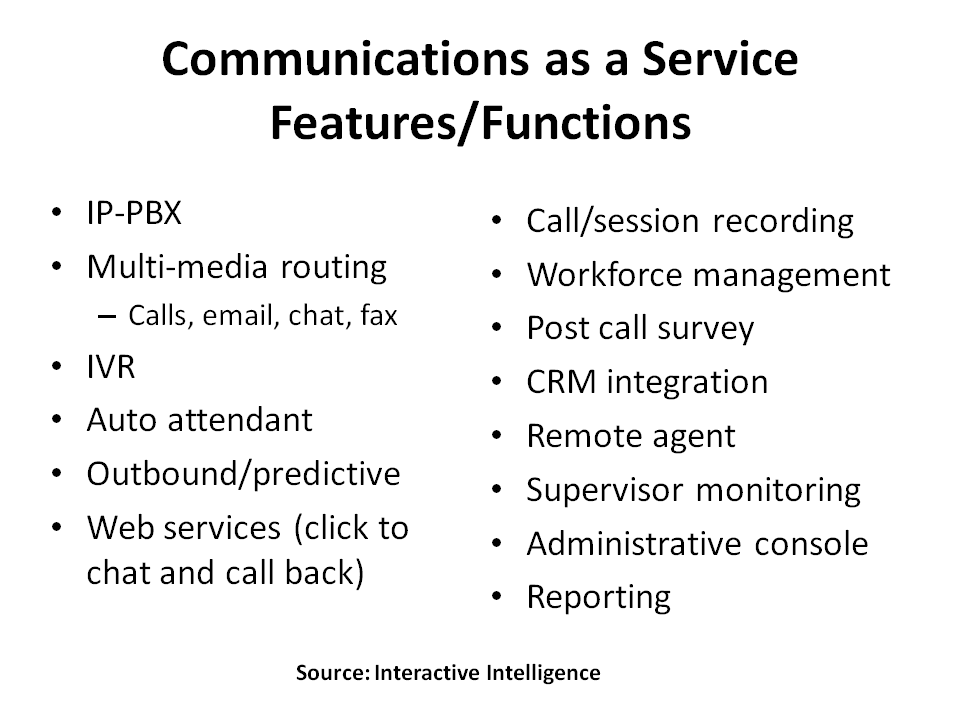
Local Control VOIP. Currently the most popular of the three options, this provides companies with a way to keep key VOIP infrastructure (including VOIP gateways, media/proxy servers, VOIP phones) and sensitive data (call recordings, customer information, databases) onsite while using cloud-based contact center application server(s) to support functions like multi-media routing (call, email, chat) and workforce management (see Table 1). Since inbound calls terminate directly on the company site, the business can take and receive calls even if the MPLS link between its location and the cloud is unavailable. In this event, signaling and data transfers can still occur over Internet VPNs. Many customers who are concerned about security in the cloud prefer this option because voice traffic, recordings and other sensitive data remain inside their firewalls. Given the amount of interworking required between premises and cloud-based resources, of the three options this is often the longest to deploy and configure. However, for customers that view cloud contact center services as a temporary measure, it also provides for the simplest and swiftest migration back to a full premise-based deployment.
Remote Control VOIP. This solution is appropriate for companies with limited premises infrastructure, and who are searching for solutions to minimize future capital outlays. For instance, this option places gateways and proxy/media servers in the cloud. Thus incoming calls are routed to the cloud for processing, and then directed to agents via MPLS. In the event the cloud/MPLS become unavailable, calls can be re-directed to the premises (via carrier or cloud-directed continuity features), while signaling and data transmissions are handled via Internet VPNs. Rather than paying the per-minute usage fees for inbound calls to the premise, customers pay similar fees for calls terminating to the cloud. Given the purchasing power of the cloud provider, smaller contact centers may find that inbound calls cost less (vs. direct termination to the premises---local control option).
Remote Control TDM. This alternative is suitable for companies that have not yet transitioned to VOIP and want to leverage existing investments in PBXs and other legacy voice infrastructure. In this mode, incoming calls are routed first to the cloud for treatment and processing, and hairpinned from there to the customer’s contact center via the PSTN. All advanced contact center functions are cloud-based. Signaling and data streams between the cloud and the router can use Internet VPNs (MPLS is optional, not required). Since calls are hairpinned, customers pay more usage charges with this option (vs. the prior two alternatives). But since all the advanced technology is in the cloud, this is also the fastest option to deploy.
Freedom to Migrate from Cloud to Premise, and Premise to Cloud
Many businesses want to migrate between premises and cloud-based systems very flexibly. They want to be able to choose the best model for the present and yet retain the ability to move to another option in the future. Here are two examples:
Cloud to premise: A healthcare benefit management company used the cloud to expeditiously activate a new contact center with 100 agents. But it also viewed this as temporary, and chose a supplier that made it easy to return to a premises-based approach. Its use of the cloud lasted about a year. Shortly after, the company activated up a second site (leveraging a premises-based deployment) to support an additional 400-500 users.
Premise to cloud: During the recent recession, a financial services company was forced to downsize and outsource whatever it could. As part of its outsourcing strategy, the company migrated its existing contact center operations to the cloud.
Flexibility Has Limits
As any vendor or service provider will tell you, to offer platform efficiencies and economies of scale, there are boundaries on flexibility. Here are a few examples of typical limitations of current cloud-based contact center solutions:
UC considerations. While a cloud based solution can queue, distribute and store a variety of media, like fax, web chat and email, but it may not extend to SMS. Interworking/integration with popular UC applications like Lotus Sametime or Microsoft Lync can be very limited. Not all cloud-based contact center solutions support web/data conferences. It is likely that cloud service providers will improve UC functionality over time. Thus when evaluating contact center upgrades, it’s important to consider the level of UC integration your company requires in the near vs. long term.
Conference calls. Depending on the platform, the cloud-based offer may support several dozen ports per conference call, not hundreds of ports. Many companies, but not all, will find this to be sufficient.
IVR applications. Customers that have designed complex IVR applications may need to have them re-deigned to work on cloud IVR platforms.
Integration with third party platforms. At some point, investment in legacy technology is simply a sunk cost, so it should be no surprise that no cloud-based contact center solution will interface to all types and vintages of PBXs, gateways, IADs or routers. Similarly, integration with legacy third party speech platforms, recording or voice mail systems may not be supported.
When considering acquiring or updating contact center functionality, businesses have a variety of alternatives, including the option of using cost-effective cloud-based services to augment or replace premises-based telephony solutions. Cloud-based contact center services provide key functions like IP ACD and IVR, call recording, support for remote agents and T.38 faxes. As seen in the case of Interactive Intelligence, some cloud provider’s services are flexible enough to support a variety of existing customer premise configurations, both VOIP and TDM, together with varying customer requirements, experiences and preferences. Depending on a company’s long term contact center strategy, services-based functions may be integrated with premises functionality as part of a hybrid architecture, or as an interim step on the migration path to a more complete cloud-based architecture.
[i] Source: TIA, Market Review and Forecast
This paper is sponsored by Interactive Intelligence.