The Next Major Smartphone Innovation: “Bling”
 The Next Major Smartphone Innovation: “Bling” by Michael F. Finneran
A couple of weeks back I posted a piece on NoJitter titled “Mobile Device Ennui” pointing out the fact that for the moment (perhaps a “long moment”) major technical advances on the smartphone front have all but come to a dead stop. For the past two to three years many of us in the mobile market have been lamenting the dearth of major advances from Apple, some pinning the cause on the passing of Steve Jobs. In reality, the time frame for realizing new ideas in deliverable products is such that we should still be seeing the fruits of any great ideas Mr. Jobs had in the pipeline at the time of his demise. The reality is that this lack of major innovation extends across the entire smartphone industry, and the next big innovation I can expect to see is an increased emphasis on “bling.”
“Bling,” “pizzazz,” “bright shiny object,” or however you want to put it, looks have always been a factor in mobile device preference. In some cases that “look” has been accompanied by a real advance in technology and/or functionality, but as often as not, it’s just a matter of “cosmetic differences.” With significant technical and/or functional differences on hold, I’m afraid for the next few years at least, “bling is the thing.”
One of the fun things to watch is how technology is portrayed in the movies. I like to tune into a movie, look at the technology, and guess the year the movie was made. If you see someone log into their email on a PC featuring an old fashioned CRT display and hear “You’ve got mail,!” you know you’re back in the 90s – particularly if it’s a young Tom Hanks or Meg Ryan pecking at the keyboard (“1998” to be exact on that one).
However, mobile devices are an even better and more precise indicator, because the lifespan of an iconic mobile device is so much shorter. In Wall Street: Money Never Sleeps, Michael Douglas’ 2010 follow up appearance as Gordon Gecko from the 1987 Wall Street, one of the best scenes is Gecko collecting his Motorola Dynatac cell phone from the property room as he is being released from prison.
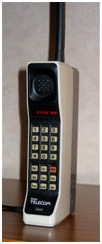
Motorola Dynatac
To its credit, Motorola did have a string of hits back in the day when a cell phone was still essentially a “phone.” Now the Dynatac was truly a technological leap being the first true handheld cellphone, but it was followed by a lot of “bling.” The big follow on to the 1984 Dynatac was the 1989 MicroTAC, one of the first flip phones and predecessor to the truly iconic 1996 StarTAC, the first clamshell model. Motorola continued its string with the RAZR line, first introduced in 2004.
While design gems, most of these follow-ons were pretty crappy phones. The MicroTAC and StarTAC had hulking batteries (these came in the days of 1G AMPS, which required far more power than 2G or 3G cellular technologies) and the battery was positioned behind the earpiece providing a very lopsided feel. The RAZR looked like it belonged in the MoMA, but it had buttons positioned in such a way that you couldn’t help hitting them and activating lots of in-call features you didn’t want activated! When smartphones took over, Motorola all but fell off the map.
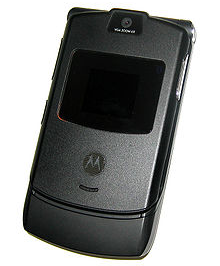
Motorola RAZR V3
BlackBerry too had its iconic devices, starting with the 850 two-way pager first introduced in 1999; that device also introduced the thumb-wheel for scrolling, an element BlackBerry stuck with for years to come. The BlackBerry 5810 was the first model capable of making phone calls, though the user required a headset – clearly, voice was an “afterthought.” The BlackBerry 6200 eliminated the need for the headset, and the 8100 replaced the thumbwheel with a trackball. However, BlackBerry prided itself on the utility of its devices rather than leading-edge design, a focus that has clearly contributed mightily to its current predicament (for a full history of the development of BlackBerry devices, see this CrackBerry blog).
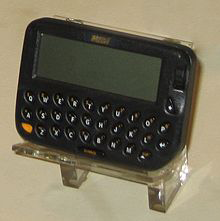
BlackBerry 850
Apple forever changed the look of smartphones with the 2007 introduction of the iPhone, but that cosmetic change was accompanied by a whole new vision of what the smartphone could be. That vision included the ability to run useful onboard apps and access the web with few trade-offs on a color touch screen device, and that functionality was enhanced by a clean simple design and minimal buttons. Clearly it had to be iconic to survive with miserable voice quality, battery life that was even worse, and a whole package chained to a totally unprepared AT&T data service.

Apple iPhone 1
But where did we go from there? Apple continued to address the iPhone’s deficiencies while Samsung, HTC, Nokia, Motorola, and the rest began spinning out an expanding variety of lookalike devices. The points of differentiation were the operating systems and incremental hardware enhancements like larger, brighter screens, faster processors, and app accessible GPS receivers, accelerometers, proximity sensors, and the rest. For my money, Apple’s last significant addition was the voice activated Siri personal assistant, but the Android camp has mimicked it feature for feature.
So what are we talking about in terms of emerging smartphone features today? Bigger screens continue to be an item. Samsung has been leading the way with more sizes than I can count, though the rumor mill has Apple delivering a 5.5-inch screen on the next generation iPhone, which should be getting its own number (i.e. not an “iPhone 5x”). Of course the ability to “grow” in that direction is limited by the size of people’s pockets.
The other big talk is “curved glass.” HTC first started talking up a curved glass screen on its HTC Ville in 2012, but they might do better to try and curve their net income back into positive territory. Samsung landed the first solid punch with the Galaxy Round in October, and Apple’s next entrant likely appear in 2014 may be “bendable.”
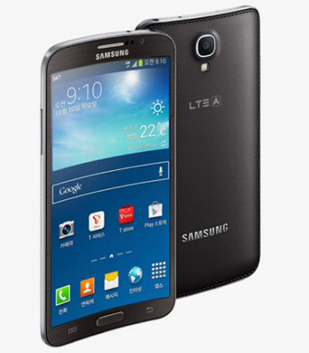
Samsung Round
Curved glass? That’s all you’ve got for me, “curved glass”? If there’s anything that screams “cosmetic enhancement” it’s “curved glass”! If it all comes down to “curved glass,” “bling is king!”
About the only “technical” advance we’re hearing about is “Lego phones” (my term). The idea comes from an initiative named Phonebloks, and has apparently been picked up by Motorola who had been working on a similar plan called Project Ara. Phonebloks started as a concept by Dutch designer Dave Hakkens and is billed as “A Phone Worth Keeping.” The Phoneboks concept is a user configurable phone that would be “modular, open sourced, designed to last, and made for the entire world.”
Couched in lots of appealing “new age” concepts like reducing waste, the core idea would be a hardware platform where different companies could build modules that would snap together on a base allowing users ultimate flexibility in crafting their own unique phone. You could snap in a faster processor, a next generation cellular modem, a speakerphone, additional memory, a bigger display, or whatever. While original in concept, I see any number of significant challenges in pulling off something like this in hardware – we have a tough enough time getting the open software concept to work.
So have we reached the end of the line with smartphones? No, but we are reaching the end of an era. The days of enormous technical leaps forward are over – at least for the foreseeable future. By the same token, people aren’t tossing their smartphones (or their tablets for that matter) in favor of something else. Rather, users have come to grips with what a smartphone can do, and the smartphone is now moving on into its new role as the personal mobile hub. The smartphone is the one device we will have with us always, and it will allow us to interact with a variety of different peripherals, the ‘Net, and, to an increasing degree, the environment around us.
Some may want an external viewing device on their wrist or their eyeglasses. The fitness focused will tie in their Nike FuelBand or Jawbone Up. If we need to connect with a laptop, the smartphone will be our hot spot, and augmented reality capabilities will allow any number of things in our environment to better inform or alert us through our smartphone. Who knows, maybe one of these days the mobile payments industry will straighten itself out and come up with ONE way of doing mobile payments to replace the mindless Tower of Babel we have today.
The key idea is that the focus is moving off the “mobile device” and onto the “total mobile experience.” The choice of which mobile device you select to engage in that is becoming more like your preference for tortoise shell versus wire rim glasses – or contacts, for that matter. So long as you buy into one of the two major O/S environments, iOS or Android, the actual device is simply personal preference.
So what does this mean for the UC suppliers? Well, that’s not part of what the users want tied into their personal mobile hub. The UC vendors are still trying to sell the same mobile UC clients they tried to sell five+ years ago; users weren’t buying them then and they’re not buying them now. They do take advantage of the "find me-follow me" or simultaneous ring capabilities which essentially says, “Get my phone calls out of this ‘last century’ telephone system into something I actually enjoy using!” The better sound quality provided by wired phones is preferred for long audio conferences, but for routine voice communications, users prefer the experience the mobile environment delivers.
In short, there remains a fundamental disconnect between what we’re doing in the mobile space and what the UC providers are delivering. Some like ShoreTel and Unify (formerly Siemens Enterprise Communications) are trying to set themselves apart on the mobile front, but for the most part it’s the same failed strategy we’ve been looking at for as long as we can remember. Not much “bling” in that.