Acronym Soup: WebRTC, VoLTE, and RCS – New Technologies to Pay Attention To
 Acronym Soup: WebRTC, VoLTE, and RCS – New Technologies to Pay Attention To by Phil Edholm
As many of you know, I believe that WebRTC is a game changer and will have the same impact on communications that the original web had on information. However, in addition to WebRTC, VoLTE and RCS are a couple of other new acronyms every enterprise UC and telecom leader should become aware of. While these sound like a new grunge band and yet another three-letter acronym, they are actually names for emerging technologies in the wireless/mobile space that may have great impact on the enterprise and UC integration with user devices.
VoLTE - Voice Over Long Term Evolution
The first technology, VoLTE, is Voice over LTE. For the first time, the data channel is now prominent in the wireless arena with LTE (Long Term Evolution) or 4G. With data channels now having hundreds of Megabits of capacity, managing them to deliver quality voice is possible. The GSMA has been working hard on VoLTE to enable real-time in the LTE data channel. This has many advantages: it reduces the cost of footprint growth by only having one set of equipment versus two in today's world where the voice packets are in a different frequency; it enables enhanced audio, including wideband/HD; it may free up spectrum that can be more effectively used with LTE; and it opens the way to video.
VoLTE has been rolled out in Korea and by Metrics in Dallas. The results are very promising, with the users indicating the quality was better than traditional cellular and Over The Top (OTT) services like Skype. While there are only a few devices from Samsung and LG that support VoLTE, almost all of the infrastructure and device vendors are committed and major mobile operators are committing to deployments.
RCS - Rich Communications Suite
The second technology is RCS, the Rich Communications Suite. With RCS, moving from a voice call to a video call is one click. Or sending data like a picture or movie to the person you are talking to is easy. Think FaceTime across a multi-operator, multi-end point world. RCS is also known by the marketing phrase JOYN (pronounced "join") as a way to market the capability. With RCS/JOYN, the potential is easy multimedia communications, retaining your phone number as a specific identity enables new capabilities. Finally, as RCS is integrated with the phone, all of the traditional contact lists and other functions will work with the rich media of RCS.
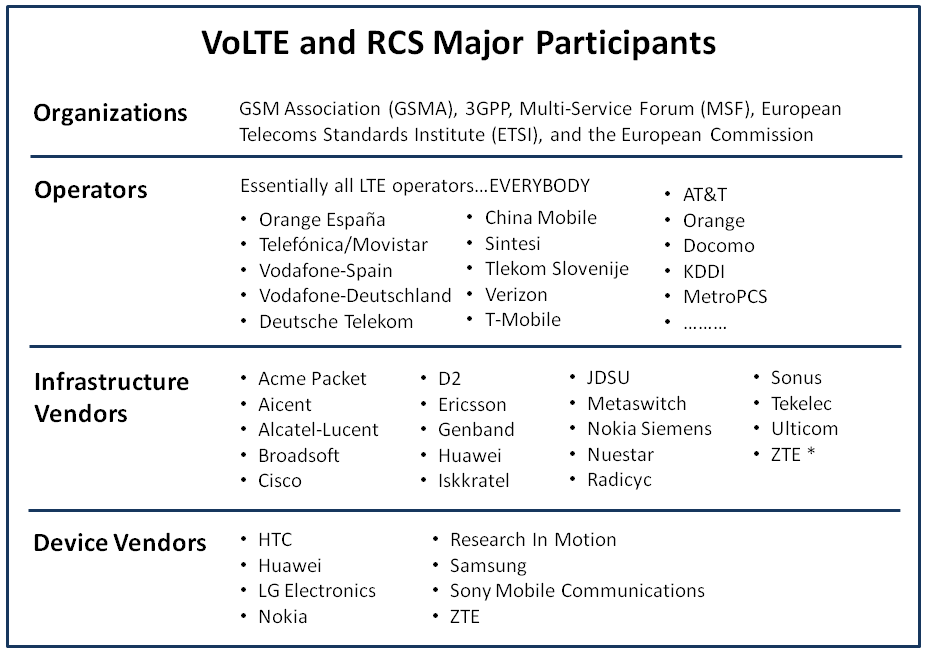
With 253 mobile operators committed to LTE in 84 countries per the GSMA and 500M LTE subscribers anticipated by 2015, VoLTE and RCS will have a large base of potential adopters, many outside of North America. In fact, support for the emerging VoLTE and RCS deployments is strong as shown in the chart. Notably absent is Apple, but virtually everyone else in the GSM/LTE community is moving ahead.
So why is this interesting to enterprises? Because there are moves afoot to enable enterprise UC solutions to integrate to LTE. With SBC and UC vendors using SIP, the basis of VoLTE and RCS through the SIP infrastructure, it is probable that mechanisms to integrate VoLTE/RCS devices into the enterprise will emerge in 2014. The key is that this will enable employees on BYOD devices to use the inherent capabilities of their smartphone and have tight integration to the enterprise UC system. As the integration will be through SIP and IMS, the level of trust will be high, potentially enabling BYOD security in a way that OTT cannot approach.
So the battle lines are being drawn – WebRTC from the internet world and VoLTE/RCS from the mobile world. However, there are some who say they both will come together. For example, a WebRTC portal from your mobile operator would allow you to use the WebRTC-enabled browser in your television as a client with RCS capabilities. If you look at the latest Samsung televisions, the top of the range models already have a camera, a microphone, a browser, a dual core processor, lots of memory and Wi-Fi and Bluetooth. This set of capabilities would have described a power desktop PC a few years back, in fact modern televisions are becoing a form of a desktop computer. WebRTC could also be used as a way to let people not on the Mobile network interact with you on your RCS device using the standard features.
For the enterprise, we may be entering a period replacing the challenges of federation and the paucity of good interoperable solutions with a new dawn with multiple powerful solutions to communicate beyond the enterprise. While I believe that WebRTC has advantages in being a triangle technology (peer-to-peer media with server control) and seems to be gaining momentum as a web/internet innovation space, there are an anticipated four billion new wireless device to ship in 2016, and they may all be capable of VoLTE and RCS. However, per Mozilla and Google, they anticipate 500M to 1.5B WebRTC-enabled devices by the end of 2013.
Isn't innovation grand? Looking forward to that video call soon.