A Discussion with Interactive Intelligence about the Cloud – A Single-customer, Multi-instance Virtualized Environment or Multi-tenancy for Critical Business Communications?
 A Discussion with Interactive Intelligence about the Cloud – A Single-customer, Multi-instance Virtualized Environment or Multi-tenancy for Critical Business Communications? by Blair Pleasant
I spoke with Jason Alley, Solutions Marketing Manager at Interactive Intelligence about their Communication as a Service (CaaS) offering for contact center and UC. Here’s what Jason had to say.
Blair: Hi Jason. Interactive Intelligence has been offering a Communication as a Service (CaaS) solution for its customers to help them get the capabilities they need without having to invest in a premise-based solution. Please tell us about the CaaS offering.
Jason: I would be happy to Blair. The Interactive Intelligence CaaS offering is a cloud-based contact center and unified communications (UC) solution that’s been architected to meet the stringent requirements of mission critical business communications and applications. CaaS is powered by our all-in-one platform, Customer Interaction Center (CIC), developed over a decade ago, with more than 4,500 cloud and on-premise customer sites worldwide.
Blair: It seems that everyone is offering a hosted solution these days. How does your offering differ from some others out there?
Jason: It certainly does seem bizarre just how many different cloud companies and offerings are popping up these days. It can make it really confusing for those considering a move to the cloud. So, what’s important?
Companies tell us they’re looking for a higher level of assurance before moving their contact center and unified communications applications to the cloud. The Interactive Intelligence CaaS offering is unique in how it addresses these requirements in several ways. First of all, Interactive Intelligence is an experienced and proven contact center and UC solutions provider. Another really important difference is that we offer a single-customer, multi-instance virtualized environment that’s maintained in our data centers, which provides increased security, isolation and flexibility. We also provide the option of keeping all voice traffic within a company’s internal network, which means increased quality, control and security while reducing WAN bandwidth requirements. Finally, one of the main differences between our solution and some others is that applications can be migrated from our data centers to premise environments if and when a business’ needs change, which gives our customers long-term investment protection.
We believe this is why our cloud business is growing significantly faster than the market as a whole. For the full year 2011, Interactive Intelligence cloud revenues were up 96% and cloud orders grew 179%, year-over-year.
Blair: That’s pretty significant. You mentioned that you offer a single-customer, multi-instance environment. I hear a lot of vendors talking about their multi-tenant architectures. Can you explain the difference between “multi-instance” and “multi-tenant” architectures, and what are the pros and cons of each?
Jason: You bet. In fact, that’s a really important question with fairly significant implications for the contact center. A multi-tenant architecture is where multiple customers use a single instance of an application running on a single instance of an operating system on a common hardware platform. In contrast, a multi-instance architecture is where multiple customers run their own separate instance of the application and operating system running on a separate virtual machine, all on a common hardware platform. Many multi-tenant solutions leverage a common database instance, while both architectures can support giving each customer their own database.
It’s important to understand that both architectures leverage common hardware and other resources for economies of scale, which results in competitive pricing and financial benefits for subscribers.

Here are some of the pros and cons of each.
For a multi-instance architecture, the pros are:
- Cost effective based on the use of common hardware and resources
- Inherently more secure and isolated environment
- Greater flexibility and control of configuration, updates and upgrades (timing, content controlled by customer), change management and SLAs
- Less chance that a provider, user or malicious behavior will impact performance and reliability of multiple customers
- Investment protection – ability to migrate to premise over time should business needs, preferences dictate
- Simplicity in software architecture, especially as the number of customers grows
The Cons are:
- Higher operational effort and cost for providers
- Requires more hardware in the provider’s data center
- More provider time and resources required to update/upgrade large numbers of customers
- Less suited to support consumer scale applications (hundreds of thousands to millions of customers)
- Requires more billing and contract management overhead
- Provider has less insight into application usage and behavior across customer base
For a Multi-Tenant Architecture, the Pros include:
- Cost effective via use of common hardware and resources
- Requires less hardware in provider data center
- Less time and resources required to update/upgrade large numbers of customers
- Better suited to support consumer scale applications (hundreds of thousands to millions of customers)
- Requires less billing and contract management overhead
- Provider has greater insight into application usage and behavior across customer base
The Cons are:
- Higher development/testing effort and cost for providers
- Inherently less secure and isolated environment
- More chance that a provider, user or malicious behavior will impact performance and reliability of multiple customers
- Less flexibility and control of configuration, updates and upgrades (timing, content controlled by provider and applied to all customers simultaneously), change management and SLAs
- Loss of investment if customer chooses to move to premise over time
- Complex software architecture to support all users on same instance in a secure and reliable manner, especially as the number of customers grows
Blair: If I were a customer, why would I prefer a multi-instance architecture?
Jason: It really comes down to requirements and preferences, but the simple answer is that customers are able to enjoy the benefits associated with a cloud solution – increased flexibility, faster deployment time, minimal upfront capital expense, and reduced IT staff requirements – while gaining a higher level of inherent security, reliability and control. For those with stringent security and regulatory requirements (financial services, insurance, government, healthcare, etc.), this can be important for moving contact center applications to the cloud. The thought of running the company’s mission critical operation on the same application instance as others, potentially competitors, just doesn’t sit well with some organizations. Speaking of mission critical, most people will agree that contact center applications are much different than CRM applications, which happen to run just fine in a multi-tenant environment. So, the nature of the company, industry and application are important factors when determining if a multi-instance architecture is preferred. You’re probably aware that advancements and maturity in virtual server technology make it a safe and cost effective alternative to multi-tenant architectures. Multi-instance architectures also give customers an additional level of investment protection by letting them migrate from a cloud to premise solution if and when their needs or strategy changes, and this isn’t possible with multi-tenant architectures.
Blair: What are the downsides of a multi-instance architecture from a customer perspective? From a service provider or vendor perspective?
Jason: Well, from my perspective, there aren’t many downsides to the multi-instance architecture from a customer or user perspective, if any. Some will say it takes longer to propagate software upgrades across the entire customer base. While this can be true, and would certainly be troublesome for consumer applications such as Facebook, we’ve found most contact center and unified communications customers prefer to have control over both content and timing of upgrades to ensure the business is ready and risk is properly managed. The one-size-fits-all upgrade approach isn’t as popular in these environments.
From a provider perspective, some would argue that the additional operational effort and costs are the primary downside. However, this is offset by the fact that multi-tenant architectures require higher development/testing effort and costs. What’s telling is that providers offering solutions built on multi-instance architectures are able to offer pricing competitive with multi-tenant alternatives.
Blair: You mentioned that multi-instance architectures provide more security, isolation, and flexibility - can you provide some detail on how this is done?
Jason: Sure, I’d be happy to. The following diagram does a pretty good job of detailing ways multi-instance architectures impact security, isolation, flexibility and control, and performance.
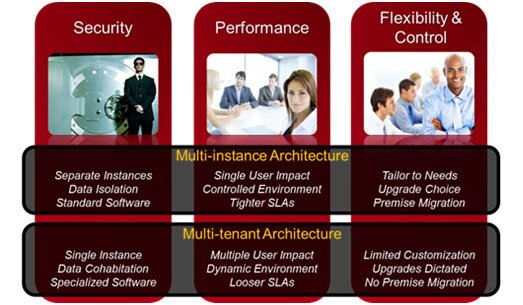
Blair: I would assume it’s more costly for a company like Interactive Intelligence to provide a multi-instance architecture rather than a multi-tenant architecture. How can you be cost competitive compared with multi-tenant providers?
Jason: You would think so, but additional operational costs are actually offset by higher development and testing costs that come with multi-tenant architectures. This means that providers offering solutions built on either architecture can offer cost competitive services.
Blair: How easy or hard is it for customers to migrate from a CaaS solution to a premise-based solution?
Jason: This is a fairly easy proposition for Interactive Intelligence CaaS customers once a fair financial arrangement has been agreed to. It involves making sure the proper infrastructure is in place and then moving the application and configuration data to the customer’s premise. As I pointed out before, this level of flexibility isn’t available with cloud-based contact center and unified communications solutions built on multi-tenant architectures.
Blair: Jason, any final thoughts?
Jason: My advice for customers evaluating cloud-based contact center and unified communications solutions is to ensure their corporate strategy drives supporting departmental and technology strategies and requirements. If security and privacy are critical success criteria, then do your due diligence to understand how each offering addresses your specific requirements. Understanding the different architectural approaches providers’ take will help. It’s also important to realize providers taking the same architectural approach can implement solutions in very different ways. For example, multi-tenant solutions may address database isolation differently – some may provide a separate database for each customer, some may use a common database for all customers but allow each customer to have their own tables, and some may use a common database and common tables but allow each customer to have their own rows which are associated with unique customer/tenant IDs. Get your security team involved and ask pointed questions to make sure your security and privacy requirements are met. And remember, contact center applications are very different than other applications found in the enterprise – they are often the lifeline of your business.