
Open-source autonomous coding agents now leverage the Model Context Protocol (MCP) to automate complex refactoring across entire codebases. However, relying on cloud-based tools often creates vendor lock-in and significant data privacy risks for sensitive proprietary logic.
This guide evaluates the best local alternatives for 2026, focusing on hardware requirements and execution isolation to help you maintain full control over your development environment.
- Open Source Autonomous Coding Agents: Selection Framework 2026
- OpenHands: Enterprise-Grade Multi-Agent Orchestration
- Aider: Terminal-Based Git Workflow Efficiency
- Cline: Task-Driven Planning for Editor Environments
- Goose: Native Execution and Automated Recipes
- Kilo Code: Cross-Platform IDE Integration
- Vellum: Persistent Context and Proactive Management
- Orchestration Logic: Multi-Agent Conflict Resolution
- Local Inference: Hardware Optimization and Privacy
Open Source Autonomous Coding Agents: Selection Framework 2026
Open-source agents like OpenHands and Aider leverage the Model Context Protocol (MCP) to automate complex refactoring. Selection hinges on Docker-based isolation for enterprise security or native terminal speed for rapid, git-integrated development workflows.
Agentic logic represents a proactive loop involving autonomous planning, execution, and self-correction. Unlike reactive completion chat, agents independently pursue high-level objectives through iterative cycles.
Agentic Logic vs Completion Chat
Reactive chat provides static suggestions based on immediate prompts. Proactive agents utilize autonomy to plan multi-step tasks. They manage entire codebases rather than single lines.
Self-correction loops enable agents to test generated code. They identify errors and refactor logic independently. This mechanism minimizes the requirement for constant human oversight during tasks.
Coding shifts fundamentally. Developers now supervise autonomous loops instead of typing manual syntax.
Isolation: Containers and Git Worktrees
Docker sandboxing ensures full environment isolation for agents. Git worktrees offer a lightweight alternative for session management. Both strategies prevent agents from corrupting the main branch unexpectedly.
Terminal access introduces specific security risks. Agents require strict permission sets. Clear boundaries prevent accidental file deletion or unauthorized system modifications.
Security in autonomous coding is not about restricting the agent, but about defining the sandbox boundaries clearly.
Model Context Protocol (MCP) Utility
MCP standardizes how agents access external data. It connects models to live documentation and databases. This protocol improves interoperability for modern developers.
Local language servers provide deep reasoning capabilities. They eliminate cloud latency during complex tasks. Agents use these tools to map codebase structures accurately.
MCP functions as a universal translator. It connects LLMs to local development environments.
Hardware Constraints for Local Runtimes
Running Llama 3.2 locally demands significant resources. Systems require at least 24GB of VRAM for efficiency. High RAM capacity supports multi-agent orchestration workflows.
OS compatibility remains a technical factor. Linux and macOS provide stable native support. Windows environments often utilize WSL2 for reliable agent execution.
Performance depends on Claude AI guide specs for optimal benchmarking. Proper hardware ensures open source autonomous coding agents: best local alternatives in 2026 operate without bottlenecks.
OpenHands: Enterprise-Grade Multi-Agent Orchestration
While general frameworks provide the foundation, specific tools like OpenHands take orchestration to the enterprise level through robust sandboxing.
Docker and Kubernetes Sandboxing
OpenHands utilizes a robust architecture for scaling agents. Docker ensures that every task runs in a clean, isolated environment. Kubernetes allows for managing hundreds of agents simultaneously within a cluster.
Environment parity is a core feature. Developers can replicate production settings locally. This prevents the “it works on my machine” syndrome during agentic execution in complex workflows.
Security is maintained through pod-level isolation. Resources are cleaned automatically after sessions.
Custom Workflow Scalability
Teams define reusable agent skills for specific tech stacks. These behaviors are shared across the organization. This approach significantly speeds up microservice maintenance in large environments. Reusable modules ensure consistency across different development teams.
OpenHands handles complex dependencies across multiple repos efficiently. Performance remains stable during large-scale refactoring. The system tracks interactions across the entire codebase to maintain architectural integrity.
- Define reusable skill templates for specific tech stacks.
- Map cross-repo dependencies.
- Integrate with CI/CD hooks for automated maintenance.
- Reusable skill templates
- Cross-repo dependency mapping
- CI/CD integration hooks
Multi-Model Support via Ollama
Local inference configuration is straightforward. Using Ollama allows for complete data privacy. It eliminates the need for expensive API calls during long coding loops by serving models locally.
Local models react faster for simple tasks. However, hosted models still lead in complex architectural reasoning and planning. Choosing the best open source AI model is vital for local performance.
Ollama provides an OpenAI-compatible API. This simplifies switching between different local LLMs.
Data Residency and Licensing
The Apache-2.0 license governs OpenHands. This permit allows for commercial use without heavy restrictions. It is ideal for building internal tools in large corporations without legal friction.
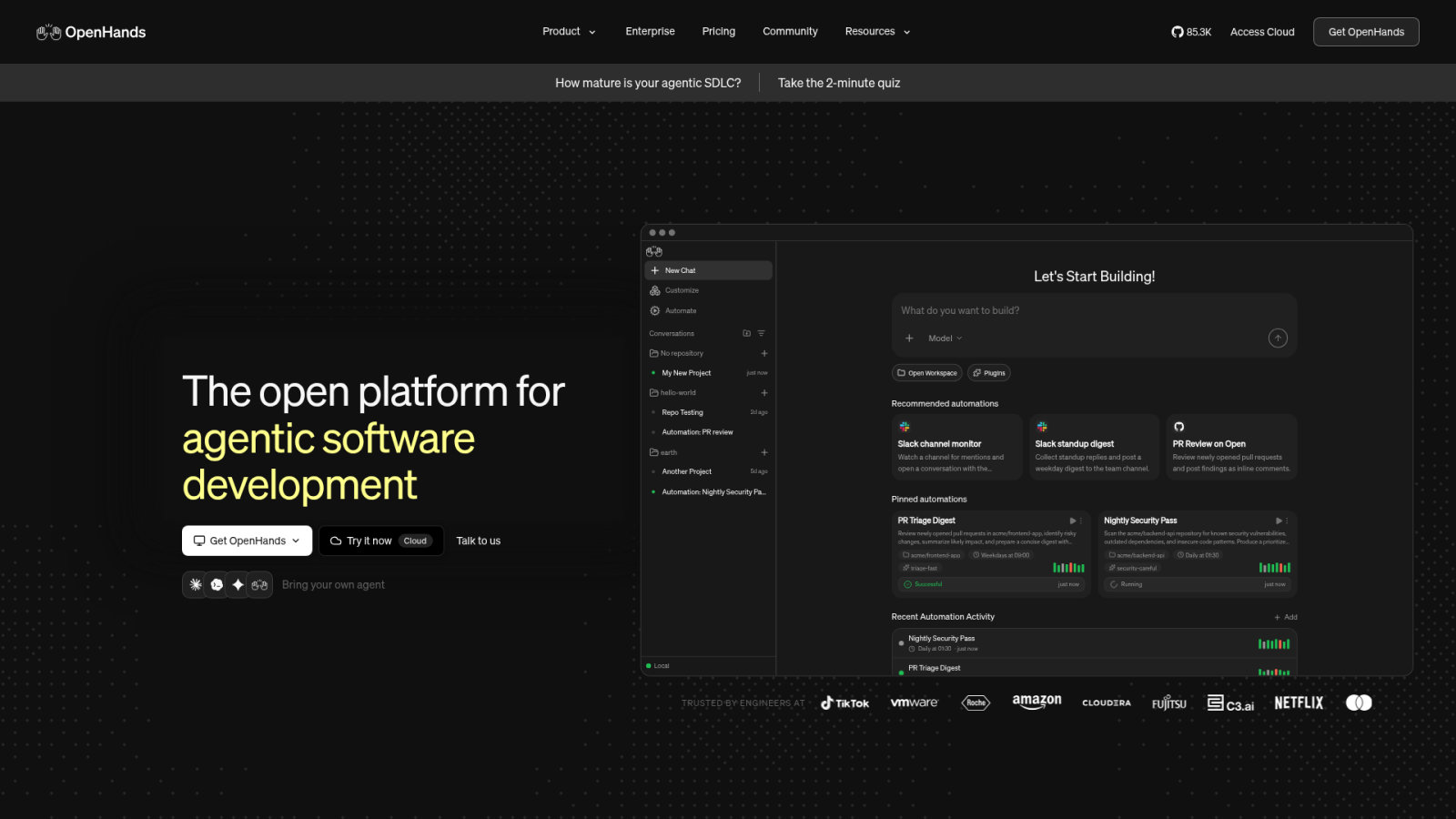
Data sovereignty is a top priority. Keeping code on private networks prevents leaks. OpenHands ensures that sensitive data never leaves the corporate firewall during the development process.
Compliance is built-in. Private hosting satisfies most legal and security requirements today.
Aider: Terminal-Based Git Workflow Efficiency
OpenHands addresses enterprise-scale needs. In contrast, Aider targets individual developer velocity by operating directly within the terminal environment.
Automated Git Commit History
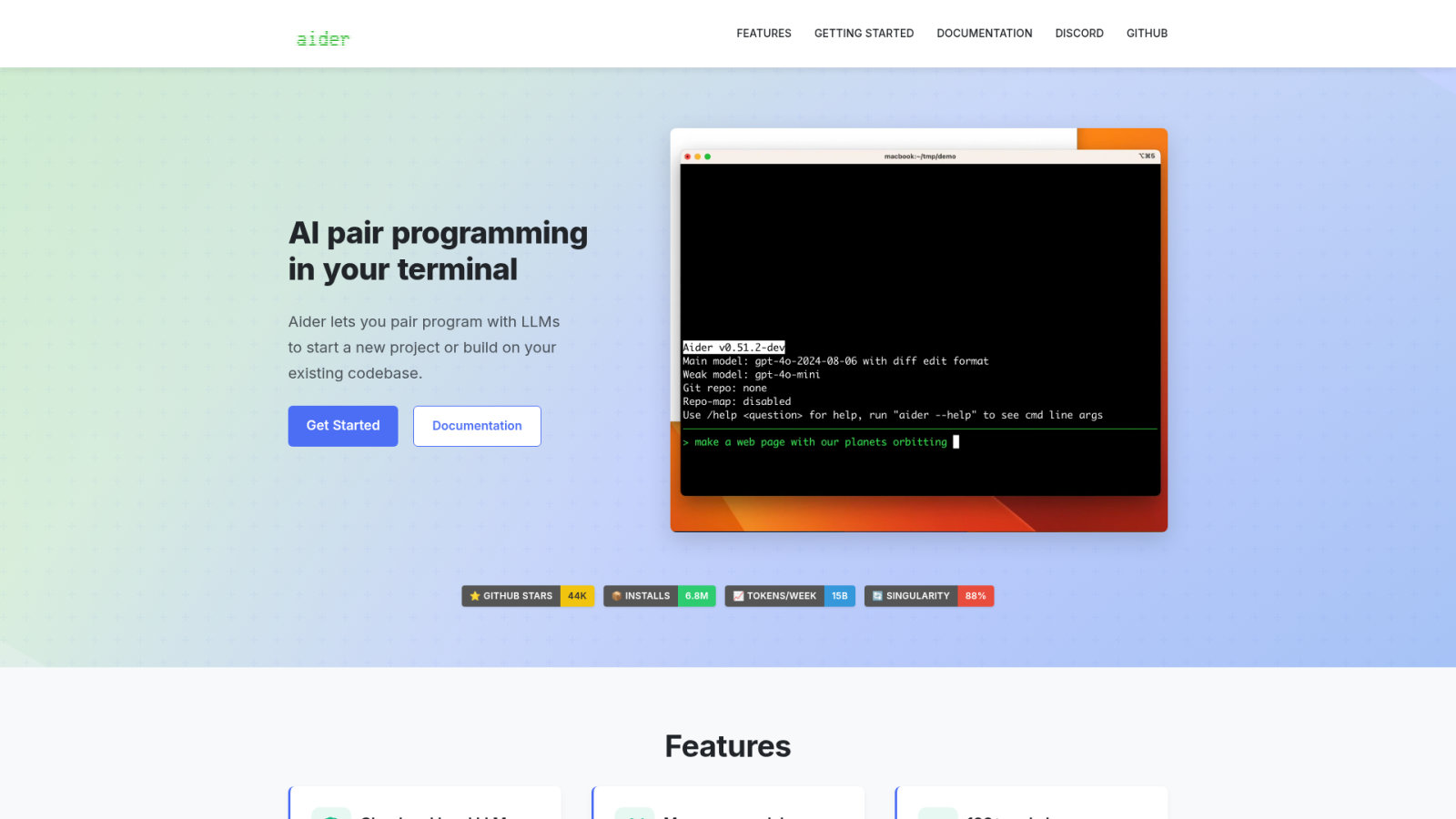
Aider generates automatic commits for every minor code modification. Each small change prompts the agent to write a descriptive commit message. This process builds a detailed and traceable history of all development activities.
The revert process is exceptionally straightforward when errors occur. A single command triggers an undo operation. This restores the repository to its previous stable state without manual intervention.
Aider turns git into a safety net, allowing agents to experiment without fear.
Pair Programming in the Terminal
The real-time interaction model enables seamless collaboration between the developer and the agent. Both parties modify the same files simultaneously. Chat occurs directly in the CLI, removing the need to switch between browsers and IDEs.
CLI speed outperforms GUI alternatives for experienced professionals. The terminal environment favors keyboard shortcuts and rapid command execution. This efficiency is a primary advantage for power users.
Reliable tools are essential, as seen in this AI coding assistant comparison for 2026.
Repository Indexing and Map Generation
Aider utilizes mental map logic to navigate complex codebases. It indexes the entire project to identify structural relationships. This allows the agent to locate relevant files across large-scale software projects efficiently.
Context window management is a core technical feature. The agent only transmits the most significant code snippets to the LLM. This strategy conserves tokens and ensures the model’s reasoning remains focused.
Smart indexing is mandatory for performance. It prevents the agent from losing orientation within massive repositories.
Local LLM Integration Patterns
Connecting local servers to Aider is a simple, multi-step process. The tool integrates natively with Ollama and LM Studio. Configuration is typically completed within a few seconds through standard commands.
Local reasoning quality is improving as smaller models evolve. These models now handle complex refactoring tasks with high precision. Accuracy remains high when the agent receives specific, well-structured prompts.
For more details on local setups, consult this Windsurf guide and benchmarks.
Cline: Task-Driven Planning for Editor Environments
Moving away from the terminal, Cline brings autonomous planning directly into the VS Code interface for a more visual experience.
Plan-Execute Cycle Verification
Cline employs a human-in-the-loop process. The agent presents a detailed plan before writing any code. Developers must manually approve each step of the autonomous execution.
Architectural planning occurs first. Coding follows only after the user validates the logic. This separation ensures that the implementation aligns with the intended design.
This cycle ensures safety. It prevents the agent from making massive, unapproved changes to the codebase.
Browser Automation for Web Tasks
Cline accesses the browser to debug frontend changes. It opens a window to detect visual bugs or console errors automatically. This feature assists React or Vue developers significantly.
Automated UI component testing saves hours of manual checking. Visual verification ensures that interface updates function as expected across different states.
UI testing efficiency is a major factor when evaluating Manus AI reviews for autonomous capabilities.
VS Code Permission Scoping
Users maintain granular control over the environment. You decide which folders the agent can access. Terminal permissions remain restricted to specific, safe commands.
The extension model keeps the agent isolated from the rest of the OS. This boundary minimizes the risk of malicious code execution during tasks.
Control is absolute. The developer remains the final authority over the development environment.
Context Loss Mitigation
Cline uses persistent state management to prevent agent drift during long tasks. It retains the original goal even after multiple execution steps.
Tracking every sub-task keeps the agent on the correct path. This method reduces the likelihood of the LLM hallucinating during complex refactoring sessions.
Effective state management is why some ask if OpenClaw is obsolete compared to integrated editor agents.
Goose: Native Execution and Automated Recipes
While Cline focuses on the editor, Goose optimizes for native performance and repeatable automation scripts.
Native execution reduces RAM overhead and increases file operation speed compared to containerized environments, but requires stricter manual oversight of terminal permissions.
Non-Docker Native Machine Performance
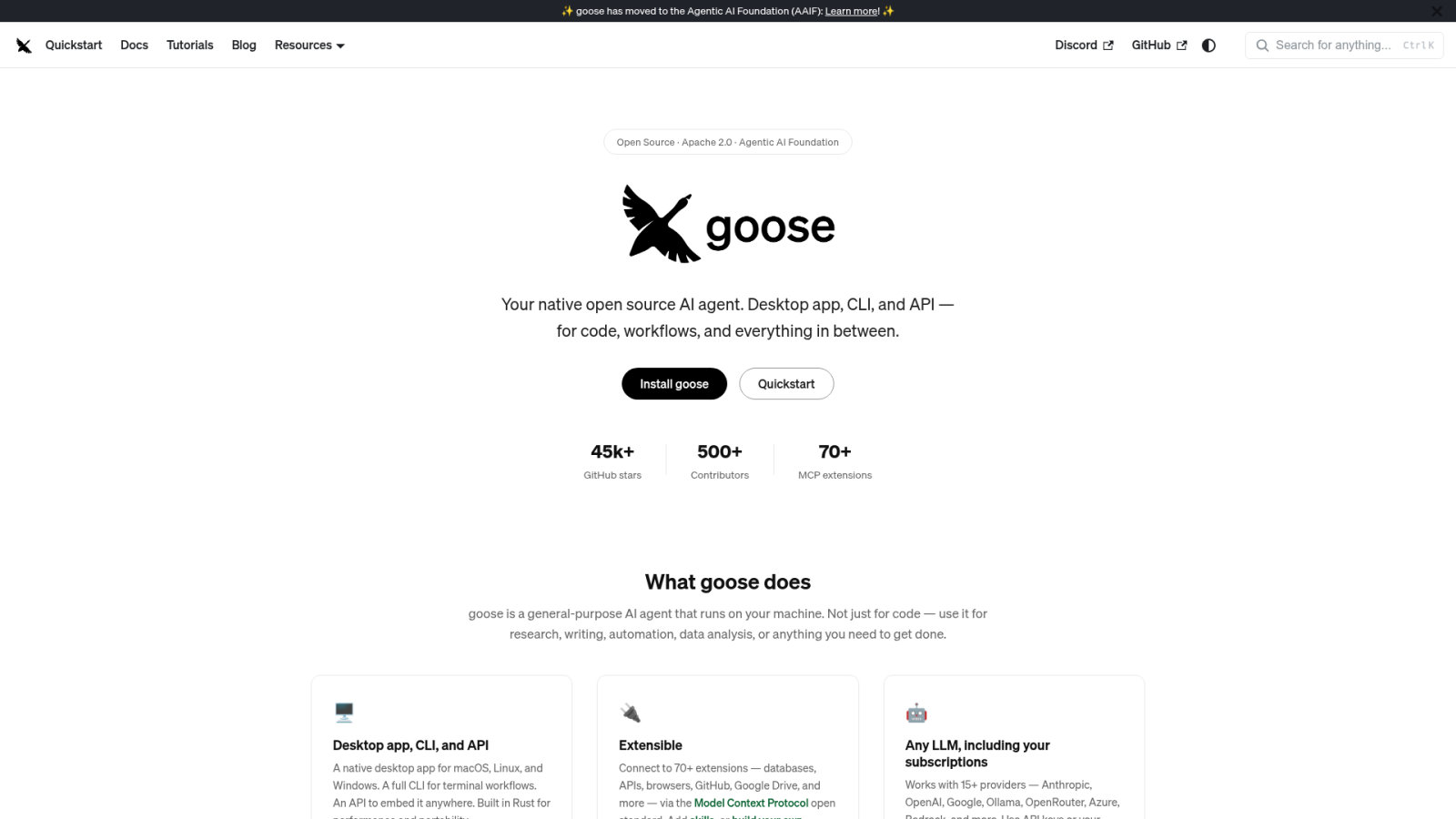
Goose runs directly on your hardware without container overhead. This architecture results in much faster file operations and command execution. The system interacts natively with the host environment.
Native agents use less RAM than Docker-based solutions. This efficiency is critical for developers working on machines with limited resources. It avoids the heavy abstraction layers of virtualization.
Speed is the priority. Native execution feels like having a local expert.
Reusable Recipe Automation
You can create scripts for recurring tasks like library migrations. These recipes are easily shared across engineering teams. They integrate perfectly with existing CI/CD pipelines for automated fixes.
Standardizing automation ensures that every developer follows the same best practices. It eliminates configuration drift across different local development environments.
Automation focuses on:
- Migration scripts
- Boilerplate generation
- Security patch automation
Agentic AI Foundation Standards
Goose is part of a community-driven effort for open standards. This ensures that the tool remains interoperable with other AI agents. Governance is managed by the Agentic AI Foundation.
Open standards prevent vendor lock-in. Developers can contribute to the core logic and expand the ecosystem. This neutrality fosters long-term sustainability and cross-platform compatibility.
This structure supports coordinated AI agent management. Interoperability is the foundation.
Multi-Provider Model Flexibility
Goose supports over 15 different model providers. You can swap between OpenAI, Anthropic, or local models instantly. The switching process is handled through the Agent Client Protocol.
If a cloud API fails, Goose can switch to a local model via Ollama. This ensures that your workflow is never interrupted by external outages. Data privacy remains under your control.
Flexibility is a superpower. It allows you to use the best model for each task.
| Feature | Native Execution | Docker Execution |
|---|---|---|
| Performance | High (Direct Access) | Moderate (Abstraction Layer) |
| Resource Usage | Low RAM Footprint | Higher Overhead |
| Isolation | System-level Permissions | Containerized Sandbox |
Kilo Code: Cross-Platform IDE Integration
Goose excels in native scripts, but Kilo Code aims for seamless parity across different development environments like JetBrains and VS Code.
JetBrains and VS Code Parity
Kilo Code provides identical agentic features across multiple IDEs. This consistency is rare compared to VS Code exclusive tools. Developers access the same power in JetBrains as in VS Code.
Agent reasoning remains stable regardless of the chosen environment. The underlying logic does not shift when switching editors. This stability protects the established developer workflow during IDE transitions.
Parity is the priority. It values professional choice.
MIT License Flexibility
The MIT license offers significant freedom for modification and forking. Enterprises utilize this permissive framework to build private, internal versions of Kilo Code. It ensures total control over internal engineering tools.
Companies can integrate proprietary features without the obligation to share them publicly. This allows for specialized internal development without compromising intellectual property.
Freedom drives innovation. Check if self-improving AI agents justify a switch.
Unified CLI Interface
Kilo Code bridges visual IDE tools with terminal scripts. It enables the execution of multi-repo tasks through a single command interface. This link unifies the developer experience across different surfaces.
The platform manages complex project structures spanning several repositories. It tracks modifications across the entire codebase systematically. This prevents fragmentation in distributed development environments.
Unified views simplify complexity. Modern codebases require it.
Local Model Performance Tuning
Optimizing local inference speed requires adjusting context window sizes. Kilo Code provides specific settings to fine-tune how agents interact with local LLMs. Proper calibration enhances overall system efficiency.
Local models provide faster response times for minor code edits. Cloud APIs remain superior for high-level architecture and deep analysis. Balancing both ensures open source autonomous coding agents: best local alternatives in 2026 perform optimally.
Tuning is mandatory. Hardware performance depends on it.
Vellum: Persistent Context and Proactive Management
While Kilo Code focuses on the IDE, Vellum introduces long-term memory to handle tasks that span days or weeks.
Persistent Memory Management
Vellum retains long-term knowledge across sessions. The agent recalls specific decisions made in previous interactions. This persistence is vital for complex refactoring projects requiring extended timelines.
The agent analyzes the codebase history effectively. It maintains architectural consistency throughout the process. Past mistakes are avoided by referencing the structured memory wiki.
Memory serves as the primary differentiator. It upgrades the agent to a true partner.
Proactive Workflow Triggers
Vellum monitors ticket systems for new bugs autonomously. It suggests fixes before manual code inspection begins. This shift defines true autonomy in open source autonomous coding agents: best local alternatives in 2026.
Proactive agents significantly reduce triage time. The transition to autonomy streamlines the entire development lifecycle.
Communication establishes necessary trust. Check out how this compares to other tools in this detailed AI agent analysis.
Data Residency Compliance
Vellum provides granular privacy controls for regulated industries. The hybrid model combines cloud reasoning with local storage. Finance and healthcare sectors benefit from this strict data isolation.
Vellum’s hybrid model: Sensitive code remains on local servers for residency compliance, while non-sensitive reasoning tokens are sent to cloud LLMs for high-level processing.
Sensitive source code never leaves internal servers. Only non-sensitive reasoning tokens reach the cloud. This architecture ensures high-level processing without compromising security.
Privacy remains a non-negotiable requirement. Vellum meets all global compliance standards.
Sync and Communication Protocols
The agent generates automated status updates for teams. Progress reports post directly to Slack or Jira. Stakeholders stay informed about autonomous work progress in real-time.
Integration into existing project management workflows is seamless. Vellum functions as a junior developer with superior reporting habits. It fits naturally into professional environments.
Consistent communication builds operational trust. Agents become integrated team members.
Orchestration Logic: Multi-Agent Conflict Resolution
Managing one agent is simple, but coordinating multiple agents requires sophisticated orchestration logic to prevent code conflicts.
Deterministic Scheduling Logic
Deterministic rules govern task decomposition. Non-LLM logic handles complex goals to ensure execution follows a predictable path. This structure prevents stochastic errors during high-level planning.
Quality gates enforce strict code validation. Every step requires a successful test pass. If a validation fails, the agent must resolve the issue before proceeding further.

Logic replaces randomness. Deterministic systems provide safety. They are better for production.
Pre-Merge Janitor Patterns
Guard agents act as specialized validators. They scan code before it reaches the main branch. These agents run automated testing loops to identify regressions early. This pattern maintains high code quality within autonomous workflows and prevents technical debt.
Automated testing loops verify every change. A secondary agent audits the work of the primary agent. This dual-layer check ensures consistency.
Validation is mandatory. Secondary agents catch errors. Reliability increases significantly.
Auditability and Lineage Tracking
Change tracking methods log every modification. Every edit made by an agent is recorded. This creates a clear history for security audits and regulatory compliance requirements.
Detailed logs facilitate stakeholder communication. Compliance benefits from full transparency. It ensures that autonomous work remains observable and explainable at every stage of the development lifecycle.
Accountability is vital. Lineage tracking aids debugging. Errors are easier to fix.
Parallel Agent Coordination
Parallel strategies allow multiple agents to operate simultaneously. They work on distinct parts of the codebase. Locking mechanisms prevent agents from editing the same file at the same time.
Orchestrators manage file access to ensure data consistency. This prevents race conditions and merge conflicts. Such coordination allows for massive scaling of development tasks without manual human intervention.
Coordination is hard. Locking mechanisms are essential. They ensure system success.
Local Inference: Hardware Optimization and Privacy
The success of any autonomous agent depends on the underlying hardware and how well you optimize local inference.
API Token Cost Management
Compare long-term costs. API fees can explode during long autonomous loops. Local hardware requires an upfront investment but saves money over time.
Detail token reduction strategies. Smart prompting and caching can lower your cloud bills significantly.
Drastic savings exist. DeepSeek V4 Pro offers massive context efficiency.
Local LSP Reasoning Boost
Explain LSP enhancements. Local language servers provide the agent with precise code definitions. This synergy improves the reasoning depth of the LLM.

Evaluate the synergy. LSPs act as a source of truth for the autonomous agent.
Key LSP features:
- Definition lookup
- Type checking
- Cross-file navigation
Troubleshooting Context Drift
Identify failure causes. Long tasks often lead to context loss. The agent might forget constraints or introduce dependency drift over time.
Provide solutions. Refreshing the context window regularly helps maintain accuracy during long runs.
Drift is dangerous. Constant monitoring is the only way to stay safe.
Security Best Practices for Terminal Access
List essential permissions. Limit agents to specific directories and read-only access where possible. Never give an agent root access to your machine.
Explain unmonitored execution risks. Autonomous terminal commands can lead to catastrophic data loss if not supervised.
| Feature | OpenHands | Aider | Cline | Goose |
|---|---|---|---|---|
| Isolation | Docker | Native | Docker | Native |
| Interface | Web | CLI | Editor | CLI |
| Primary Use | Enterprise | Individual | Individual | Individual |
| License | Apache-2.0 | Apache-2.0 | Apache-2.0 | Apache-2.0 |
| Local Support | Strong | Strong | Strong | Strong |
Open-source autonomous coding agents like OpenHands and Aider redefine development through MCP-driven interoperability and local inference. Prioritizing Docker-based isolation and Git-integrated workflows ensures enterprise security and rapid iteration. Adopt these local alternatives now to secure your data and master the future of agentic software engineering.
FAQ
What defines an autonomous coding agent compared to standard completion tools?
Coding agents operate with task-driven autonomy. Unlike completion tools that suggest immediate lines of code, agents plan, execute, and iterate on complex objectives like bug fixes or feature implementations. They manage multi-step workflows independently.
Completion tools function as reactive assistants during active typing. Agents act as proactive partners, utilizing terminal access and file system manipulation to resolve high-level technical requirements with minimal human intervention.
Which open-source agents provide the best local alternatives in 2026?
OpenHands stands out for enterprise-grade orchestration. It utilizes Docker-based isolation to ensure security and scalability. It is model-agnostic, allowing teams to maintain full control over their data residency and custom agentic workflows.
Aider and Cline offer specialized environments for rapid development. Aider focuses on terminal-based efficiency with native Git integration, while Cline optimizes the VS Code experience through structured plan-execute cycles and Model Context Protocol utility.
How does the Model Context Protocol (MCP) enhance local agent performance?
MCP standardizes the connection between local LLMs and external tools. It functions as a universal bridge, allowing agents to retrieve real-time data from databases and documentation. This protocol enables deeper reasoning without relying on cloud-based infrastructure.
Integration via MCP ensures interoperability across different development surfaces. By using JSON-RPC 2.0 transport, agents achieve fast, synchronous communication with local resources, transforming static models into dynamic, tool-equipped entities.
What are the hardware requirements for running these agents locally?
Local inference requires significant VRAM for stability. Running advanced models like Llama 3.2 or Qwen-Code typically necessitates at least 24GB of VRAM. High RAM capacity is essential for orchestrating multiple agents simultaneously without latency.
Operating system choice impacts execution stability. Linux and macOS provide the strongest native support for these tools. Windows environments generally require Docker or WSL2 to maintain consistent performance during long autonomous coding loops.
How is security managed when agents have terminal access?
Security relies on the principle of least privilege. Agents operate within restricted directories and use specific permission scopes to prevent unauthorized file deletion. Sandboxing via Docker or Kubernetes provides a critical layer of environment isolation.
Human-in-the-loop verification remains a primary safety standard. Developers must approve sensitive actions or terminal commands before execution. This ensures that the agent remains an auditable tool rather than an unmonitored risk to the codebase.
Are there high-quality free AI coding agents available for professional use?
Aider and OpenHands provide robust free tiers through their open-source cores. Users only incur costs from their chosen LLM provider or local hardware energy consumption. These tools offer professional-grade features without recurring per-user licensing fees.
Vellum and Kilo Code offer additional flexibility for local deployment. Vellum excels in persistent memory management for long-term projects, while Kilo Code provides an MIT-licensed framework compatible with both VS Code and JetBrains IDEs.