

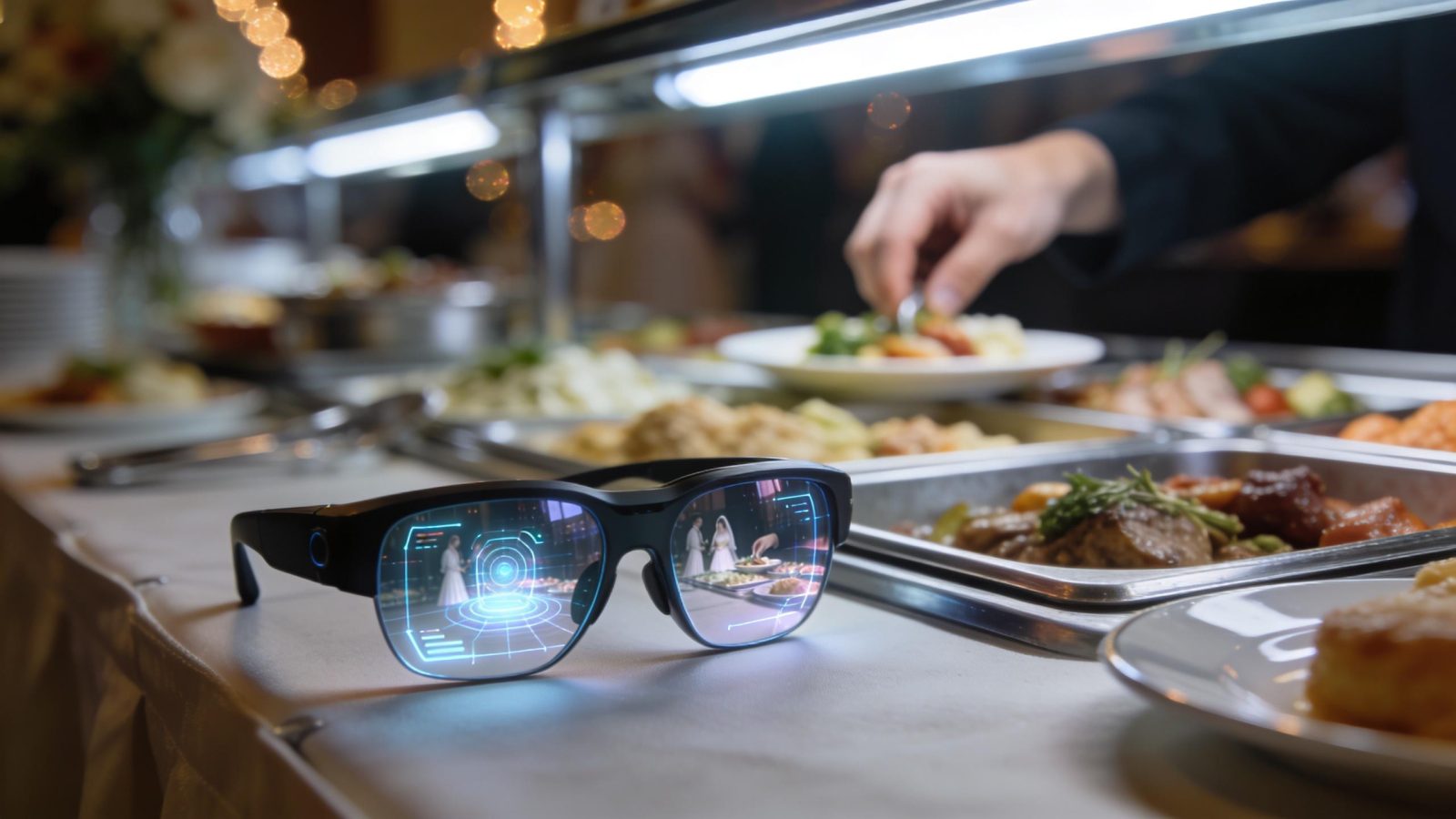
You’re at your cousin’s wedding, plate in hand, staring at 40 dishes you’ll never taste again — and an AI camera on someone’s glasses is scanning every bite you consider. BuffetGPT went viral last month as a clever phone hack to avoid buffet regret. Now OpenAI’s on track to ship its first wearable device this year that does the same thing — except it’s always watching, and you didn’t consent to be in the dataset.
The gap between “fun AI tool” and “privacy nightmare” just collapsed. Wedding guests and event-goers are about to become unwilling participants in food AI training.
Your buffet choices are becoming someone else’s data
OpenAI is building toward a device launch in late 2026 — think earbuds or AR glasses that scan buffets in real-time. Dr. Timnit Gebru, former Google Ethical AI lead, calls this kind of tech “restaurant surveillance” that profiles diners without consent. Unlike BuffetGPT where you point your phone and control the scan, wearables record continuously.
Every plate, every person, every cultural dish at a wedding becomes training data. The device targets “everyday food decisions” — which means your family recipes could end up in a corporate model, especially as Apple’s smart glasses plans accelerate the wearable AI race. Cultural events get hit worst. Weddings, religious gatherings, and private celebrations already have unspoken rules about food photos.
Now someone’s glasses might be feeding your grandmother’s biryani recipe into an AI dataset. You won’t know. You can’t opt out — similar to how AI tools operating without oversight have already infiltrated workplaces. This isn’t paranoia. It’s the logical endpoint of “AI everywhere.” The convenience is real. The cost is your autonomy at private events.
The AI actually works — that’s why the privacy trade-off stings
Nielsen Norman Group just published the first real study on AI buffet tools. The numbers are uncomfortably good. Decision time drops from 4.2 minutes to 1.8 minutes. Satisfaction jumps 27% (6.4/10 to 8.1/10). 68% of users report less decision paralysis.
This isn’t vaporware — it genuinely solves the “I should’ve tried that” regret, proving AI’s expanding reach into everyday micro-decisions. The contrast: BuffetGPT (phone-based, you control when to scan) vs. wearable AI (always-on, scans everyone’s plates). Both deliver similar results. One respects boundaries. The other treats every meal like a data collection event.
Reddit users already joke about “BuffetGPT saving my plate at cousin’s shaadi” — but the AR glasses version erases the line between helpful and invasive. I’ve watched demos that looked seamless until you realize the device never stops learning from everyone around you.
Big Tech isn’t building this for you
Berkshire Hathaway’s $311B portfolio allocates 23% to just two AI stocks — Apple and Alphabet. Google Cloud AI revenue hit $15B (up 34% YoY). The money isn’t in quirky consumer tools. It’s in enterprise contracts and data pipelines. Wearable AI that scans buffets isn’t the product. The behavioral data is.
Your food choices, timing, cultural preferences — that’s what trains models for restaurants, caterers, and food delivery platforms using the same behavioral nudges AI uses to keep you engaged. The hobbyist tools like BuffetGPT stay fun because they’re not monetizing your data. The moment Big Tech enters, the incentive structure flips.
You’re not the customer. You’re the dataset. Some teams have already stopped using always-on AI tools at client events for exactly this reason.
If wearable AI becomes the default at weddings and private events, do we lose the right to eat without being studied?
The BuffetGPT hack was charming because it was optional. You pulled out your phone, scanned your options, put it away. Wearables remove that boundary. Every meal becomes a data event. Every guest becomes a participant in someone else’s AI training.
The question isn’t whether the tech works. It’s whether we’re okay with never eating in private again.
