

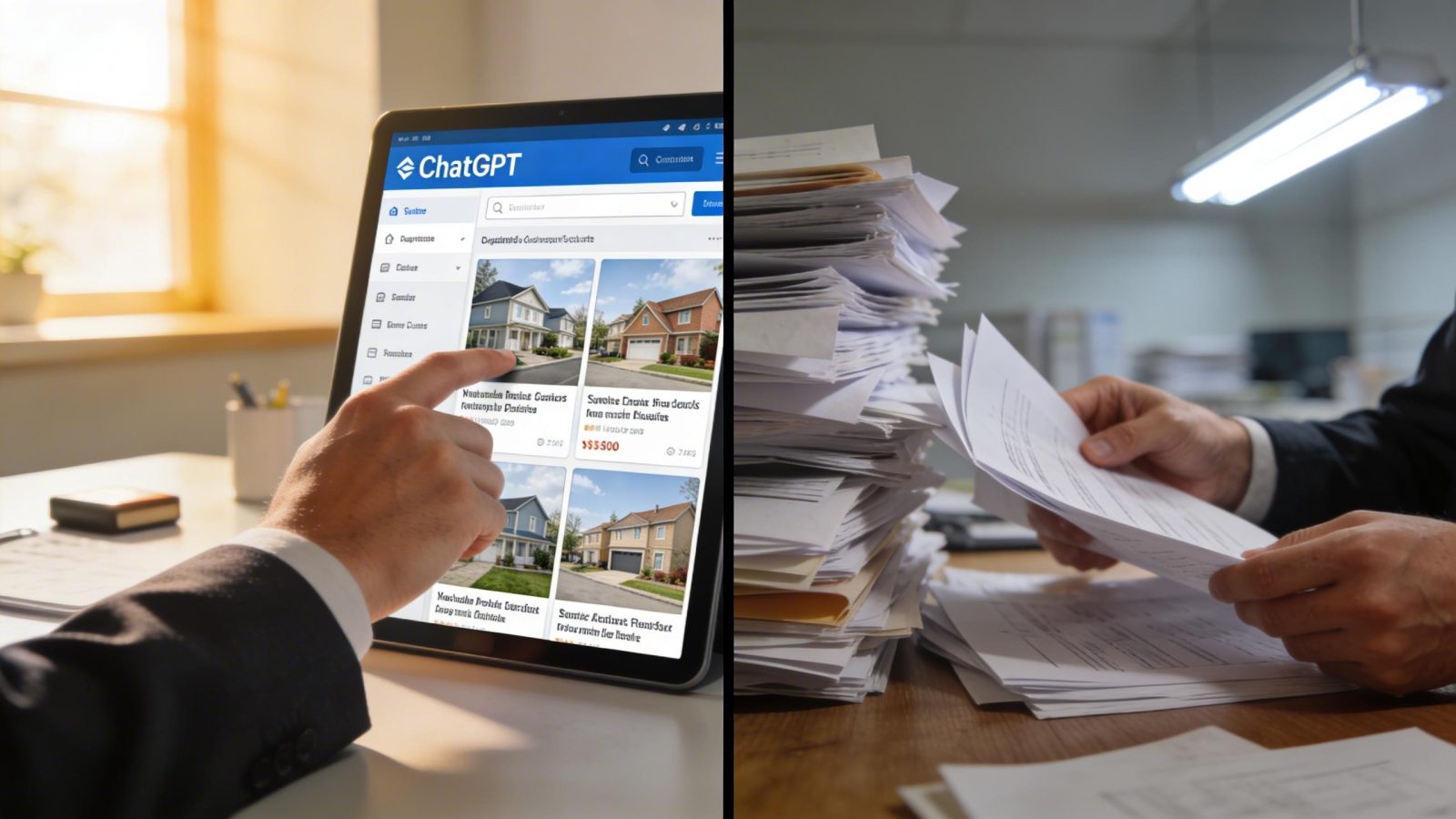
Real estate agents no longer care what AI costs—they want tools that save mental energy. The problem: nearly half the industry hasn’t started using AI daily, and Zillow just bet its platform rebuild on the assumption they will.
Released today, Zillow’s 2026 Agent Trends Survey reveals a fundamental shift: ease of use now outranks cost as the primary factor agents consider when choosing technology. This inverts the traditional SaaS adoption model. Agents aren’t asking “What does it cost?” anymore—they’re asking “Will this stop me from thinking about admin tasks at 11 PM?”
The catch: while nearly 50% of agents now use ChatGPT, Gemini, or Claude daily, the other half is falling measurably behind. And Zillow’s shipping features that assume everyone’s already there.
Half of real estate agents now use AI daily. The other half is falling behind.
The obsolescence threat isn’t theoretical. Agents who’ve adopted AI daily aren’t just faster—they’re developing AI skills that separate leaders from laggards in a stalling market. Recent industry surveys show 68% of agents use AI daily or several times weekly, with 71% citing time savings as the top value. But that means roughly a third are using AI sporadically or not at all.
Zillow’s betting they’ll catch up. Fast.
The company’s ChatGPT integration lets users type “Zillow, show me apartments in West Village under $5K/month” directly into the chatbot—natural language search that assumes baseline AI fluency. Virtual staging, AI-powered Zestimate refinements, and the upcoming Zillow Pro platform (launching mid-2026 with nationwide availability) all embed AI into transaction steps that used to be manual.
Real estate agents join a growing list of high-skill professions facing AI’s impact—but unlike doctors or engineers, agents can’t hide behind regulatory moats. The market is forcing efficiency obsession because housing stalled, not despite it.
Zillow’s internal AI velocity reveals the infrastructure gap no one’s talking about
Here’s the uncomfortable truth: Zillow’s engineers have used AI coding assistants for over two years while half their agent user base hasn’t started daily AI adoption. The company’s partnership with Glean—which hit $200 million ARR in December 2025—enabled employees to create 4,600+ internal AI agents for tasks ranging from code review to customer support triage. CTO David Beitel told reporters the company has been “continuously testing and refining models” since early 2024, a timeline that predates the moment even Linux’s creator is vibe coding with AI assistants.
That infrastructure advantage shows in velocity: the ChatGPT integration reportedly shipped in roughly six weeks. Meanwhile, agents are fragmented across tools, with some engaging in shadow AI adoption—using ChatGPT or Claude without brokerage approval or training.
The gap isn’t just technical. It’s cultural. Zillow’s building for a future where AI is ambient, but the survey data proves half its users aren’t living in that future yet.
The real cost isn’t price—it’s optionality
Zillow Pro unifies CRM (Follow Up Boss), buyer insights, seller tools, and branded agent profiles into one platform. Zillow Preferred partners get Pro free through 2026—a lock-in strategy disguised as a gift. Premier Agent pricing averages $223 per connection in major metros, and now you need AI fluency on top of that spend.
Smaller brokerages have no leverage to resist platform consolidation. No churn data. No reported failures from January or February 2026. No pricing transparency for Pro beyond “varies by number of users.” The ecosystem tightens—Zillow Home Loans, Buyability budgeting tools, Listing Access Standards—and agents either adapt or get priced out by peers who did.
This is the honest trade-off: simplicity costs optionality. Zillow’s making the bet that agents value mental energy savings more than independence. The survey suggests they’re right. But someone’s getting left behind, and Zillow won’t say who.
Zillow’s engineers have used AI coding assistants for over two years. Half of real estate agents haven’t started. One of these groups is building the future. The other is hoping it slows down.
