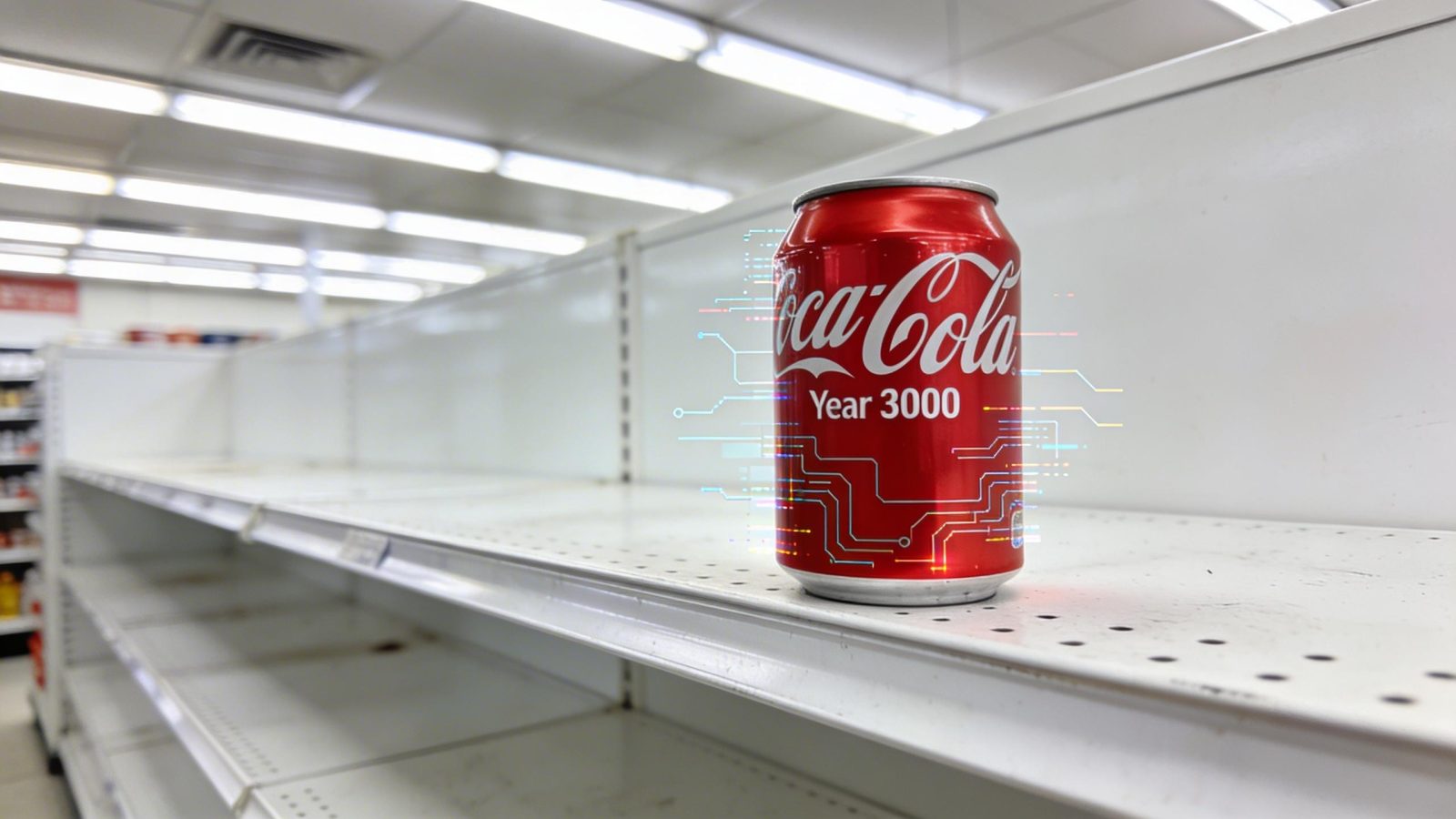
Coca-Cola just launched an AI-developed soda. The company won’t tell you if anyone’s buying it.
Zero Sugar Year 3000 hit shelves in February 2026 as a limited edition co-created with artificial intelligence — the clearest signal yet that Coca-Cola’s AI strategy has moved from marketing gimmicks to actual product development.
The company is betting its 2026 growth on “bigger and bolder innovation” powered by AI, pivoting from price increases to what executives call “persuasion-led growth.”
But here’s the problem: Coca-Cola won’t release a single number proving any of this works. No cost savings data. No sales figures for AI products. No before/after metrics comparing traditional launches to AI-developed ones.
When a company with a market cap near $380 billion bets its transformation on AI and refuses to show the math, that’s not innovation. That’s faith.
AI went from cutting costs to creating products — but Coca-Cola won’t show the receipts
The escalation happened fast. AI started as a marketing efficiency play — reportedly, a five-person team used generative tools to produce 70,000 video clips in 30 days for a 2025 campaign.
Now it’s designing beverages. Zero Sugar Year 3000 was “co-created with human and artificial intelligence,” according to Coca-Cola’s official announcement, blending consumer insights with AI-generated flavor concepts. The company also launched Coca-Cola Cherry Float in the US, Canada, and UK the same month — a nostalgia play for uncertain economic times.
This fits Coca-Cola’s stated 2026 strategy: fewer, bigger bets on platforms like Zero Sugar (the growth engine), Fairlife (protein), and Topo Chico (premium hydration).
AI is embedded throughout — operational digitization for bottlers, real-time campaign optimization, demand forecasting. The promise is hyper-efficient, data-driven persuasion to replace the pricing power that carried the company through inflation.
But zero cost comparisons exist. Coca-Cola hasn’t disclosed production budgets for AI campaigns versus traditional ones. No ROI figures. No sales data for AI-developed products versus human-led launches. The efficiency claim — 70,000 clips in 30 days — sounds impressive until you realize there’s no baseline. Was the old process slower? More expensive? We don’t know. Coca-Cola declined to provide specifics.
The last time Coca-Cola went big on AI, consumers called it “soulless”
There’s a credibility gap here. In 2025, Coca-Cola’s AI-generated Christmas ad triggered measurable backlash. DAIVID analysis found it scored 2.1% lower on positive emotions and 2% higher on distrust compared to industry norms. Social media reactions were harsher: “creepy,” “boycott,” “soulless.” The campaign became a case study in what happens when brands automate creativity without understanding why the old version worked.
Pratik Thakar, Coca-Cola’s head of generative AI, told reporters in 2025 the company needed to “keep moving forward.” No acknowledgment of what went wrong. No adjustment in messaging. Just momentum.
Now Coca-Cola is scaling AI into product development while the most recent consumer data shows AI-generated content triggers distrust. The company claims AI enables real-time optimization and persuasion-led growth as inflation eases. But if shoppers can detect synthetic creativity — and they demonstrably can — the whole model collapses. You can’t optimize your way out of consumers thinking your product feels fake.
The privacy problem Coca-Cola isn’t talking about
AI-driven personalization requires consumer data. Lots of it. Coca-Cola’s 2026 strategy depends on operational digitization and demand-shaping — predicting what consumers want before they know they want it. But GlobalData’s Ramsey Baghdadi warned in February 2026 that “the majority of consumers are still wary about sharing too much personal information.” The company’s push for transparency and loyalty programs runs headlong into rising consumer data wariness across digital interactions.
This isn’t a small tension. If AI-powered persuasion requires behavioral data that shoppers refuse to provide, the entire growth thesis breaks. Coca-Cola can’t force people to trust algorithms with their preferences. And the company hasn’t released any metrics showing consumers are actually engaging with AI-personalized experiences at scale.
The honest trade-off: AI might streamline production. It might generate interesting flavor concepts. But if the end result feels synthetic and the data collection feels invasive, none of the efficiency matters. You’re optimizing a system consumers are actively rejecting.
Coca-Cola is asking investors and shoppers to believe AI is transforming its business. The evidence? A limited-edition soda with no sales data, a Christmas ad that tanked on emotion scores, and a lot of corporate language about “bigger bolder innovation.” Until the company releases actual numbers — cost savings, sales figures, consumer adoption rates — this isn’t a transformation story. It’s a $380 billion brand running on vibes.