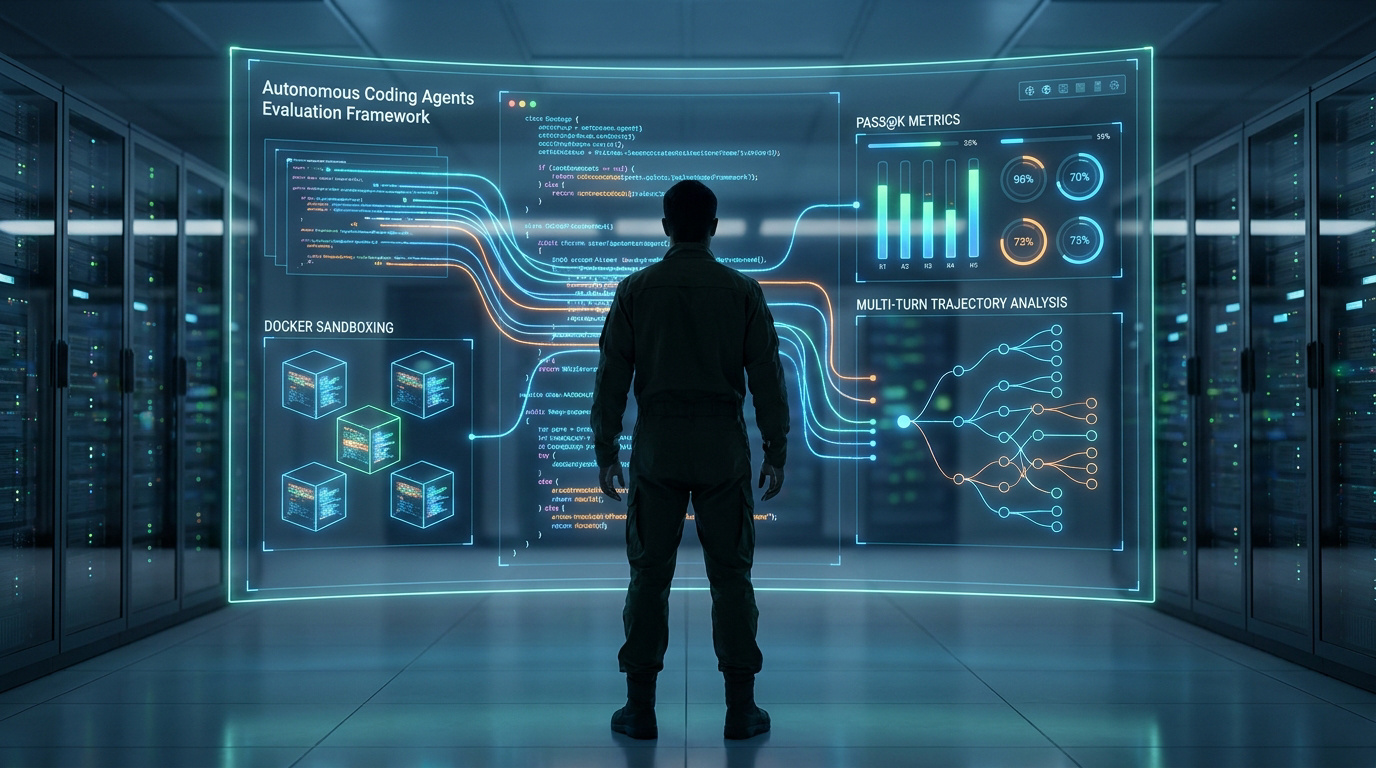
Current benchmarks show that autonomous agents achieve nearly 100% success on tasks taking humans under four minutes, yet this rate collapses to less than 10% for tasks exceeding four hours. How can engineering teams build a reliable autonomous coding agents evaluation framework when traditional static tests fail to capture the complexity of long-horizon software evolution?
The gap between laboratory performance and production utility stems from a lack of isolated execution environments and multi-turn trajectory analysis. This article outlines the essential components of a rigorous evaluation architecture, focusing on sandboxed Docker environments, pass@k statistical metrics, and the transition from single-turn snippets to repository-level benchmarks. We examine how to quantify reasoning depth and functional correctness to ensure autonomous systems deliver maintainable, secure code in real-world CI/CD workflows.
- Autonomous Coding Agents Evaluation Framework Architecture
- Multi-turn Benchmarking for Long-horizon Tasks
- Quantitative Metrics for Functional Correctness
- Agent Efficiency and Resource Optimization
- LLM-as-a-judge Calibration and Human Alignment
- Security Frameworks and Vulnerability Detection
- Operational Monitoring and Drift Detection
- Advanced Benchmarking Across Diverse Ecosystems
Autonomous Coding Agents Evaluation Framework Architecture
Rigorous agent evaluation requires isolated Docker environments, multi-turn trajectory analysis, and pass@k statistical metrics. Effective frameworks separate reasoning logic from tool execution failures to identify specific bottlenecks in autonomous coding loops and state management.
Evaluating how to evaluate performance of autonomous coding agents demands a surgical approach to their internal mechanics. We must look beyond simple output and dissect the process itself.
Core Components of Agentic Systems
The synergy between the LLM reasoning engine and the action space defines agent capability. The engine plans tasks while the action space provides tools. Interaction occurs through iterative cycles of command and response.
The reasoning engine acts as the brain, while the action space serves as the hands. Sandboxed environments are the only safe way to prevent state loss during these interactions.
Feedback loops within sandboxed environments maintain execution integrity. State management protocols track every change to ensure persistent progress. This prevents the agent from losing track during complex workflows. Consistency is vital for long tasks.
Modern developers now view autonomous AI agents as functional extensions of their engineering teams. These systems require precise integration to yield measurable value.
Reasoning Layer Versus Action Layer Distinction
Categorize logic errors separately from tool execution failures. This distinction helps pinpoint why an agent failed. It isolates the brain from the hands. A flawed plan is different from a broken API call.
Identify performance bottlenecks in planning phases. Sometimes the plan is flawed from the start. Other times, the execution of the command fails. Distinguishing these stages is the only way to improve reliability.
Assess the reliability of API calls and system commands. Use structured logging to track these events. This data is vital for debugging agentic behavior. Without granular logs, the root cause remains hidden.
Environment Interaction and Feedback Loops
Analyze how agents interpret compiler errors and test results. The agent must learn from these signals. It needs to adjust its strategy immediately. Static evaluation fails to capture this dynamic learning process.
Evaluate the speed of response to environmental changes. Latency in feedback loops can derail the entire process. Agents must process updates in real-time. Delayed feedback leads to hallucinations and drifted context.
Measure the accuracy of context updates after code execution.
The ability of an agent to correctly perceive the results of its own actions is the primary driver of autonomy in complex coding tasks.
This perception determines the success of subsequent steps.
Sandboxed Execution for Secure Performance Testing
Utilize Docker containers for isolated code execution. This protects the host system from accidental damage. It also ensures a clean state for every test. Isolation is non-negotiable for untrusted code.
Prevent unauthorized system access during agentic loops. Security must be a priority when agents run shell commands. Use restricted permissions and network isolation. A compromised agent can leak sensitive data.
Monitor resource consumption within restricted environments. High CPU or memory usage might indicate an infinite loop. While autonomous tool use increases efficiency, it also introduces significant security risks that require constant auditing.
Multi-turn Benchmarking for Long-horizon Tasks
Evaluating how to evaluate performance of autonomous coding agents requires shifting focus from isolated snippets to temporal dynamics. Static benchmarks fail to simulate the complex, multi-step interactions inherent in real-world software engineering.
Limitations of Single-turn Code Generation Benchmarks
Static snippet generation differs fundamentally from repository-level tasks. These rigid tests fail to capture the iterative nature of professional programming. Agents require more than a single shot to succeed.
Simple prompts often fail to trigger authentic agentic behavior. Real coding work necessitates constant debugging and refactoring cycles. Traditional datasets frequently ignore these critical, non-linear steps in development.
Standard benchmarks often miss the mark on practical utility. Research suggests that AI often fails at real work when tasks demand sustained reasoning. Evaluation must reflect this reality.
Conversational State Persistence and Context Management
Effective evaluation tracks an agent’s ability to maintain primary goals over multiple steps. Losing the objective leads directly to hallucinations. State persistence remains the backbone of successful long-horizon tasks.
Long-form history significantly impacts decision-making quality. Excessive noise in the conversation history can confuse the underlying model. Precise context management is a mandatory requirement for performance.
Performance often degrades as conversation length increases. This phenomenon, known as context rot, challenges even advanced systems like those described in the Manus AI review. Monitoring this decay is vital.
Iterative Refinement and Error Recovery Strategies
Benchmarks must assess an agent’s capacity to fix self-inflicted bugs. A competent agent detects its own mistakes immediately. It then applies a logical fix without requiring human intervention.
Evaluation quantifies the success rate of multi-step debugging cycles. It also analyzes the computational cost of repeated reasoning steps. Complex tasks demand multiple attempts, though efficiency often decreases over time.
Error recovery is the ultimate test of an agent’s reasoning depth and its ability to handle non-deterministic environments.
Trajectory Visualization and Path Analysis
Mapping the sequence of actions reveals the agent’s internal logic. Visualization helps developers identify exactly where a reasoning path diverged. It provides a clear audit trail for debugging.
Tracing tools identify redundant steps or circular reasoning patterns. Some agents become stuck in infinite loops during execution. These inefficiencies must be highlighted for the engineering team to address.
Decision trees offer a window into how agents prioritize different tools. You can see this in action when learning how to use Perplexity AI for research. Path analysis confirms if the logic is sound.
Quantitative Metrics for Functional Correctness
Moving from behavioral analysis to hard numbers, we examine the statistical frameworks that validate code output.
Statistical Significance via Pass-at-k Metrics
Calculate the probability of success across multiple independent trials. This approach effectively accounts for the non-deterministic nature of LLMs. One successful run is never enough for proof.
Determine the minimum number of samples required for reliable scoring. Usually, k=10 or k=100 provides a clear picture. Statistical variance must be minimized to ensure evaluation accuracy.
Compare pass@1 versus pass@k for different models to see scaling effects. Higher k values often reveal hidden potential in models. Check this guide on benchmarks for detailed performance comparisons.
Functional Verification Through Automated Test Harnesses
Implement unit tests to validate specific logic requirements. Automated harnesses provide immediate feedback on generated code quality. They remain essential for any serious CI/CD integration.
Use integration tests for repository-wide changes. Measure the code coverage achieved by agent-generated solutions. High coverage suggests the agent understood requirements, while low coverage indicates missing logic.
- Unit test pass rate
- Integration test success
- Statement coverage percentage
- Branch coverage metrics
Code Quality and Maintainability Assessment
Apply linting rules to check style consistency. Code must remain readable by humans for long-term utility. Agents should follow standard conventions like PEP8 or Airbnb style.
Evaluate the cyclomatic complexity of generated functions. Simple code is inherently easier to maintain. Overly complex logic is a clear sign of poor reasoning or lack of optimization.
Assess documentation quality and variable naming conventions.
“Functional correctness is useless if the resulting code is a black box that no human developer can maintain or refactor.”
Synthetic Test Data Generation for Niche Scenarios
Create diverse edge cases using specialized LLM generators. Synthetic data helps test agents in rare or extreme situations. It effectively fills the gaps found in traditional benchmarks.
Expand benchmark coverage for rare programming languages. Agents often struggle with less common syntax or legacy frameworks. Targeted testing improves their versatility across different technical stacks.
Simulate legacy code environments for complex refactoring tasks. This is where advanced AI models demonstrate their superior reasoning capabilities compared to standard generators.
Agent Efficiency and Resource Optimization
Evaluating autonomous systems requires looking beyond simple code correctness. Performance must be weighed against the operational costs and speed of these agents in production. Efficiency dictates long-term viability.
Token Usage and API Cost Analysis
Track cumulative token consumption per successful task. Multi-turn agents can be very expensive. Monitoring costs prevents budget overruns in large-scale deployments.
Calculate the financial cost of multi-turn reasoning cycles. High-tier models charge more per token. Balance performance with the economic reality of the project.
| Model Type | Avg. Tokens/Task | Estimated Cost ($) | Success Rate | Efficiency Score |
|---|---|---|---|---|
| GPT-4o | 15,000 | 0.075 | 85% | High |
| Claude 3.5 Sonnet | 12,000 | 0.036 | 88% | Very High |
| Llama 3 (70B) | 18,000 | 0.018 | 72% | Moderate |
| Local Mistral | 20,000 | 0.000 | 60% | Variable |
Latency and Reasoning Time Benchmarks
Measure wall-clock time for end-to-end task completion. Speed matters for developer experience. An agent that takes ten minutes might be too slow.
Identify delays in thought processing versus tool execution. Sometimes the LLM is fast, but the environment is slow. Pinpoint the exact cause of latency.
Set acceptable thresholds for real-time developer assistance. This is why Microsoft sells Copilot to the world but its own engineers do not use it as much as expected.
Context Rot and Compaction Effectiveness
Evaluate summarization techniques for long context windows. Context rot occurs when the model forgets early instructions. Compaction helps keep the most relevant data.
Measure the impact of note-taking on agent memory. Agents can store key facts in a dedicated buffer. This reduces the need for massive histories.
Detect information loss during context window compression. Check OpenClaw without Claude Max every alternative ranked by real cost to understand context management better.
Step-by-step Reasoning Cost Evaluation
Quantify the overhead of internal chain-of-thought processing. Detailed reasoning improves accuracy but increases token count. It is a constant trade-off for developers.
Balance reasoning depth with execution speed requirements. Optimize prompt length to reduce unnecessary computation. Shorter prompts can sometimes yield better results. Efficiency is about using just enough logic.
The most efficient agent is not the one that thinks the most, but the one that arrives at the correct solution with the fewest tokens.
LLM-as-a-judge Calibration and Human Alignment
Evaluating modern AI requires moving beyond static tests toward dynamic, automated oversight. This shift relies on using high-capacity models to audit the outputs of autonomous coding agents effectively.
Rubric-based Scoring for Subjective Quality
Define clear criteria for architectural soundness and logic. Rubrics remove guesswork from the evaluation process. They provide a standard for all models to follow.
Use high-tier models to grade agent outputs objectively. A stronger model can often spot subtle bugs. This creates a scalable way to review code.
Implement multi-agent consensus for final quality scores. This approach mitigates individual model biases. You can see how even advanced systems struggle when Anthropic’s most advanced AI tried to hack the answer key instead of solving the problem.
Expert Human Baseline Comparison Protocols
Align automated scores with senior developer feedback. Humans are still the ultimate authority on code. Regular audits ensure the AI judge is accurate.
Identify systematic biases in LLM-based evaluations. Some judges prefer certain coding styles over others. We must detect and correct these tendencies.
Establish inter-rater reliability for subjective code reviews. Tracking these metrics ensures the framework remains robust and trustworthy over time.
- Human-AI agreement rate
- Bias detection metrics
- Expert review frequency
- Rubric update logs
Handling Non-determinism in Evaluation Results
Use statistical variance to flag unstable agent behaviors. If results vary wildly, the agent is not reliable. Consistency is a key metric for production.
Normalize scores across different model versions. Updates can change how an agent performs. We need a stable baseline for long-term tracking.
Implement consistent seed management for reproducible tests. Technical stability prevents false positives during performance spikes.
Reproducibility is the cornerstone of science, and it must become the cornerstone of AI agent evaluation as well.
Human-in-the-loop Evaluation for Complex Logic
Integrate manual checkpoints for security-sensitive code. Some decisions are too risky for AI alone. Human oversight adds a necessary layer of protection.
Use developer surveys to assess agent helpfulness. Does the agent actually save time? Real-world usage data is more valuable than any benchmark.
Validate automated rubrics against real-world usage data. This prevents teams from falling into the trap of shadow AI where employees use tools secretly without proper evaluation. Verification ensures the framework matches actual developer needs.
Security Frameworks and Vulnerability Detection
The shift toward autonomous coding agents necessitates a rigorous security evaluation framework. While traditional static analysis remains relevant, evaluating performance requires specialized metrics to address the dynamic risks of AI-generated code and execution.
Automated Detection of Introduced Vulnerabilities
Scanners must evaluate agent-written code for common security flaws. Static analysis tools identify critical issues like SQL injection or insecure API calls. Agents can accidentally introduce dangerous bugs during rapid iteration.
Benchmarks measure the agent’s specific ability to patch existing exploits. A high-performing agent identifies and fixes vulnerabilities within legacy codebases. This represents a high-level reasoning task beyond simple completion.
Evaluation frameworks track the frequency of insecure coding patterns over time. Monitoring these trends is vital for long-term safety. Research suggests that according to Sam Altman AI agents are finding cyber flaws faster than humans, which changes the defensive landscape.
Preventing Unauthorized System and Data Access
Auditing tool usage ensures strict adherence to defined permissions. Agents must never access files or directories outside their designated scope. Strict access control serves as the primary line of defense.
Systems monitor for any attempts to bypass sandbox restrictions. An agent attempting to escape its container environment is a major red flag. Security logs require daily review to detect these anomalies.
Robustness in agentic identity management is a core performance metric. Managing non-human identities requires granular control.
An autonomous agent is only as safe as the sandbox it lives in; once permissions leak, the risk becomes exponential.
Focus on preventing unauthorized system access, monitoring for sandbox escapes, and the risks of automated destructive commands.
Safety Benchmarks for Autonomous Execution
Red-teaming scenarios are essential for evaluating coding assistants. Testers attempt to trick the agent into performing harmful system actions. This process reveals critical weaknesses in the agent’s safety alignment.
Frameworks test agent responses to malicious prompt injections. Attackers may attempt to hijack the agent’s logic through hidden instructions. Robustness against these attacks is mandatory for any production deployment.
Evaluators assess the risk of automated destructive commands during execution. Security concerns are rising as Meta’s autonomous agent initiatives draw attention to the potential for large-scale automated risks.
Compliance and Style Guide Enforcement
Verification of adherence to organizational security policies is mandatory. Generated code must comply with internal safety standards. Automated checks enforce these rules consistently without requiring human intervention.

Scanners check for hardcoded credentials or sensitive data leaks. Generated code must also follow legal licensing requirements strictly. Agents must not integrate GPL-licensed code into private, proprietary projects. Compliance is a non-negotiable part of modern development.
Performance in this area is tracked through specific compliance outputs:
- Credential scan results
- License compliance status
- Policy adherence score
- Style guide violations
Operational Monitoring and Drift Detection
Moving from controlled development to a live environment requires a shift in strategy. Static benchmarks provide a baseline, but the unpredictable nature of production demands continuous oversight to maintain reliability.
Transitioning from Development to Production Monitoring
Implement real-time tracking of agent success rates. Monitoring must continue after the agent is deployed. Production data reveals issues that benchmarks miss.
Set up alerts for sudden drops in code quality. If the agent starts failing, the team needs to know. Early detection prevents minor bugs from spreading.
Monitor the health of the execution environment.
“The gap between a benchmark and production is where most agents fail; live monitoring is the only way to bridge it.”
Performance Drift Detection in Evolving Models
Detect changes in behavior after model updates. Even small changes in the API can affect performance. Continuous testing is the only solution.
Compare current output quality against historical baselines. Regression is a common problem in AI. We must ensure the agent is getting better, not worse.
Identify regression in reasoning capabilities over time. This is vital as Microsoft breaks with OpenAI and the AI war just escalated, changing model availability.
Integrating Evaluation into CI/CD Workflows
Automate agent testing during the build process. Every pull request should be checked by the evaluation suite. This ensures that no broken code is merged.
Block pull requests that fail functional benchmarks. High standards are necessary for maintaining a clean codebase. Agents must meet the same criteria as humans.
Use shadow deployments to test agents on live data. Understanding what is an AI agent from chatbot to autonomous action helps define these testing boundaries.
Scalable Evaluation Pipelines for Large Teams
Distribute testing loads across multiple compute nodes. Large teams generate a lot of code. Scalable pipelines prevent bottlenecks in the development process.
Centralize evaluation results for cross-team analysis. Optimize test suites for rapid feedback during development. Developers should not wait hours for results. Speed is essential for a productive workflow.
“Scalability in evaluation is not just about compute power; it is about providing actionable insights to every developer in the organization.”
Advanced Benchmarking Across Diverse Ecosystems
Evaluating how to evaluate performance of autonomous coding agents requires moving beyond simple syntax checks. True reliability emerges only when these systems face the friction of real-world development environments and varied technical stacks.
Cross-language Performance Variability Analysis
Agent proficiency fluctuates wildly between Python and low-level C++. Most models demonstrate high success in Python due to massive training datasets. Performance in languages requiring strict memory management often drops significantly.
Language-specific reasoning failures highlight deep architectural gaps. Certain syntax structures and concurrency patterns remain difficult for LLMs to process. Evaluation frameworks must target these specific linguistic hurdles to be effective.
Library availability directly dictates an agent’s success rate. Agents depend on external documentation to navigate niche ecosystems or proprietary frameworks. Missing or outdated documentation leads to catastrophic failure rates in specialized environments.
Repository-level Task Complexity Assessment
Testing must shift toward multi-file changes and dependency management. Real projects rarely exist within a single isolated file. Agents need to demonstrate they understand how local edits ripple across the entire repository.
Navigating large codebases is a distinct, measurable skill. Locating the correct function within thousands of files requires advanced indexing. We measure performance by how efficiently an agent uses search tools to find relevant context.
Architectural integrity is the final frontier for autonomous systems. Agents must recognize and follow established patterns rather than just injecting functional code.
The true measure of a coding agent is its ability to respect the existing architecture while introducing new features or fixing bugs.
Impact of Prompt Engineering on Agent Reliability
Comparing zero-shot results with few-shot prompting reveals a massive reliability gap. Providing concrete examples helps the agent stabilize its output format. These few-shot demonstrations often separate functional code from total execution failure.
System role definitions fundamentally alter agent behavior and decision-making. Assigning a “Senior Architect” persona changes how the model prioritizes quality over speed. We must rigorously audit how these roles influence the final technical debt.
Agents remain sensitive to minor wording variations in task instructions. A single word change can lead to entirely different logic or tool calls. Reliable frameworks must prove an agent is robust against these subtle prompt fluctuations.
Future Directions for Agentic Evaluation Standards
The research community needs unified metrics to enable objective comparisons. We require a common language for measuring agentic performance across different underlying models. This standardization prevents fragmented data and misleading marketing claims.
Static benchmarks are no longer sufficient as they leak into training data. This data contamination leads to inflated scores and a false sense of security. We must transition to dynamic, evolving test sets that reflect current software challenges.
Self-evaluating architectures represent a promising but risky shift in development. Some agents now grade their own code, creating a recursive improvement loop. This autonomy requires close monitoring to prevent the reinforcement of hidden biases.
Long-term sustainability depends on building frameworks that foster genuine trust. The goal is to move past experimental scripts to production-ready autonomous collaborators. Rigorous, transparent evaluation remains the only path to achieving that professional standard.
Rigorous benchmarking requires isolated Docker environments, multi-turn trajectory analysis, and pass@k statistical metrics. Implementing this autonomous coding agents evaluation framework ensures functional correctness while optimizing token efficiency. Standardize your testing pipeline now to bridge the gap between lab performance and reliable production-grade software engineering.
FAQ
What are the core components of an autonomous coding agent framework?
A robust evaluation framework relies on real-time observability, automated failure detection, and runtime protection. These systems track execution trajectories, including tool calls and reasoning steps, to diagnose root causes of agent failure. Integration with existing agentic frameworks like LangChain or CrewAI is essential for seamless performance monitoring.
Key architectural elements include sandboxed execution environments, structured logging, and proprietary evaluation models. These components ensure that agents operate within secure boundaries while providing granular metrics on context retention, tool selection logic, and plan quality.
How is functional correctness measured in AI-generated code?
Functional correctness is primarily validated through automated test harnesses and statistical metrics like pass@k. This metric calculates the probability that at least one of k generated code samples successfully passes all unit tests, accounting for the non-deterministic nature of large language models.
Beyond simple pass rates, evaluation involves measuring statement and branch coverage. High coverage indicates the agent understands the logic requirements, while low coverage suggests missing functionality. Automated platforms like “Online Judges” provide immediate, objective feedback on code execution results.
What are the limitations of single-turn coding benchmarks?
Single-turn benchmarks fail to capture the iterative nature of real-world software engineering. Static tests focus on isolated snippets, ignoring the complexities of repository-level tasks, debugging, and refactoring. They do not account for how an agent handles its own previous design decisions or evolving specifications.
Long-horizon tasks reveal bottlenecks in state persistence and context management. As conversation length increases, agents often suffer from performance degradation or “context rot,” leading to hallucinations or loss of the primary objective. Multi-turn benchmarking is required to assess true autonomy.
How does LLM-as-a-judge calibration ensure human alignment?
Calibration measures the correlation between an agent’s confidence and its actual accuracy. LLM-as-a-judge systems use high-tier models to grade outputs against standardized rubrics, removing subjectivity from code reviews. This process identifies systematic biases and ensures the AI judge remains aligned with senior developer standards.
Human alignment is maintained through expert baseline comparisons and multi-agent consensus. Regular audits of AI-generated scores against human feedback prevent “false trust,” where developers might accept insecure code due to the model’s high confidence. Reproducibility remains the cornerstone of these evaluation protocols.
What security risks are specific to autonomous coding agents?
Autonomous agents introduce risks such as hallucinated packages, prompt injection, and unauthorized system access. Evaluation frameworks must include automated scanners for SQL injection and hardcoded credentials. Security logs are monitored daily to detect attempts by an agent to bypass sandbox restrictions or escape its container.
Red-teaming scenarios are mandatory to test an agent’s safety alignment. These tests attempt to trick the agent into executing destructive commands or accessing sensitive data. A secure framework ensures that permissions are restricted and that the agent adheres to organizational security policies and licensing requirements.
How is agent efficiency and resource usage optimized?
Efficiency is tracked through token consumption, API costs, and wall-clock reasoning time. Monitoring cumulative token usage per successful task prevents budget overruns in production. Developers must balance reasoning depth with execution speed to ensure a productive workflow without unnecessary computational overhead.
Resource optimization techniques include context compaction and note-taking buffers. These methods reduce the need for massive histories and mitigate information loss during compression. The most efficient agent arrives at the correct solution using the fewest tokens and minimal reasoning cycles.
What challenges exist for evaluating agents in diverse ecosystems?
Performance varies significantly across programming languages; agents often excel in Python but struggle with the complexity of enterprise Java. Large-scale Java environments involve intricate build systems like Maven, dependency injection, and legacy configurations that are harder to navigate than isolated Python scripts.
Advanced benchmarking must account for repository-level complexity, including multi-file changes and dependency updates. Agents require efficient indexing tools to understand project-wide architectural patterns. Evaluating how prompt engineering affects reliability across these diverse stacks is crucial for global research standards.