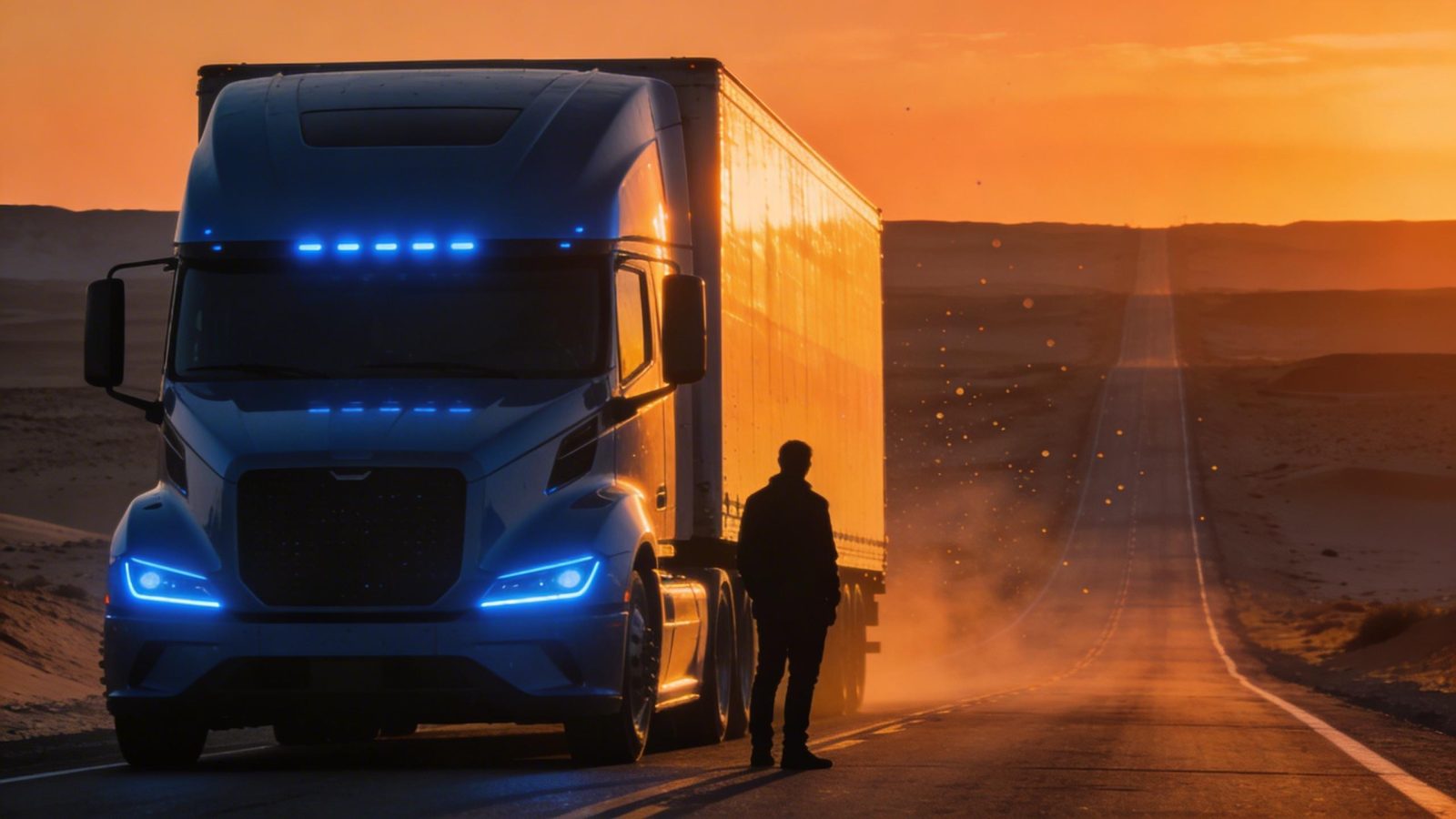
Waabi just raised $1 billion to prove one AI can drive both trucks and robotaxis. The company won’t say how many trucks it’s actually driving today.
On January 28, 2026, the Toronto-based autonomous vehicle startup closed a $750 million Series C at a $3.8 billion valuation—Canada’s largest fundraise ever. The round was oversubscribed. Investors include Uber, Nvidia, Volvo, and Khosla Ventures. Add in a separate $250 million milestone-based investment from Uber, and you’ve got a billion-dollar bet on a company founded in 2021 that has disclosed zero operational metrics: no miles driven, no revenue, no confirmation of how many trucks are actually on the road.
That matters because this isn’t just about trucking anymore. Waabi is pivoting hard into robotaxis, promising to deploy 25,000 or more vehicles exclusively on Uber’s platform. That’s the scale Waymo spent nearly two decades and tens of billions building toward. Waabi thinks they can do it in half the time with a fraction of the capital.
Waabi’s $3.8B valuation rests on a promise nobody can verify
The pitch is seductive: one AI architecture—what CEO Raquel Urtasun calls the “Waabi Driver”—powers both long-haul trucks and urban robotaxis simultaneously. Capital-efficient. Elegant. Unproven.
Waabi launched in 2021 with a promise to deploy autonomous trucks by 2025. It’s now 2026, and the company has not disclosed current truck operations, miles driven, or revenue. When Urtasun told Bloomberg they’re “entering robotaxi really, really quickly,” she offered no timeline, no pilot data, no explanation for why this dual-use approach should work when competitors have spent years mastering single environments.
And here’s the structural risk: Uber’s $250 million isn’t guaranteed. It’s milestone-based. If Waabi misses truck validation targets or robotaxi rollout deadlines, the cash stops flowing. The 25,000-vehicle deployment collapses. This is smart risk management from Uber’s side—they’re not writing a blank check. But it exposes Waabi’s vulnerability: they’re racing to prove their architecture works before the money runs out.
This is one of the massive AI infrastructure bets defining early 2026. It’s also the only one promising dual-use deployment with zero operational proof.
The “one brain” claim sounds efficient until you see the actual cost of mastery
Waabi’s story depends on one architectural claim: a single AI can handle highway trucking and dense urban robotaxi navigation without separate training stacks. If true, it rewrites the economics of autonomous systems replacing specialized roles. If false, it’s a $3.8 billion bet on a shortcut that doesn’t exist.
The research contains no named experts validating this approach. But we have a comparison case. Waymo’s operational scale includes commercial service since 2018 and real urban deployment data. They focused on ONE use case—robotaxis—and it took nearly two decades and capital measured in tens of billions to reach commercial viability.
Meanwhile, Waabi quietly pivoted its trucking strategy. The company initially promised hub-to-hub transfers: autonomous trucks handle highways, human drivers take over for local delivery. Logistics companies rejected it. Too many handoffs, too much cost. So Waabi adapted to include full surface-street navigation—a significant architecture change that undermines the “one brain, simple deployment” narrative.
That’s not a failure. It’s honest iteration. But it reveals the complexity Waabi is betting they can compress into a single AI system when competitors needed separate stacks for highway and urban environments.
Milestone-based funding is a safety net that becomes a trap
The $250 million from Uber isn’t patient capital. It’s tied to “simple milestones” like truck validation and robotaxi rollout timelines. Miss a target, and deployment stalls. Cash flow stops. The 25,000-vehicle promise evaporates.
This is the tension at the heart of capital-intensive AI development: Waabi’s $1 billion total funding looks lean compared to Waymo’s multi-decade burn. That’s either brilliant capital efficiency or dangerous under-resourcing. We won’t know which until Waabi ships real operational data—miles driven, incidents per mile, cost per vehicle, actual deployment timelines.
Right now, we have none of that. Just a valuation, a partnership announcement, and a CEO promising speed without showing the work.
Waabi’s capital efficiency could rewrite autonomous vehicle economics. Or it’s a $3.8 billion bet that one AI can master two fundamentally different driving environments—something no competitor has proven possible. By the time we know which version is true, 25,000 robotaxis will either be on the road or stuck in a funding milestone Waabi couldn’t hit.