

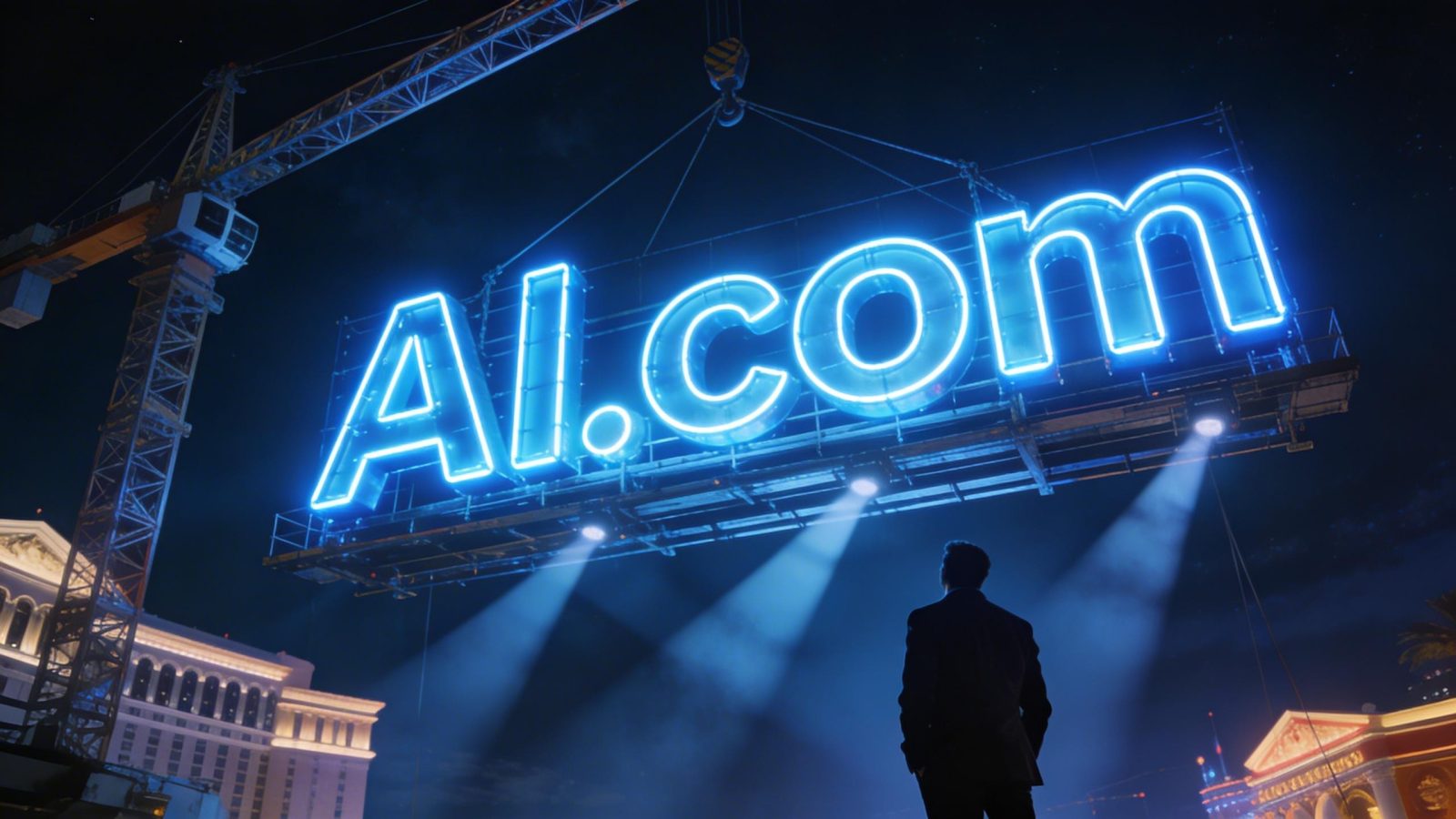
Kris Marszalek spent $70 million on AI.com in April 2025—the most expensive domain sale in internet history. On February 8, 2026, he finally revealed what he bought it for: autonomous AI agents that promise to trade your stocks, manage your calendar, and automate workflows.
They’re also free to use, operate in a “specially protected environment,” and launched three days before a Super Bowl ad that drove so much traffic the site crashed.
The math is simple: $70M for the domain, millions more for the ad, and a product that’s free at entry. This isn’t a technology play. It’s a distribution bet.
The $70M domain buys instant credibility, not technical superiority
Marszalek has form here. His $700M arena rename in 2021 turned the Staples Center into Crypto.com Arena—expensive, controversial, effective. The AI.com purchase follows the same playbook: pay for attention, then convert it. With 150 million
Crypto.com users already in the ecosystem and Super Bowl LX reaching 120+ million viewers, he’s guaranteed traffic. The domain was initially listed at $100M before closing at $70M—a 30% discount that suggests the seller knew the price was inflated but took the deal anyway.
Here’s the thing: AI.com doesn’t need to be the best AI agent platform. It just needs to be the first one 150 million people hear about. The $70M price tag beats CarInsurance.com’s $49.7M record from 2010, but it’s buying SEO dominance and brand recall—not a breakthrough in agentic AI architecture.
Agents promise autonomy but deliver sandboxed execution
The February 6 PR announcement claimed agents could “send messages, manage calendars, automate workflows.” What it didn’t emphasize: they operate in a “specially protected environment.” That’s corporate speak for sandboxed, permission-gated execution. Autonomous agents raise privacy concerns when they access calendars, emails, and financial accounts—so AI.com gates every action behind user permissions. Same constraints as AutoGPT, AgentGPT, and Microsoft Copilot agents.
The free tier is smart user acquisition. But it undercuts the premium positioning a $70M domain implies. If the product were genuinely superior, why give it away? The paid upgrades remain undisclosed, which means we don’t know if AI.com is competing on features or just hoping brand recognition carries conversions.
And the execution? Rough. The Super Bowl ad drove massive traffic, then the site crashed. Not exactly the seamless experience you’d expect from a platform promising to automate your life.
The self-improvement claim has no public evidence
Marszalek’s pitch includes language about self-improving AI systems that “accelerate AGI.” Three days post-launch, there’s no public data on task success rates, user adoption, or how the self-improving architecture actually works. No technical documentation. No benchmarks. No third-party validation. Just marketing language in a press release and a Super Bowl ad.
Compare that to competitors: AutoGPT is open-source with visible GitHub commits. Microsoft Copilot has enterprise case studies. Claude’s agent features ship with documented capabilities. AI.com has a $70M domain and a promise.
I’m not saying the platform won’t work. I’m saying we have no proof it works better than free alternatives. AI agents promise to automate workflows across apps, but execution depends on user permissions and API access—the same constraints every competitor faces. The expensive domain doesn’t solve the hard technical problems.
Marszalek is betting that distribution beats innovation. The domain guarantees traffic. The Super Bowl ad guarantees awareness. But can a $70M URL make AI agents actually work? That’s the bet Crypto.com’s 150 million users are about to test.
