
The pharmaceutical world stands on the cusp of a revolution thanks to artificial intelligence.
While recent advancements have caught the attention of experts, the story of rentosertib – an innovative treatment for idiopathic pulmonary fibrosis designed with AI assistance – exemplifies how quickly things are changing.
It took less than two years to go from modeling to clinical trials.
This is a rapid pace in an industry where developing a treatment usually takes more than a decade. Behind this achievement is AI developed by the startup Insilico Medicine.
Its drug candidate, rentosertib, could be the first designed without direct human intervention to reach the market. And this may only be the beginning.
Artificial intelligence accelerates the path from lab to clinic
Idiopathic pulmonary fibrosis, a rare and often fatal chronic disease, has few truly effective treatments.
This is precisely what rentosertib targets. Developed using artificial intelligence algorithms, this drug has progressed through preclinical and clinical stages at an unprecedented speed. According to Quartz, the molecule entered human trials in less than two years, compared to the usual four to five years.
Drug development remains one of the most time-consuming and costly processes in the pharmaceutical industry. It takes an average of ten to fifteen years and more than $2 billion to bring a project to market.
Yet 90% of molecules fail along the way. In this context, AI is no longer just assisting researchers, it is redefining the stages of the process.
Tools such as AlphaFold2, developed by Google DeepMind, have revolutionized protein modeling.
They now make it possible to predict the three-dimensional structure of nearly 200 million molecules. These advances would not have been possible without breakthroughs in deep learning and open biological databases.
Why the first AI-designed drug is a game changer?
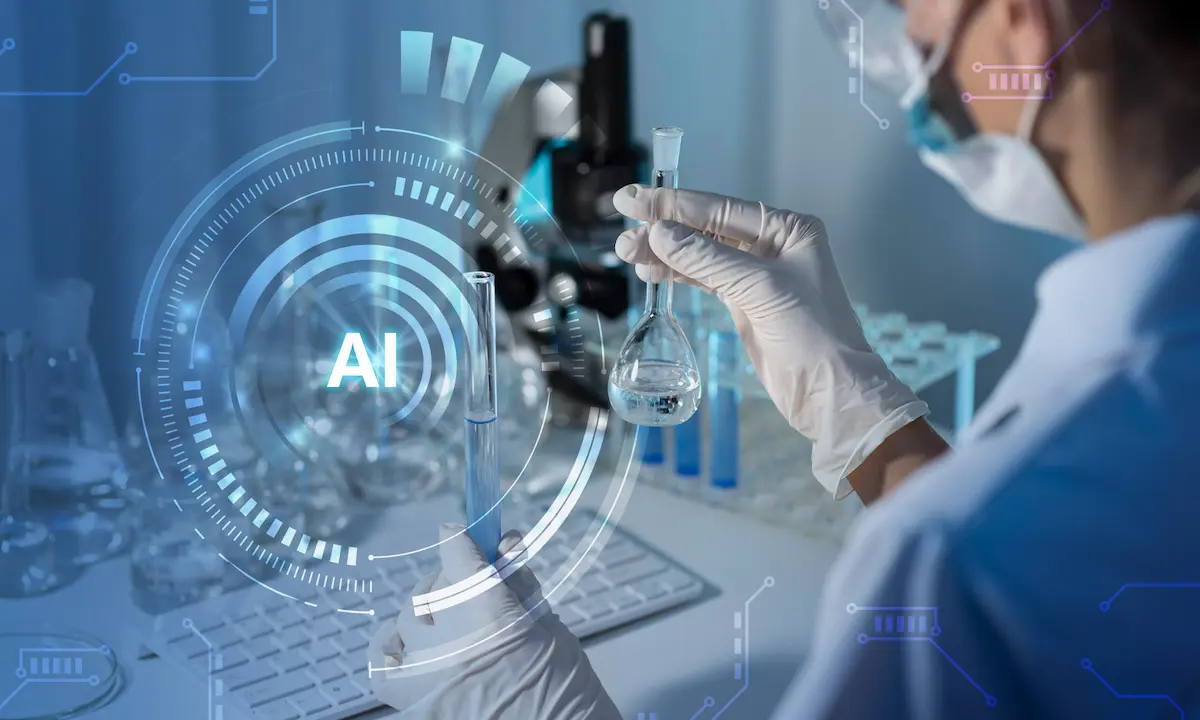
Rentosertib, the first AI-designed drug to reach phase 3 clinical trials, symbolizes this change of scale. In a phase 2 study of 71 patients, the treatment showed improved lung function with few side effects. These encouraging results pave the way for wider validation.
This step is not merely symbolic.
As Slate points out, the widespread use of artificial intelligence could permanently transform biomedical research. Generative models explore millions of molecular combinations, identify correlations invisible to the human eye, and quickly eliminate the least promising leads. This algorithmic sorting streamlines the entire R&D chain.
What makes idiopathic pulmonary fibrosis such a challenge?
Idiopathic pulmonary fibrosis (IPF) ranks among the deadliest and least understood lung diseases. Characterized by progressive scarring, this rare disorder severely impairs breathing and often leads to fatal outcomes within just a few years of diagnosis. Effective treatments remain scarce, so even incremental therapeutic gains offer hope.
Traditional research has struggled to find breakthroughs for IPF due to the complexity of the underlying biological mechanisms. High failure rates and limited efficacy of approved drugs further underline the need for fresh solutions and bold scientific strategies.
Inside the technology: How AI transforms drug design?
Modern AI models work by analyzing enormous troves of biomedical data – far beyond what any laboratory team could feasibly review.
Machine learning algorithms spot connections between genes, proteins, and disease manifestations that humans might overlook. In addition, generative models can rapidly scan through molecular combinations, recognizing subtle patterns and dismissing unpromising candidates almost instantly.
By eliminating dead ends early, AI helps manufacturers focus resources on compounds with real potential. This strategy not only streamlines innovation but also significantly cuts costs during the research process, opening doors for drugs previously too risky or expensive to pursue.
From bench to bedside: Clinical results move fast
Results speak volumes.
When rentosertib reached phase 2 trials involving dozens of patients, researchers noted meaningful improvements in lung function, accompanied by relatively few side effects. Advancing to phase 3, this candidate soon positioned itself among the first successful examples of AI-guided medicine passing rigorous human testing.
Such efficiency contrasts sharply with prior standards, where projects frequently got stuck in pre-clinical or early-phase evaluation for extended periods. The difference highlights the rising influence of advanced computation and strategic automation in healthcare innovations.
The role of partnerships in scaling up innovation
AI alone cannot change the face of pharmaceutical research without strong collaboration across sectors. Forward-thinking companies increasingly form alliances to enhance their technological capabilities. These synergies, sometimes involving supercomputers tailored for virtual molecule screening, help multiply efforts and unlock discoveries faster.
Aside from resource pooling, tech investors play an active part, funneling substantial capital into startups specializing in age-related diseases or other high-need areas. This inflow ensures steady momentum for continual software refinement and novel applications across various fields of medicine.
The growing market for AI in pharmaceuticals
As digital tools prove their worth, industries anticipate rapid growth for AI in pharmacy. Experts forecast the global market value to climb markedly, mirroring intensifying demand for effective medicines, increasing regulatory scrutiny, and greater emphasis on cost-efficiency.
Expected jumps in market size illustrate how central algorithmic intelligence has become in today’s biomedicine landscape. With such financial stakes, leaders show little doubt about the sustained impact and practical necessity of these technologies.
- Faster identification and validation of drug targets
- Reduced research and development costs
- Shorter timelines to bring therapies to market
- Improved ability to personalize medicine for patient subgroups
- More reliable prediction of side effects and treatment outcomes
How does AI change the daily reality for researchers?
Laboratories now operate with a different set of priorities and opportunities. With sophisticated analytic engines performing routine hypothesis testing at astounding speed, scientists shift attention toward interpreting data outputs, designing targeted experiments, and collaborating with engineers to refine performance.
There is no fear of machines sidelining human expertise. Instead, professionals enjoy a more data-rich, agile work environment where probabilistic reasoning and precision are prioritized. Together, AI and humans craft better questions, chase answers faster, and deliver actionable insights.
What could the next decade hold for AI in drug development?
Given current trajectories, expanding access and success stories suggest that algorithm-driven therapies may soon become standard practice. Applications will likely extend from rare conditions to common diseases, leveraging ever-greater data granularity and deeper biological insight.
Ultimately, a combination of intelligent algorithms and expert guidance points the way to medicine that is faster, smarter, and more responsive to urgent health needs worldwide.