

Related: If you are evaluating Google’s business phone product rather than Gemini voice AI, read our practical guide to Google Voice for Business.
Google just gave 200 countries access to real-time voice AI. It can’t start a conversation on its own.
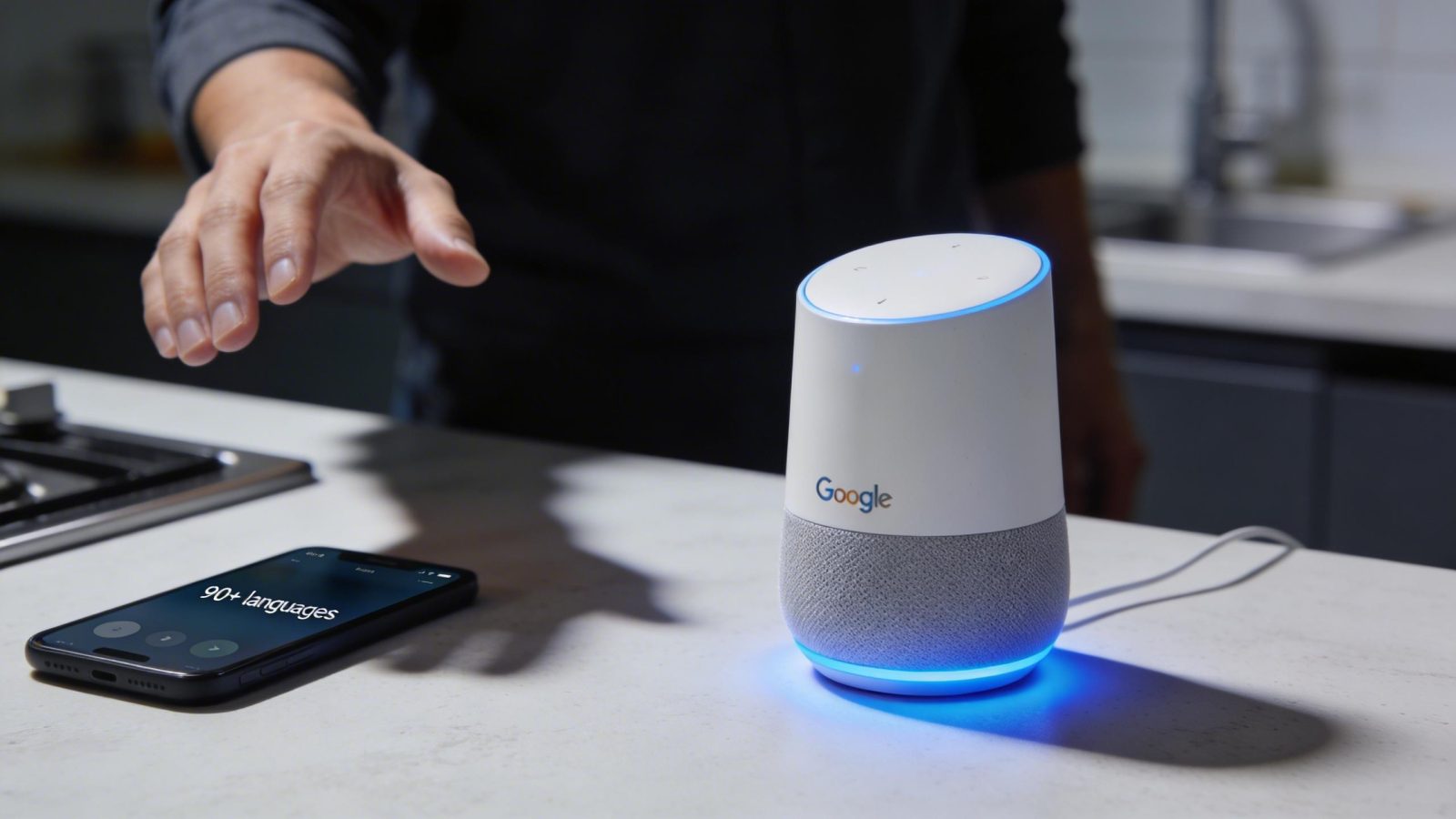
Gemini 3.1 Flash Live launched March 26, 2026, powering Search Live globally with support for 90+ languages and the kind of low-latency performance that makes voice interfaces feel natural. But Google stripped out the features that make voice AI useful beyond demos — proactive audio, structured outputs, batch processing — to ship the fastest model on the market. The result: a product that benchmarks beautifully and breaks in production.
This matters because enterprises betting on voice-first AI at work need models that handle interruptions and complex workflows, not just clean audio samples in controlled environments.
The benchmark Google wants you to see hides the one it doesn’t
Google’s 90.8% score on ComplexFuncBench Audio is legitimately impressive. The benchmark measures multi-step function calling based on audio input alone — the kind of task that separates real assistants from glorified transcription services. It beats Google’s previous models and establishes Flash Live as the accuracy leader for voice-driven task completion.
Then you look at the other number.
On Scale AI’s Audio MultiChallenge, which tests how models handle interruptions, background noise, and long-horizon reasoning, Flash Live scored 36.1% with “thinking” enabled. That’s the gap between controlled lab conditions and messy reality. The 90.8% benchmark assumes clean audio, patient users, and sequential tasks. The 36.1% score reveals what happens when someone talks over the AI, a dog barks mid-sentence, or the user changes their mind halfway through a request.
Google’s global ambition — 90+ languages, 200+ countries — amplifies this problem. Accent variations, code-switching, and regional speech patterns all push the model toward the 36.1% failure mode, not the 90.8% success case.
Google’s $99 smart speaker bet depends on AI that isn’t ready for your home
The timing isn’t accidental. Google is positioning Flash Live as the voice interface for the next generation of Home devices, following Apple’s Gemini integration announcement. But the preview limitations mean it can’t do what Alexa has done since 2014: initiate reminders, respond to ambient cues, or maintain conversational context across sessions.
No proactive audio. No affective dialogue.
YouTube creators testing the model call it “game-changing” for calendar-linked assistants and real-time search queries. They’re right about the speed. But every demo includes the same caveat: the AI waits for you to speak first. It can’t notice you’ve been sitting in silence for 20 minutes and ask if you need help. It can’t hear frustration in your voice and adjust its responses. It can’t learn your patterns and offer suggestions before you ask.
This aligns with broader enterprise voice strategy shifts, but the hardware-software gap could stall adoption. Google is racing to ship devices for software that doesn’t exist yet.
Developers are building workarounds for a model that’s supposed to be production-ready
Google AI Studio documentation lists what’s missing: batch API, caching, image generation, structured outputs. These aren’t nice-to-haves. They’re table stakes for production deployment.
Developers with AI implementation skills are learning to work around these gaps — building custom caching layers, preprocessing requests to avoid hitting the model’s blind spots, architecting entire systems around what Flash Live can’t do. That’s not a sustainable product strategy. It’s technical debt at launch.
The fastest model on the market forces you to architect around its limitations, not your use case. Google shipped this as the foundation for a 200-country rollout. The preview label doesn’t change the fact that real users in real markets are hitting these walls right now.
Google just proved you can build real-time voice AI that works in 90+ languages. It also proved that “real-time” and “useful” are still two different products.
