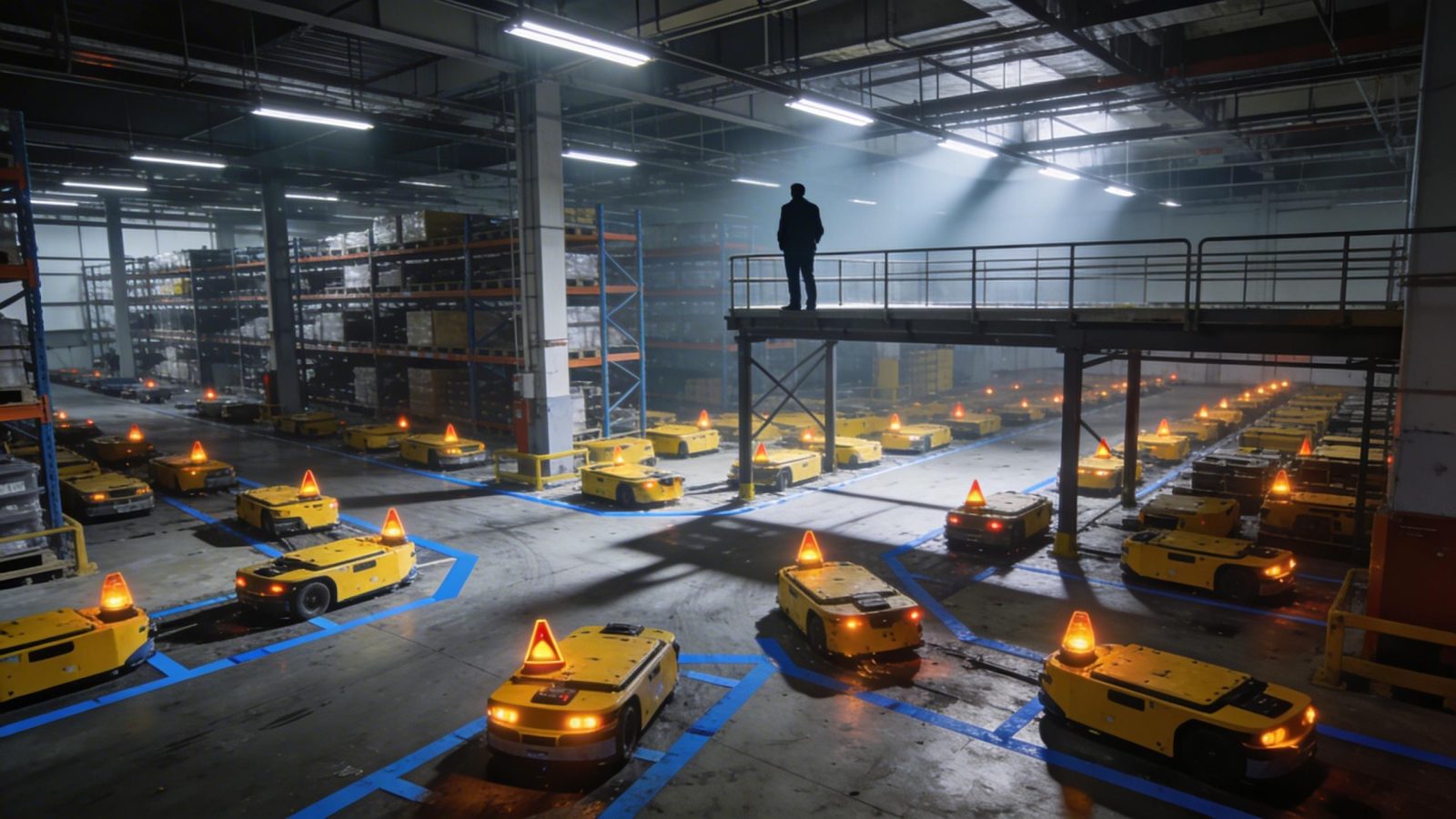
Warehouse automation is a good test case for practical AI: the problems are measurable, but the operating environment is messy. Research can show a better coordination method, while adoption still depends on integration, cost, and trust on the warehouse floor.
- AI can help coordinate routing and congestion when many robots or workers share the same space.
- A strong research result does not automatically mean a production-ready system.
- For companies, the key metrics are downtime, safety, throughput, and deployment complexity.
For more context, see the AI at Work section.
The 25% gain requires a training investment most warehouses can’t afford
MIT’s March 26 announcement coordinates hundreds of robots in real-time by learning priority rules through simulation. Feed it your warehouse layout, let the neural network train on millions of virtual scenarios, deploy. Simple in theory.
In practice? “Training it on our weird layouts takes forever,” one warehouse engineer reportedly complained on Hacker News in late March. The system adapts to varying robot counts and floor configurations, but that flexibility comes at a cost—you can’t train once and deploy everywhere unless your facilities are identical. This pattern mirrors broader AI deployment gaps across industries: lab performance rarely translates to production timelines.
The research team demonstrated 25 robots operating simultaneously without collisions. Impressive for a controlled demo. But most warehouses run 50 to 200 robots, and the simulation training scales exponentially with complexity. MIT hasn’t released training duration benchmarks for real-world facilities.
Hybrid architecture explains the performance—and the problem
The system’s name is DeepXube, though MIT’s press materials barely mention it. The architecture splits the workload: classical algorithms handle deterministic pathfinding (getting from Point A to Point B), while a neural network trained via reinforcement learning fundamentals decides which robot gets priority when routes conflict.
That division of labor is why it works. Pure AI approaches struggle with the combinatorial explosion of possible robot movements—too many variables, not enough training data. Pure classical algorithms can’t adapt to changing warehouse conditions in real-time. The hybrid model uses parallel CPU data generation and GPU reinforcement learning updates to learn heuristics that classical planners can’t discover on their own.
But training requires both CPU clusters for simulation and GPUs for neural network updates. According to the MIT-Mecalux study from November 2025, businesses now dedicate 11% to 30% of warehouse tech budgets to AI and machine learning, with typical payback periods of two to three years. DeepXube’s compute requirements fit that investment range—if you’re Amazon or Walmart with standardized layouts.
If you’re not? The math gets ugly fast.
Amazon wins, everyone else waits
Uniform, high-volume facilities could theoretically train once and deploy across dozens of identical warehouses. Train the neural network on one Amazon fulfillment center’s layout, replicate it to 50 others. The training cost amortizes.
For the millions of robots already installed in non-standard warehouses—irregular aisles, legacy shelving systems, seasonal layout changes—every facility needs custom training. While autonomous manufacturing systems advance in controlled environments, warehouse retrofits face messier integration challenges. Dr. Matthias Winkenbach, Director of the MIT Intelligent Logistics Systems Lab, warned in the Mecalux study: “The hard part now is the last mile: integrating people, data, and analytics seamlessly into existing systems.”
Winkenbach’s warning highlights why AI implementation expertise now commands premium salaries—the technical gap is human, not algorithmic. You need engineers who understand both reinforcement learning and warehouse operations. Those people are expensive and scarce.
Six weeks after MIT’s announcement, zero logistics companies have publicly committed to deployment. No pilot programs announced. No partnerships confirmed. The silence is louder than the 25% throughput gain.
The breakthrough isn’t in question. The business case is.