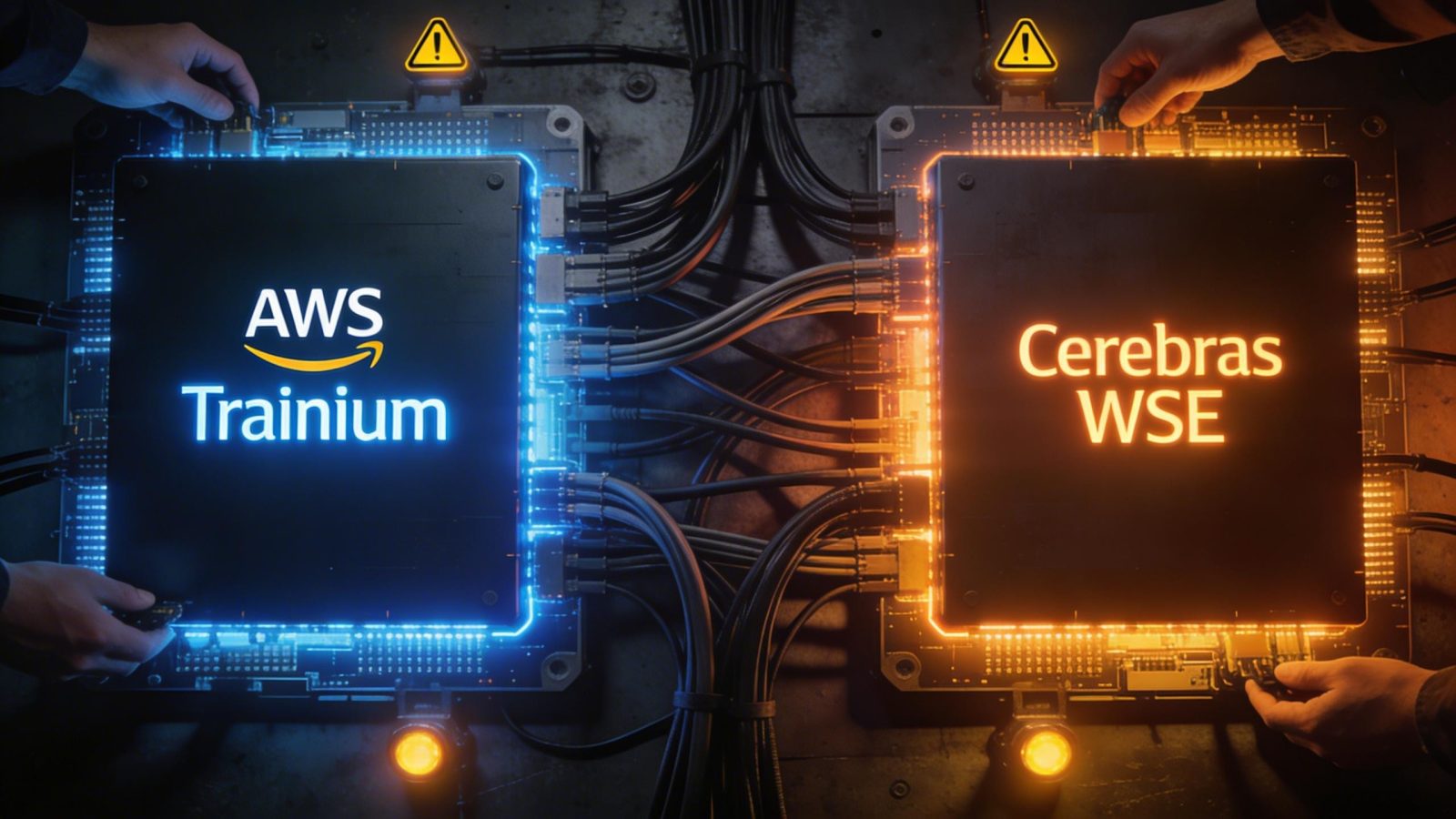
Cerebras Systems deployed CS-3 chips on AWS Bedrock for AI inference on March 16, 2026, promising 5x faster token throughput via disaggregated architecture. The speed comes with a cost: developers must now architect around hardware limitations instead of building what users need.
The announcement lands six months before the service actually ships—H2 2026 availability means competitors have time to close the gap through software. And the 5x claim isn’t a single breakthrough. It’s the result of splitting inference workloads across two different chip types, forcing teams to manage complexity that GPU-based systems handle invisibly.
That’s the real story here. Cerebras isn’t just faster—it’s fundamentally different in a way that matters for anyone building real-time AI agents.
The 5x speed claim requires splitting your AI workload in half
The disaggregated setup pairs AWS Trainium chips for prefill (processing the prompt) with Cerebras Wafer Scale Engine for decode (generating output tokens). Traditional GPU deployments run both tasks on the same hardware. Simple. Cerebras forces you to orchestrate two processors with different architectures, different memory systems, different failure modes.
According to Cerebras, the WSE handles decode at 3,000 tokens per second for workloads from OpenAI, Cognition, and Meta—versus hundreds on GPUs. That’s real. But it only works if your application can cleanly separate prefill from decode and handle the handoff between Trainium and WSE without introducing new latency.
“Inference is where AI delivers real value to customers, but speed remains a critical bottleneck,” David Brown, VP of Compute & ML Services at AWS, said in a statement. “What we’re building with Cerebras solves that… The result will be inference that’s an order of magnitude faster.”
Order of magnitude. That’s the pitch. The catch is that most development teams don’t have the engineering resources to rebuild their inference pipelines around disaggregated hardware.
While Cerebras chases speed, the real race is efficiency
Software improvements are outpacing hardware announcements. GPT-5.4 shipped as OpenAI’s most efficient frontier model for reasoning and coding just days after GPT-5.3 launched in early March 2026. Model architecture gains—not faster chips—are what’s actually democratizing AI access right now.
The six-month gap between Cerebras’ announcement and actual service availability gives competitors runway. Moor Insights & Strategy notes that traditional GPU deployments simplify infrastructure design precisely because they don’t force architectural splits. While Cerebras builds custom pipelines, software efficiency gains are making existing hardware go further.
Rough.
And there’s a bigger problem: voice-driven interfaces and agentic coding assistants need sub-second latency, but most teams lack the engineering resources to manage disaggregated inference pipelines. The promise of plug-and-play AI is colliding with hardware that demands bespoke integration work.
SRAM’s speed advantage creates a new memory bottleneck
Cerebras built the WSE around on-chip SRAM—massive bandwidth, limited capacity. That’s the architectural trade-off. SRAM delivers the throughput needed for decode-heavy workloads, but it can’t hold the multi-billion-parameter models that power frontier reasoning tasks. You get speed at the cost of memory constraints that GPU-based systems don’t face.
Disaggregated setups also raise integration costs. AWS announced pay-as-you-go Bedrock access—no hardware management required—but coordinating Trainium and WSE workloads isn’t free. Someone has to build the orchestration layer, monitor dual-chip performance, debug failures that span two architectures.
AWS hasn’t announced per-token pricing as of March 22, 2026. That makes ROI calculations impossible. Teams can’t compare Cerebras costs to GPU alternatives because the numbers don’t exist yet. Launch is six months out and the economic case remains unproven.
Cerebras isn’t alone in fragmenting the market—Nvidia’s specialized chip strategy suggests the entire industry is moving toward use-case-specific hardware. But that fragmentation creates a new problem: developers choosing between systems optimized for speed and systems they can actually maintain.
Cerebras bet on throughput. Nvidia bet on versatility. The AI agent revolution promised to simplify work. The hardware war just made it more complex.