

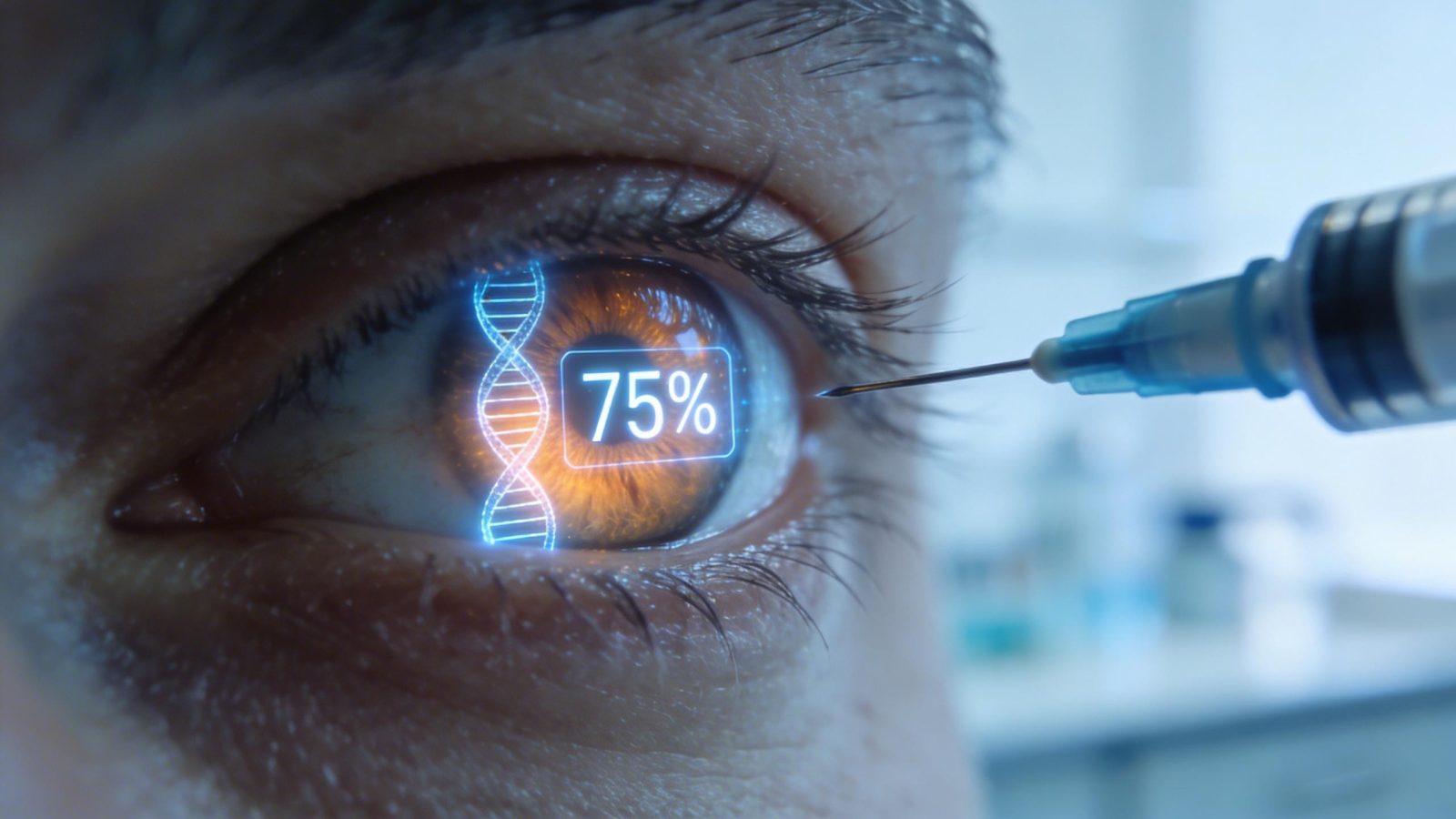
Life Biosciences just started dosing the first humans with ER-100, a gene therapy designed to reverse cellular aging in the eyes of patients going blind. The FDA cleared the trial in early March 2026. First patient got the injection weeks ago.
This isn’t another longevity supplement or lifestyle hack. It’s partial epigenetic reprogramming—using three of the four Yamanaka factors (OSK: Oct4, Sox2, Klf4) to rewind cells to a younger biological state. The same technology that won Shinya Yamanaka a Nobel Prize in 2012, now being tested in humans for the first time. David Sinclair, the Harvard geneticist who co-founded Life Biosciences, posted “It’s happening…” on Facebook in February. CEO Mehmood Khan called it “a transformational day for science” when the FDA clearance came through in January.
By December 2026, we’ll have topline safety data. That’s when we find out if Sinclair’s 30-year bet was real or just hype with better credentials.
The first patients are going blind anyway—and they know it
Life Biosciences didn’t pick NAION (non-arteritic anterior ischemic optic neuropathy) patients because the science is ready. They picked them because they’re desperate enough to be first. NAION is a “stroke of the eye”—sudden, permanent vision loss with no approved treatment. Patients face the risk of losing their second eye within a few years, and there’s nothing doctors can do except watch.
The trial protocol enrolls up to 18 participants total: 12 with open-angle glaucoma for dose escalation, then 6 NAION patients in the expansion phase. Single dose of ER-100. Fourteen clinic visits over five years. The first “sentinel” patient at each dose level gets monitored for 28 days before the next cohort starts—staggered intervals to catch safety signals early.
These aren’t volunteers in a typical trial. They’re people betting on a technology that joins the long list of medical breakthroughs that sound inevitable until you read the fine print.
75% isn’t a starting point—it’s the finish line
Here’s the part nobody wants to say out loud: partial reprogramming has a ceiling. And it’s 75%.
Full Yamanaka factor reprogramming uses four transcription factors—OSKM (Oct4, Sox2, Klf4, plus c-Myc). It rewinds cells all the way back to “age zero,” creating induced pluripotent stem cells. Those cells can become anything. Including tumors. The fourth factor, c-Myc, is a known oncogene. Push cells too far, and you get teratomas—benign tumors made of teeth, hair, and scrambled tissue.
So Life Biosciences uses three factors instead of four. OSK without the M. Preclinical data in mice and monkeys showed this partial approach restores DNA methylation patterns and reverses biological age markers in eye tissue without triggering cancer. But it stops at roughly 75% reversal by design. That’s not a floor they’re trying to exceed—it’s a ceiling they deliberately won’t cross.
While AI-designed therapies have collapsed drug development timelines from years to months, aging research remains stuck on a problem no algorithm can solve: how to reverse cellular age without triggering cancer. Even if ER-100 works perfectly in humans, whole-body rejuvenation is off the table until someone figures out how to safely cross that 75% threshold.
December 2026 answers one question—and raises a dozen more
Topline safety data by year-end only tells us if ER-100 is safe enough to keep testing. It doesn’t tell us if vision improves. It doesn’t tell us if effects last. And it definitely doesn’t tell us if delayed cancer shows up in year three.
The five-year follow-up means we won’t have real efficacy or long-term safety data until 2031. Like early adopters discovering limitations in overhyped software, the first ER-100 patients may find the gap between “reverses aging” and “might restore some vision in one eye” wider than the press releases suggest. And even if it works, scaling from 18 patients to millions requires manufacturing partial reprogramming factors at pharmaceutical grade—something no one has done yet.
The catch isn’t just that NAION patients are getting a treatment that might save one eye while the other goes blind. It’s that the trial’s design—staggered dosing, small cohorts, long follow-up—means the first real answers won’t arrive for years. Dosing starts in March, data trickles in by December, but the question of whether partial reprogramming actually works in humans? That’s a 2031 problem.
The first human data arrives in nine months. The question isn’t whether partial reprogramming works—it’s whether 75% of your youth back is enough when the other 25% might kill you.
