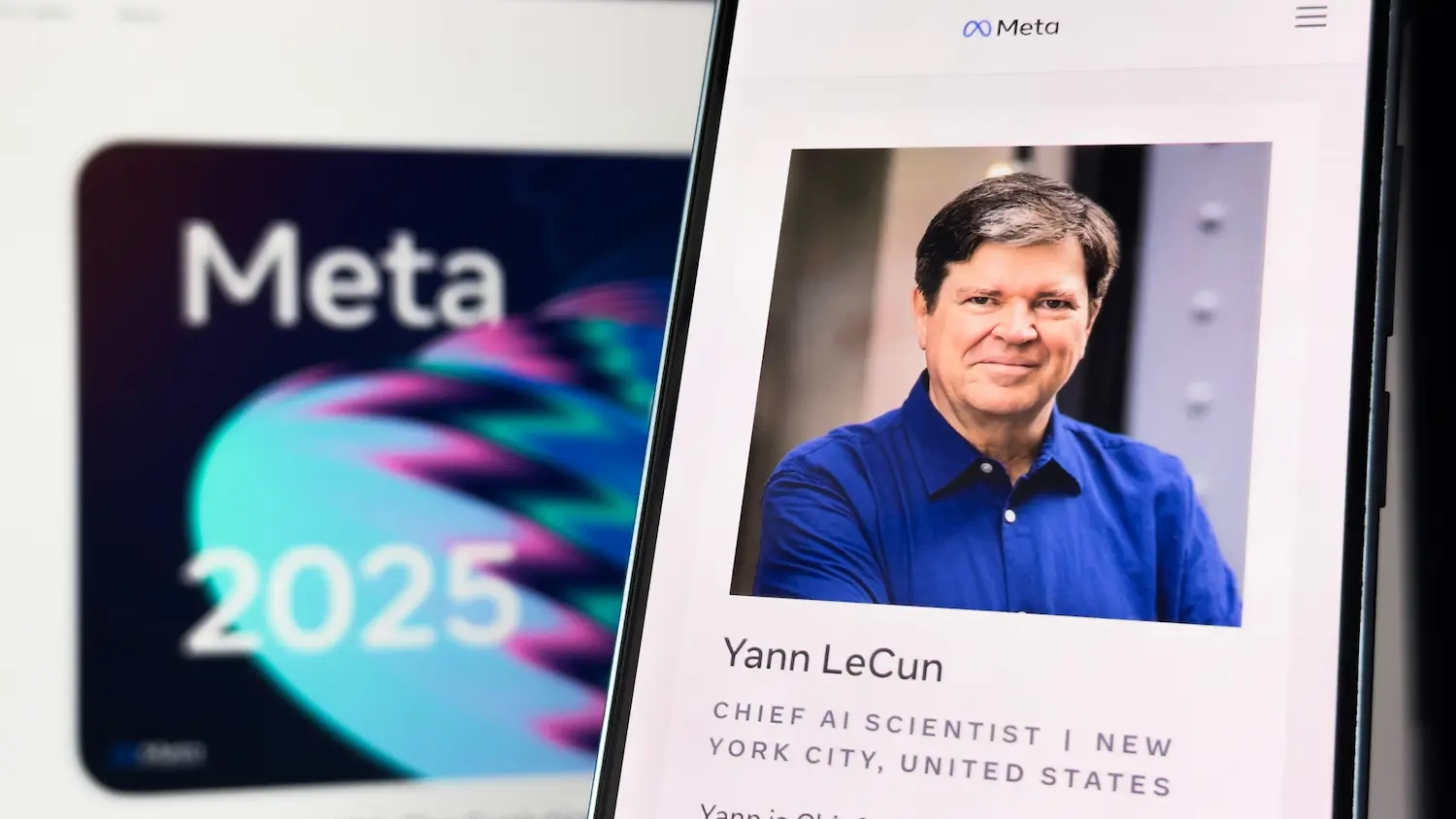
While most of the artificial intelligence industry focuses on improving chatbots and language models, one of the field’s most influential researchers is pursuing a radically different vision.
Yann LeCun, the French AI scientist and co-recipient of the 2018 Turing Award — often described as the Nobel Prize of computing — has raised $1 billion (890 million euros) for his new startup AMI. The company, valued at €3 billion before the funding round, aims to develop a new generation of artificial intelligence capable of understanding the physical and real world.
The investment marks the beginning of what LeCun himself describes as the next revolution in artificial intelligence, one that moves far beyond today’s conversational systems.
A Massive Funding Round Backed by Global Tech Leaders
The fundraising attracted some of the most powerful names in technology and industry. Major corporations including Toyota, Nvidia, and Samsung joined the round, alongside prominent technology figures such as former Google CEO Eric Schmidt and Amazon founder Jeff Bezos.
French President Emmanuel Macron praised the announcement on X, calling the project a symbol of “France’s researchers, builders and bold innovators.”
The startup, headquartered in Paris, already operates additional offices in New York, Singapore, and Montreal.
A Radical Vision: AI That Understands the Physical World
LeCun’s ambition is not to build a better chatbot. Instead, he wants to create AI systems capable of understanding the physical world itself.
“The objective is to build artificial intelligence that understands the physical world, the real world,” LeCun explained in an interview with AFP.
His approach focuses on creating models that reason from many different types of data rather than relying mainly on language.
The goal is to develop AI systems that learn and interpret reality in a way closer to how animals and humans understand their environment.
A Voice Against the Current AI Consensus
For years, LeCun has been one of the most prominent critics of generative AI systems built around large language models (LLMs), the technology behind tools like ChatGPT or Gemini.
According to the French researcher, systems trained primarily on text face fundamental limitations when it comes to understanding how the real world works.
This disagreement eventually pushed him to leave Meta after twelve years, as the company increasingly focused its strategy on developing large language models.
Despite this strategic divergence, LeCun says he remains on good terms with Meta CEO Mark Zuckerberg.
“I am clearly in the camp of a paradigm shift,” he said.
Building AI Based on “World Models”
The research pursued at AMI builds on LeCun’s earlier work at Meta around a new AI architecture known as JEPA.
These systems are part of a broader approach often referred to as “world models” — AI systems designed to model, predict and understand complex real-world processes.
Unlike traditional language models, these systems aim to reason using diverse data sources rather than text alone.
The ambition is to create machines capable of analyzing and predicting complex processes such as the functioning of an aircraft engine, a power plant, or even biological processes in a human organ.
A Roadmap Toward Universal Intelligent Systems
According to the company’s roadmap, the first year will focus primarily on research and development.
Discussions with industrial partners are expected within six to twelve months, paving the way for early industrial applications.
Within three to five years, AMI hopes to develop what LeCun describes as “somewhat universal intelligent systems”.
Such systems could power a wide range of technologies that require machines capable of understanding and interacting with the real world, including autonomous driving and robotics.
A Small Team With Global Ambitions
The company is still at an early stage but is rapidly expanding its team.
According to LeCun, the startup currently expects to reach between 20 and 30 employees in the near term.
AMI’s leadership structure includes LeCun as non-executive chairman, while Alexandre Lebrun, former executive at the French health startup Nabla, serves as the company’s CEO.
The Ethical Question Behind the Next Generation of AI
Despite the ambitious technological vision, LeCun stresses that the future use of such systems should not be determined solely by engineers or technology companies.
“There are things that we should obviously forbid,” he said.
According to the researcher, decisions about how artificial intelligence should be deployed must ultimately be made by society and democratic institutions.
As the global AI race accelerates, AMI’s billion-dollar bet represents something rare in today’s landscape: a fundamental attempt to rethink how machines learn, reason, and understand reality.
If LeCun’s approach succeeds, the next major breakthrough in artificial intelligence may not come from more powerful chatbots—but from machines capable of understanding the world itself.