

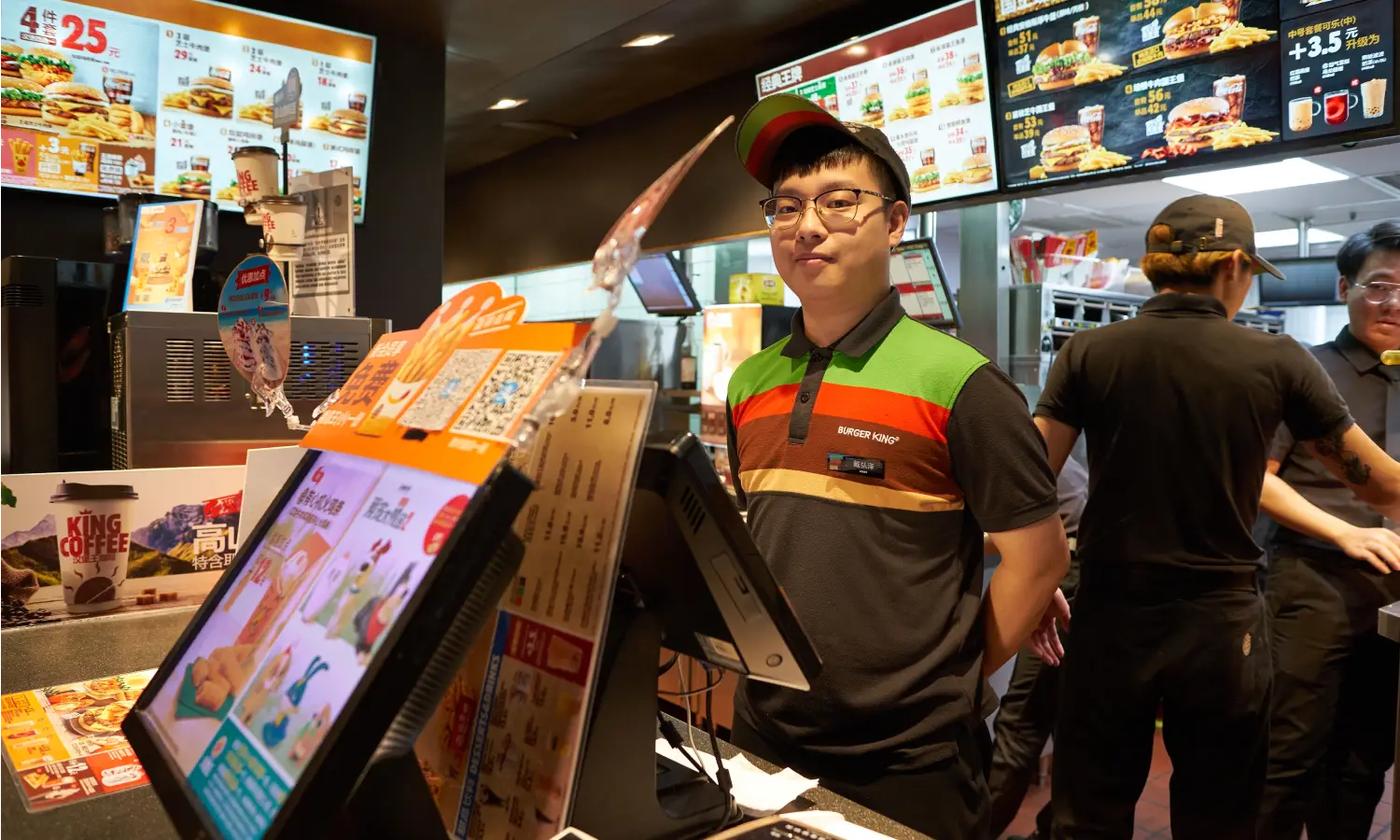
Burger King has begun testing a new AI assistant called Patty, integrated directly into employees’ headsets. While the technology is designed to support daily operations, one feature is drawing attention: the system listens to drive-thru conversations and tracks how polite staff interactions are.
The key news: AI is measuring “friendliness” at the drive-thru
Patty is trained to detect specific customer-service phrases such as “Welcome to Burger King”, “Please”, and “Thank you”. The goal is to generate a “friendliness score” that managers can use to understand how consistently teams deliver courteous service.
According to Burger King’s leadership, the tool is intended for coaching and performance improvement, not surveillance. In practice, however, it represents a shift from occasional human feedback to continuous, data-driven measurement of real customer interactions.
More than monitoring: Patty is also an operational assistant
The system is not only focused on language analysis. Patty functions as a real-time support tool that employees can query without leaving their station. Staff can ask about product preparation, ingredient quantities, cleaning procedures, or equipment instructions.
Patty is connected to a broader digital ecosystem that includes inventory levels, kitchen equipment status, cloud-based POS data, and menu displays. If an item runs out, updates can be pushed across ordering systems and digital boards within minutes, helping restaurants stay synchronized during peak hours.
Why the rollout is controversial
The debate isn’t about operational efficiency. It’s about what happens when every interaction becomes data. Even if framed as coaching, the technology introduces a new type of performance indicator: emotional and behavioral metrics such as politeness and customer tone.
Burger King is already exploring ways to analyze voice tone in addition to keywords. That could move the system beyond “Did you say thank you?” to a more subjective question: Did you say it with the right attitude?
At that point, the AI is no longer measuring tasks—it’s evaluating human behavior.
Deployment plans and scale
The rollout is happening in phases. Patty is currently being piloted in approximately 500 restaurants. A broader digital assistant platform—accessible via web and mobile—is expected to expand across U.S. locations, with a wider deployment targeted by the end of 2026.
Interestingly, Burger King is taking a cautious approach to fully automated AI ordering at the drive-thru. Fewer than 100 locations are testing full AI ordering, with executives acknowledging that many customers are still not comfortable interacting exclusively with machines.
In other words, customers may not be ready for fully automated service—while employees are already adapting to AI in their headsets.
Efficiency gains vs. workplace pressure
From an operational perspective, the benefits are clear: faster access to information, fewer mistakes, better inventory coordination, and more consistent service. In high-volume restaurants, even small efficiency gains can have a significant impact.
But the human impact is less certain. Some employees may appreciate real-time support and clearer expectations. Others may feel uncomfortable knowing their interactions are continuously analyzed, especially if courtesy metrics become part of performance evaluations.
The outcome will depend largely on how the data is used—and how transparent the system is.
The bigger shift behind Burger King’s AI
Patty is presented as a tool to improve hospitality. But the broader implication goes further. This is part of a new phase of AI-augmented management, where technology doesn’t just automate tasks—it measures and standardizes human behavior.
The key question isn’t whether the technology works. It’s whether customers experience better service—or whether workplaces move toward algorithmic standardization of human interaction.
Key takeaways
- Burger King is testing Patty, an AI assistant integrated into employee headsets.
- The system detects phrases like “please” and “thank you” to measure friendliness.
- Patty also provides real-time operational support for recipes, equipment, and inventory.
- The pilot covers about 500 restaurants, with broader U.S. expansion planned by 2026.
- The debate centers on whether the technology enables coaching—or continuous behavioral monitoring.
