

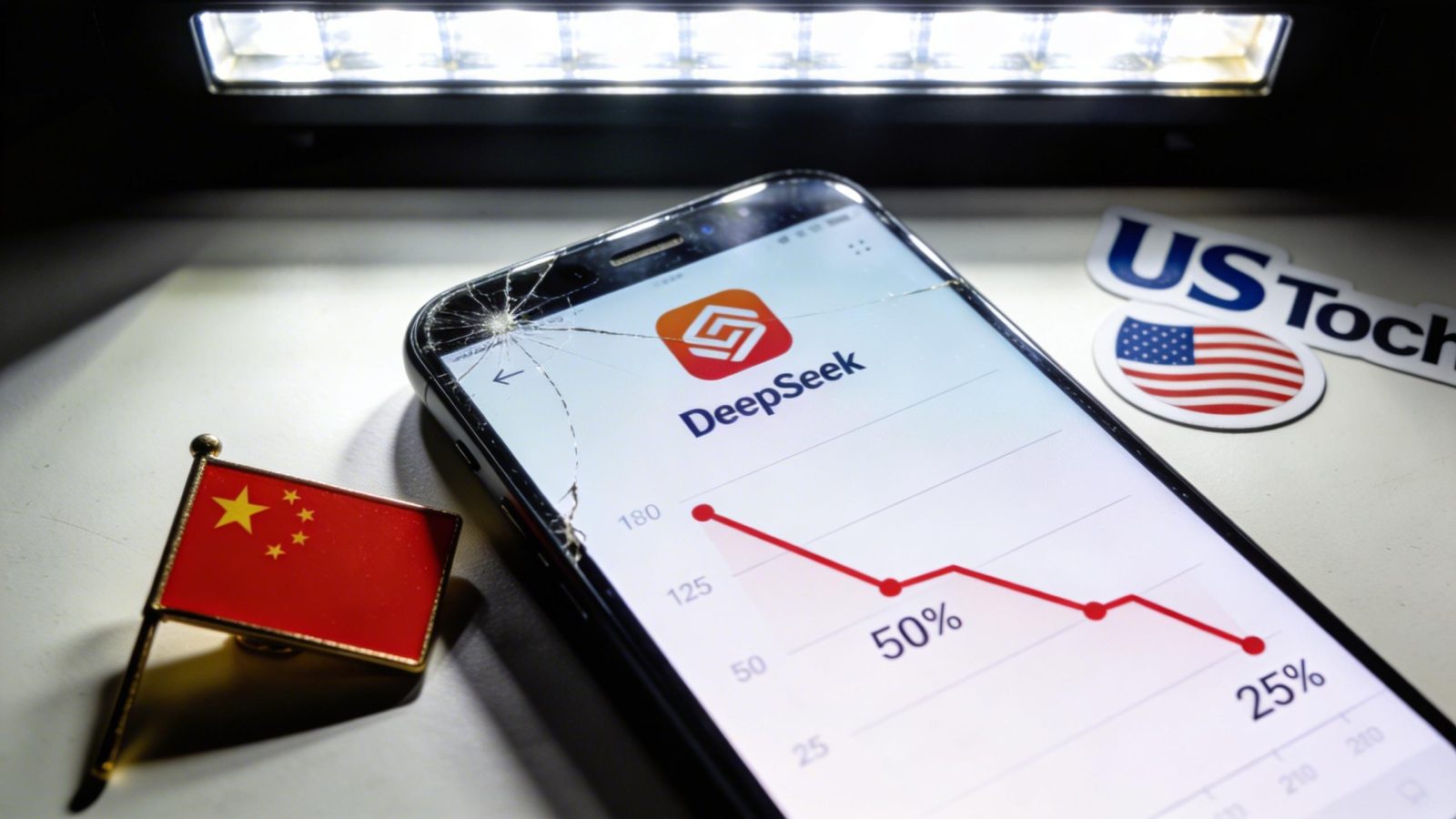
DeepSeek’s market share in China collapsed from 50% to under 25% between early and late 2025, according to Economic Times data. Not because the tech failed — because Chinese users learned what US developers are about to discover: cheap AI from China-based servers comes with reliability problems Western media ignored while crowning it the ChatGPT killer. Now DeepSeek V4 targets a mid-February 2026 launch with benchmarks claiming 80%+ SWE-bench coding scores at radically lower costs, and the question isn’t whether it’ll work — it’s whether US teams can afford to bet production systems on infrastructure they don’t control.
Here’s why this matters right now: DeepSeek V4 isn’t trying to win China anymore. It’s trying to force American developers into an impossible choice between their budgets and their compliance officers.
DeepSeek V4’s cost advantage has a geopolitical price tag
The economics look brutal for Western AI labs. Internal benchmarks claim V4 delivers strong coding performance at inference costs 10-40x lower than US rivals, with a 1M token context window that handles entire codebases. Runs on dual RTX 4090s for self-hosting. Apache 2.0 licensing means the weights are yours if you want them.
But Italy already banned DeepSeek R1 over data security concerns, EU GDPR scrutiny is mounting, and most developers won’t self-host — they’ll use the API, which means proprietary code flows through China-based servers with 150-200ms latency. For any team handling customer data or regulated information, that’s not a cost savings. That’s legal exposure.
The 80%+ SWE-bench claim suggests software engineers aren’t safe from automation, but only if developers trust the model enough to deploy it. Italy’s data security ban on DeepSeek R1 isn’t an isolated incident — it’s the opening move in a geopolitical fragmentation that could make America lose the AI war even with technical superiority.
The hype cycle already collapsed once — in China
DeepSeek R1 already matched ChatGPT’s performance at 96% lower cost, but Chinese users abandoned it anyway. Market share fell from 50% to under 25% even as China’s AI market posted >30% growth forecasts for 2026. That’s not a technical failure — it’s an infrastructure failure.
Developers on Verdent AI warned each other: “Build fallback logic now — rate limits hit 20 req/min on Day 0.” Scarce H200 GPUs make self-hosting a fantasy for most teams, and China’s chipmaker is maxed out making chips for data centers that sit empty. The country’s >30% AI market expansion looks impressive until you realize DeepSeek lost share in a booming market.
Western developers are ignoring this. They see the cost advantage and assume the reliability will follow.
It won’t.
Apache 2.0 weights don’t fix the trust problem
Open-source licensing sounds like a solution until you realize most teams will choose the API over self-hosting dual RTX 4090s. That means data flows through China-based servers, and for production systems with real liability, that’s a non-starter. The real cost isn’t the API fee — it’s the legal review, the compliance audit, the fallback infrastructure when rate limits hit during a product launch.
This model is perfect for hobbyists and side projects. Dangerous for anything that matters.
And the 150-200ms latency from China servers? That’s not catastrophic for batch processing. But for real-time code completion, for chatbots that need to feel responsive, for any developer experience that competes with Claude or GPT? It’s a UX tax users will notice immediately.
DeepSeek V4 will launch, the benchmarks will probably hold up, and Western AI labs will have to cut prices or lose market share. But the developer ecosystem is splitting — not because of technical quality, but because trust became infrastructure. The question isn’t whether DeepSeek V4 works. It’s whether you can afford to find out it doesn’t — after you’ve already shipped it to production.
