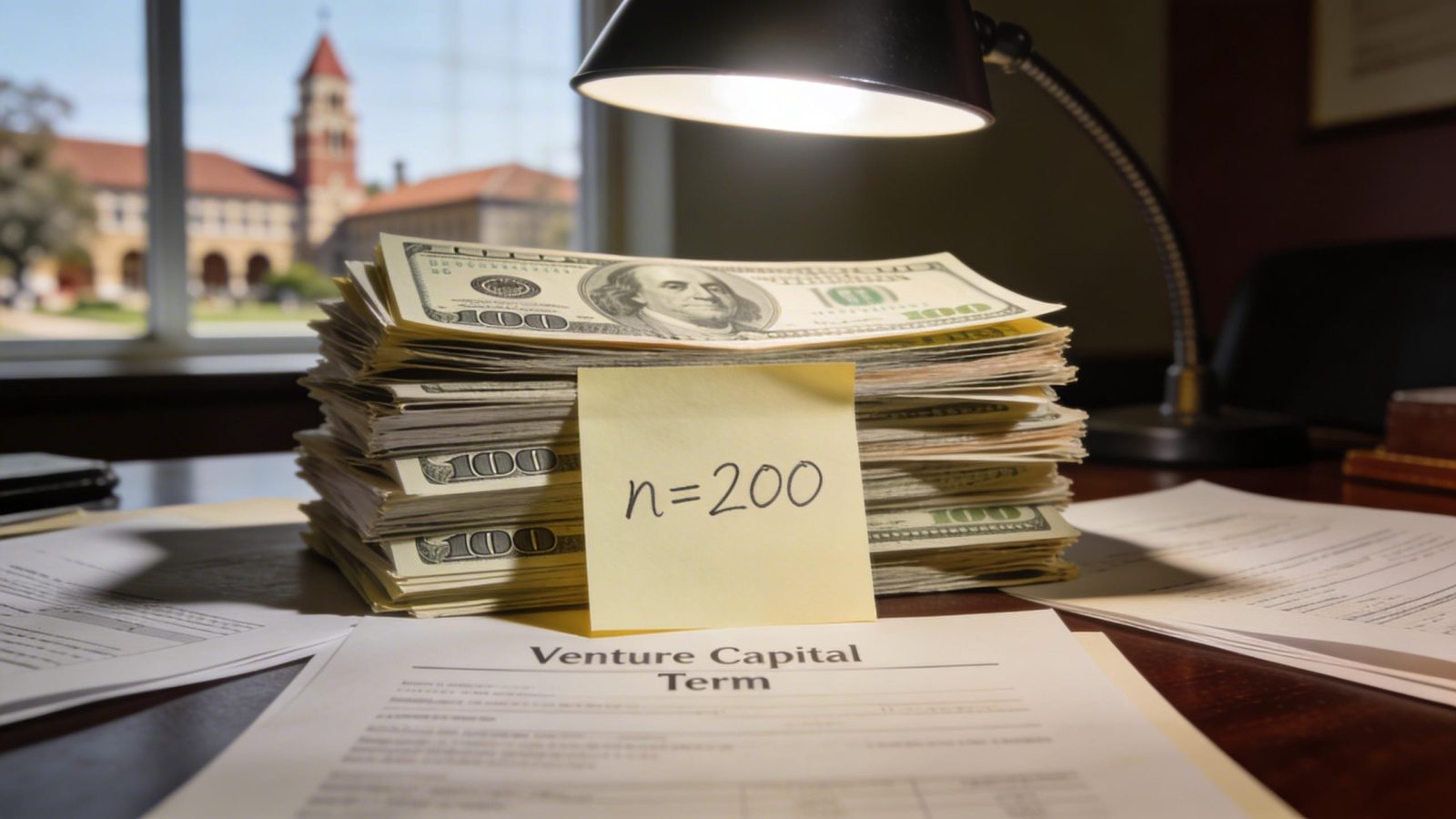
Stanford AI legends just raised $100 million to predict how millions of consumers will behave—using a training set of hundreds of interviews. The training data wouldn’t pass peer review in a college statistics class.
Simile emerged from stealth on February 12, 2026, backed by Fei-Fei Li (ImageNet co-author) and Andrej Karpathy (Tesla Autopilot architect), with funding led by Index Ventures. When those names attach to an AI startup, technical credibility is assumed. But market research isn’t computer vision. And the gap between the founders’ résumés and the methodology they’re selling is where this story lives.
This is a bet that synthetic focus groups can replace a $50 billion market research industry—and enterprises are signing checks before anyone’s published accuracy data.
The $100M bet on a sample size that breaks every research rule
Traditional focus groups require 6-8 groups of 8-12 people per demographic segment—minimum. Nielsen demands 1,200+ respondents for national consumer studies. Simile spent seven months in stealth training AI agents on “hundreds” of real interviews, then started selling those synthetic personas to enterprises as predictive oracles.
The math doesn’t work.
Behavior prediction at scale requires statistical validity—sample sizes large enough that outliers don’t skew the model, demographic coverage broad enough to capture regional and cultural variation, longitudinal data to separate trends from noise. Simile’s training set is smaller than a single traditional focus group study. Yet CVS Health is testing the platform for store stocking decisions—product placement bets worth millions if the predictions are wrong.
There’s no published validation. No accuracy benchmarks. No peer-reviewed methodology. No disclosed results from CVS, Telstra, or Banco Itau—the other named customers. The Gallup partnership Simile announced? Waitlist-only. Even Gallup hasn’t validated this at scale yet.
This follows a pattern of massive AI bets on unproven technology, where investor FOMO trumps due diligence. And market research analysts—already on the list of AI-threatened professions—now face synthetic competitors trained on sample sizes they’d reject in peer review.
Why enterprises are paying more for less proven data
Here’s the pricing inversion nobody’s talking about. Traditional focus groups cost $20,000-$50,000 per project and take 4-8 weeks. Simile charges an estimated $100,000-$250,000 per year for enterprise access—demo-only, no self-serve option.
At low volumes, you’re paying more for synthetic data with zero validation.
Competitor Ditto claims 92% overlap with traditional focus groups across 50+ parallel studies—the only published validation data in this space. Simile? Nothing. It’s the enterprise version of adopting AI tools without validation because the fear of falling behind outweighs the risk of bad data.
The market’s already fragmenting. Self-serve synthetic tools charge $2-$27 per respondent. Mid-market platforms like Quantilope start at $22,000/year. Ditto offers unlimited studies for $50,000-$75,000/year—meaning at 50 studies per month, you’re paying $83-$125 per study versus Simile’s $167-$417.
Enterprises aren’t buying better data. They’re buying the promise of speed and a brand built on Stanford pedigree.
The honest trade-off nobody’s talking about
Simile might get some things right. Speed: synthetic interviews in hours versus weeks. Scale: unlimited “respondents” without recruitment logistics. Cost efficiency at high volumes—if you’re running hundreds of studies per year, the per-study economics improve.
But here’s what you’re gambling on: synthetic personas that reflect real human irrationality. No way to verify if the AI captures the cognitive biases, emotional triggers, and cultural nuances that drive actual purchasing decisions. No published failure cases. No independent audits.
For low-stakes decisions—packaging colors, ad copy tweaks—maybe the risk is acceptable. For high-stakes bets like new product lines or market entry strategies, you’re staking millions on a black box. And recent studies show AI fails at real work when deployed without proper testing—but Simile’s enterprise customers won’t know until after the product launch bombs.
The Gallup partnership is still in waitlist mode. The enterprise pricing locks you in before you can test reliability at scale. And the training data—”hundreds” of interviews—remains smaller than the sample size required for a single statistically valid consumer study.
Nielsen requires 1,200+ respondents for national studies. Simile raised $100 million on hundreds. That’s the whole pitch.