

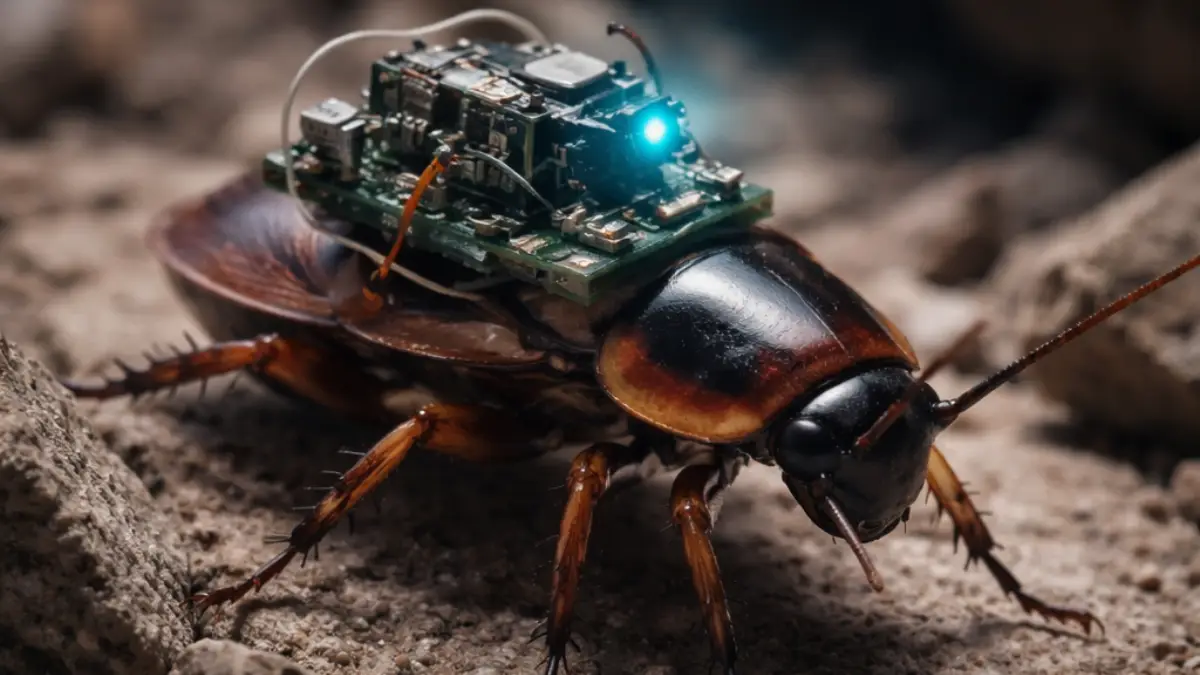
Tiny backpacks, live cockroaches, and cutting-edge artificial intelligence—this scenario may sound straight out of science fiction, yet these biorobots are quickly moving from SWARM BIOTACTICS‘s laboratory experiments to real-world missions.
By merging biology with advanced technology, researchers and security experts are reimagining how living creatures can be enlisted for exploration and surveillance.
How do cockroach cyborgs actually work?
Transforming an ordinary insect into a sophisticated tool for data collection or reconnaissance involves far more than clever gadgetry. Engineers fit compact devices onto the backs of cockroaches, ensuring that these systems allow the insect to move unimpeded.
Each tiny backpack houses micro-sensors for environmental data gathering, neural stimulation circuits to guide movement, and secure communication modules for relaying information back to human operators.
These technological innovations take advantage of cockroaches’ remarkable abilities: slipping through narrow crevices, surviving in hostile environments, and navigating complex spaces where conventional robots would fail. Thanks to artificial intelligence, these enhanced insects can respond to real-time commands while autonomously avoiding obstacles.
What makes augmented cockroaches valuable for hard-to-reach places?
Traditional drones and ground robots often face significant challenges—short battery life, excessive noise, bulky designs, or the inability to maneuver through rubble or dense vegetation. Cockroach cyborgs sidestep many of these issues by uniting the strengths of biology with intelligent technology.
- Silent operation across unstable or debris-filled terrain.
- Exceptional durability and natural resistance to harsh conditions.
- Lower costs compared to deploying traditional robotic units.
- The ability to access dangerous or inaccessible areas where electronics might fail.
Another major advantage is swarming behavior. Coordinated groups of cockroach cyborgs can fan out over large zones, collect diverse sets of data at the same time, and adapt if one unit stops functioning. This flexibility unlocks new scenarios where conventional machines simply cannot compete.
Potential uses far beyond espionage
While surveillance is often the first application that comes to mind, the potential of cockroach cyborgs extends well beyond spying. Their resilience and agility make them promising candidates for disaster response and scientific research.
Rescue operations after natural disasters
In the aftermath of earthquakes or explosions, searching for survivors is both perilous and complex. Augmented cockroaches, steered by remote teams or algorithms, can slip beneath rubble, transmit audio signals or gas readings, and help locate trapped individuals. This rapid, unobtrusive scouting offers rescuers precious time and increases the likelihood of successful outcomes.
Unlike heavy equipment, which risks causing further collapses, these lightweight insects pose minimal threat to fragile structures. Their small size allows teams to assess stability and air quality before sending personnel inside.
Environmental monitoring and safety inspections
Engineers and scientists are increasingly turning to biohybrid systems for inspecting hazardous sites or exploring caves, collapsed tunnels, and contaminated areas. Outfitted with various sensors, cockroach cyborgs can measure chemical concentrations, temperature shifts, or atmospheric toxins—and instantly transmit this critical information.
Beyond safety applications, these innovative tools could transform how researchers study hidden ecosystems or monitor sensitive archaeological sites. With versatile sensors, a single swarm can track structural vibrations, humidity, and even capture images—all without the need for cumbersome equipment.
Challenges and ethical debates
Despite rapid technical progress, this emerging field faces serious questions. Guidance systems must be accurate enough not to harm the animal, sparking ongoing debate about the acceptable level of control over living beings. Critics raise concerns about bioethics and the risk of misuse—such as unchecked surveillance or privacy violations.
Regulatory frameworks have yet to catch up with these advances, creating a grey area around both civilian and military use. As investors from Europe, the United States, and other regions pour resources into scaling production and boosting operational readiness, public conversations lag behind on transparency, oversight, and animal welfare.
Future prospects for biohybrid robotics
Cockroach cyborgs mark only the beginning. Researchers are now exploring other species, aiming to combine biological flexibility with ever-smaller computing technologies. If current technical and ethical challenges are addressed, future swarms could include multiple species, expanded functions, and integration with larger autonomous networks.
| Feature | Cockroach cyborgs | Traditional robots |
|---|---|---|
| Navigation in confined spaces | Excellent | Limited |
| Durability in harsh environments | Very high | Moderate |
| Stealth capability | High | Low |
| Operational cost | Low | High |
| Ethical concerns | Significant | Minimal |
As geopolitical tensions rise and technology evolves at breakneck speed, biohybrid robotics are poised to play a pivotal role in fields ranging from rescue operations to defense. The coming years may witness not just machines mimicking living organisms, but also unprecedented partnerships between nature and code.
