

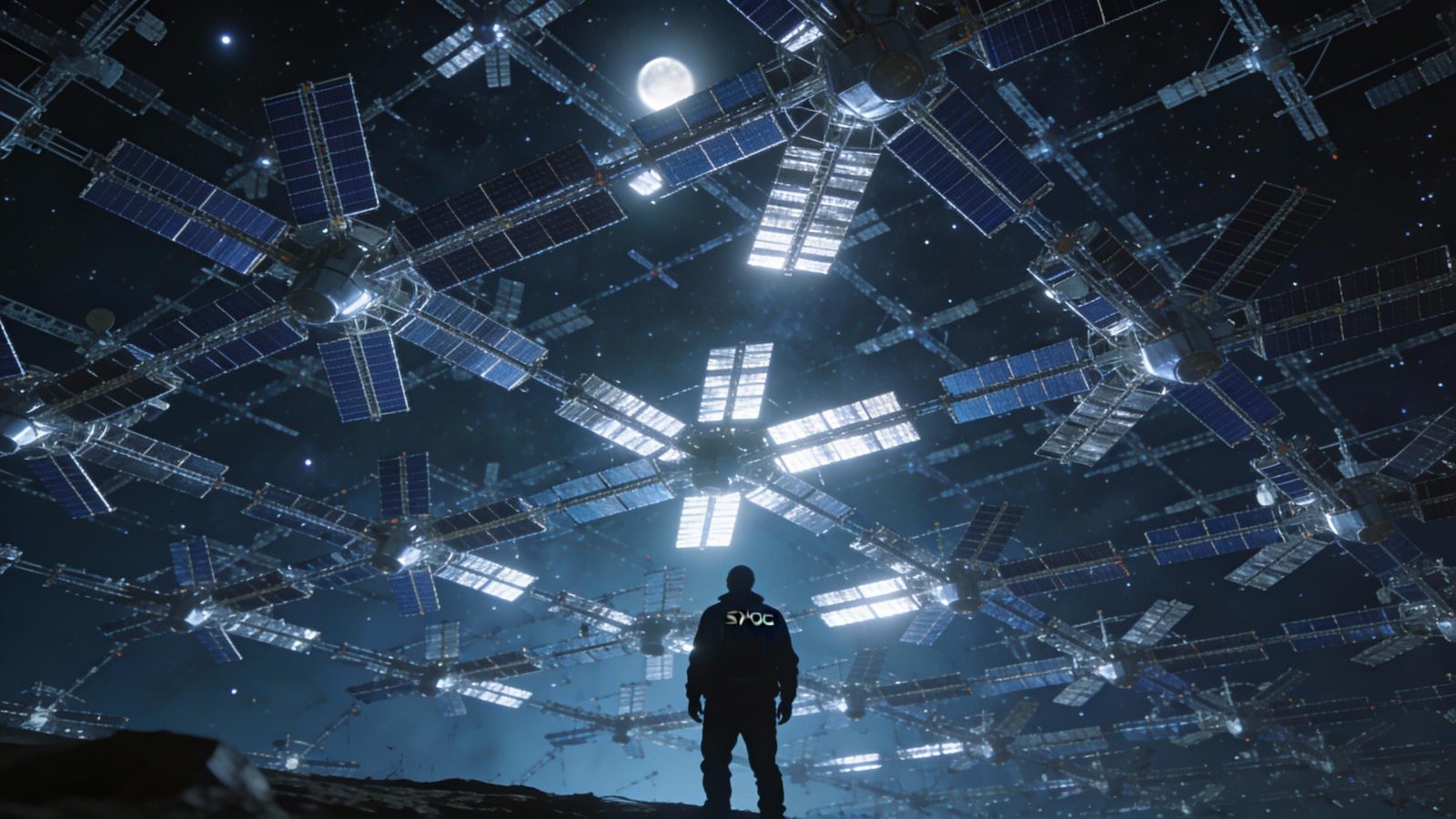
SpaceX just filed paperwork to launch more satellites than currently orbit Earth — not for internet, but to run AI in space because ground-based power is “too expensive.” The FCC request landed the same week xAI’s reported $1 billion monthly losses became public, and three months before SpaceX’s rumored mid-2026 IPO at a $1.25 trillion valuation. This isn’t about solving AI’s energy problem. It’s about making a cash-bleeding AI company look like inevitable infrastructure before going public.
xAI is burning $1 billion a month — and orbital compute is the narrative exit
The timing is too perfect. xAI reportedly loses $1 billion monthly running Colossus, an $18 billion supercomputer with 300,000 GPUs in Memphis. SpaceX files to launch 1 million satellites as “orbital data centers.” And suddenly the merger is worth $1.25 trillion — 37 times more satellites than Starlink’s current authorization of 27,000.
The FCC filing positions this as solving AI’s power crisis, but the real crisis is xAI’s balance sheet. Merging with SpaceX’s profitable launch business ($8 billion in annual operating income) turns a money pit into “critical infrastructure investment.” While other tech giants are cutting costs to fund AI bets, xAI is burning cash with no clear path to profitability — unless you count “merge with a rocket company” as a business model.
If this works, SpaceX becomes a monopoly controlling satellite internet AND AI compute. If it fails, public investors absorbed a $1.25 trillion bet on technology Google thinks won’t be viable until the mid-2030s — a full decade after Musk’s “two to three years” promise. This feels less like innovation and more like financial engineering with rockets.
The math doesn’t work even if launch costs collapse
Andrew McCalip, an independent analyst who modeled orbital versus ground-based compute, found orbital solar power costs $51.1 billion over five years versus $14.8 billion for boring natural gas data centers. That’s 3.5 times more expensive — and his model assumes $1,000/kg launch costs and ignores radiation shielding, latency penalties, and the fact that you can’t just walk into a server room 400 kilometers above Earth.
Google explored this exact concept and concluded it won’t be economically viable until the mid-2030s. The gap between Musk’s timeline and industry consensus isn’t a rounding error — it’s a decade, and it ignores the energy and infrastructure limits already forcing ground-based AI companies to rethink their entire approach.
SpaceX’s filing claims 100 gigawatts of annual AI compute capacity from launching 1 million tonnes of satellites per year. But Hacker News engineers are calling it “off by 50-100x” even with optimistic assumptions, because radiation-hardened processors are slower and more expensive than their ground equivalents. Meanwhile, the companies building AI infrastructure that actually works are investing in ground-based nuclear and natural gas solutions — not orbital fantasies.
The real cost no one’s pricing in
Even if the satellites launch, the hidden costs kill the economics. Radiation shielding alone adds $1.2 million per 40 megawatts (at 1 kg per kilowatt). Maintenance requires ISS-level servicing logistics. Latency adds milliseconds that make real-time AI training impractical. And every satellite eventually becomes space debris.
University of Michigan researcher Mojtaba Akhavan-Tafti warned that a single collision “could wipe out the entire cluster” through cascading impacts — the Kessler syndrome risk that already worries astronomers about Starlink’s 27,000 satellites, let alone 1 million. SpaceX’s current fleet of 9,000 satellites already has experts concerned about orbital congestion. A million satellites isn’t a data center strategy — it’s a traffic jam waiting to trap humanity on Earth.
This article isn’t anti-Musk. It’s anti-bad-math-dressed-as-vision. The engineering doesn’t support the timeline, and the economics don’t support the valuation.
If SpaceX’s IPO roadshow sells “orbital AI infrastructure” as the next inevitable platform — and public markets buy it at $1.25 trillion — what happens when the first cluster fails, or when ground-based nuclear data centers (already being built by Amazon and Google) deliver cheaper, faster compute without the rocket dependency? The real question isn’t whether space can host AI. It’s whether this story was designed to survive contact with physics, or just with investors.
