
The hype cycle around autonomous AI agents has cooled down in recent months.
After the initial wave of demos and viral experiments, many wondered whether tools like OpenClaw were practical—or just another short-lived trend.
A recent thread by Matt Van Horn suggests the answer may already be clear
Instead of theory or promises, the post documents very specific OpenClaw workflows that are live, running, and used daily, gathered from X, Reddit, and the wider web.
The result is less sci-fi and more operational: real agents doing real work, quietly.
Email and inbox automation at scale
Just shipped /last30days. A Claude Code skill for @claudeai that scans the last 30 days on Reddit, X, and the web for any topic and returns prompt patterns + new releases + workflows that work right now.
Last 30 days of research. 30 seconds of work.
👉 https://t.co/vywJV9IlXw pic.twitter.com/uB9Q2JNppw
— Matt Van Horn (@mvanhorn) January 25, 2026
One of the most common uses of OpenClaw today is inbox management. Several users report agents processing thousands of emails autonomously, unsubscribing from spam, categorizing messages by urgency, and drafting replies for review.
In one case, a user cleared over 4,000 emails in two days by letting an agent work overnight.
Another workflow combines Gmail access with credential management tools, allowing the agent to log into services without manual intervention.
Daily briefings without newsletters
Morning briefings are another recurring pattern. Users describe OpenClaw agents that run on a fixed schedule, pulling data from calendars, weather services, emails, RSS feeds, GitHub, and Hacker News.
These briefings are delivered through Telegram at a precise time every morning, effectively replacing multiple newsletters with a single, personalized summary.
Family, home, and physical-world awareness
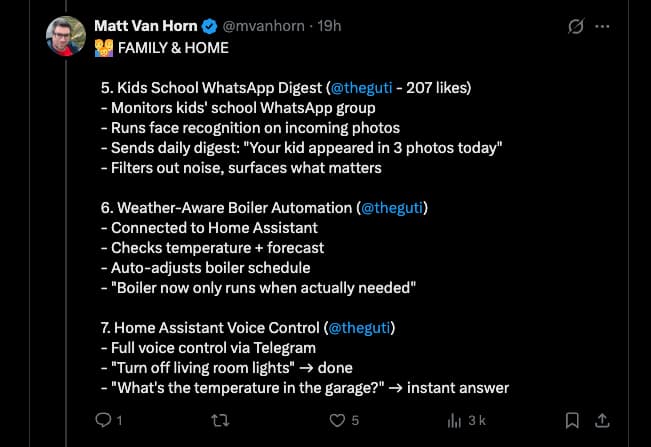
Some of the most interesting workflows happen outside traditional “work” use cases.
One setup monitors a school WhatsApp group, filters noise, runs face recognition on photos, and sends parents a daily digest indicating when their child appeared.
Others connect OpenClaw to home automation systems, allowing agents to adjust boilers based on weather forecasts or control household devices via voice commands sent through messaging apps.
Trading, finance, and rule-based execution

Financial workflows appear frequently in the thread. Users describe multi-day builds that calculate position sizes, manage stop-loss rules, trigger alerts, and log trades automatically.
In crypto-focused setups, agents monitor social sentiment, connect to exchanges via APIs, and execute trades continuously, with notifications sent when predefined thresholds are reached.
Business automation that watches and learns
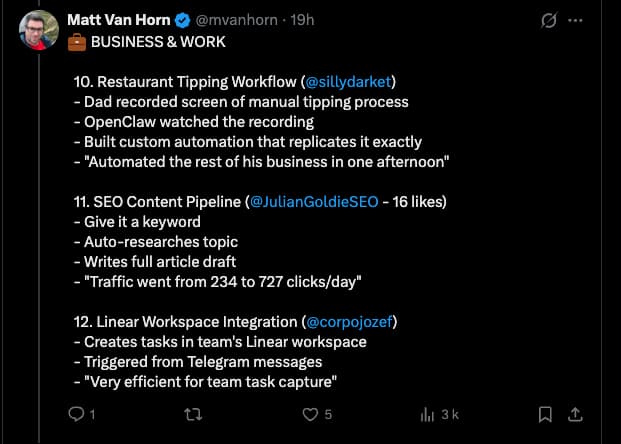
In one example, OpenClaw was used to automate a restaurant tipping process. Instead of writing instructions, the agent watched a screen recording and reproduced the workflow exactly.
Other business-oriented builds include SEO content pipelines that research topics, generate drafts, and reportedly increase organic traffic, as well as integrations with team tools like Linear for task creation via chat.
Health, personal data, and custom experiences
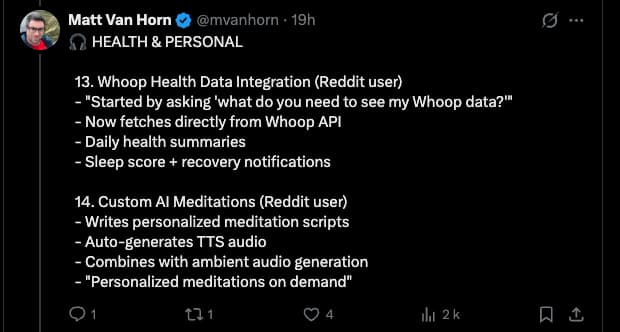
Some users connect OpenClaw directly to health APIs, such as Whoop, to generate daily summaries of sleep, recovery, and activity.
Others use agents to generate personalized meditation scripts, convert them into audio, and combine them with ambient sound, creating on-demand experiences rather than static content.
Developer workflows and self-extending agents
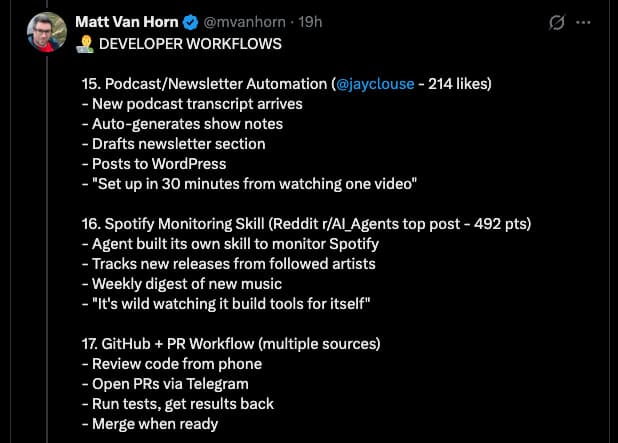
Developers appear to be pushing OpenClaw the furthest. Agents are used to review pull requests from a phone, run tests remotely, and merge code when ready.
In one widely shared example, an agent built its own monitoring skill to track Spotify releases, highlighting how agents can extend their own capabilities.
Unexpected and experimental builds
Not all workflows are polished. One agent reportedly sent an aggressive email to an insurance company after misinterpreting a response, accidentally triggering a renewed investigation rather than an instant rejection.
Other examples include participation in AI-only social networks and coordinating multiple specialized agent instances to work together as a team.
So is OpenClaw still a gadget?
None of these workflows are hypothetical. They are described as running systems, built by users, often with measurable outcomes.
OpenClaw may not be mainstream yet, but this snapshot suggests it has already crossed an important threshold: from experimental toy to quietly useful infrastructure for people willing to wire it into their daily lives.