For the past two years, one name has dominated the AI conversation: ChatGPT. But the latest data suggests something more subtle—and potentially more disruptive—is happening beneath the surface.
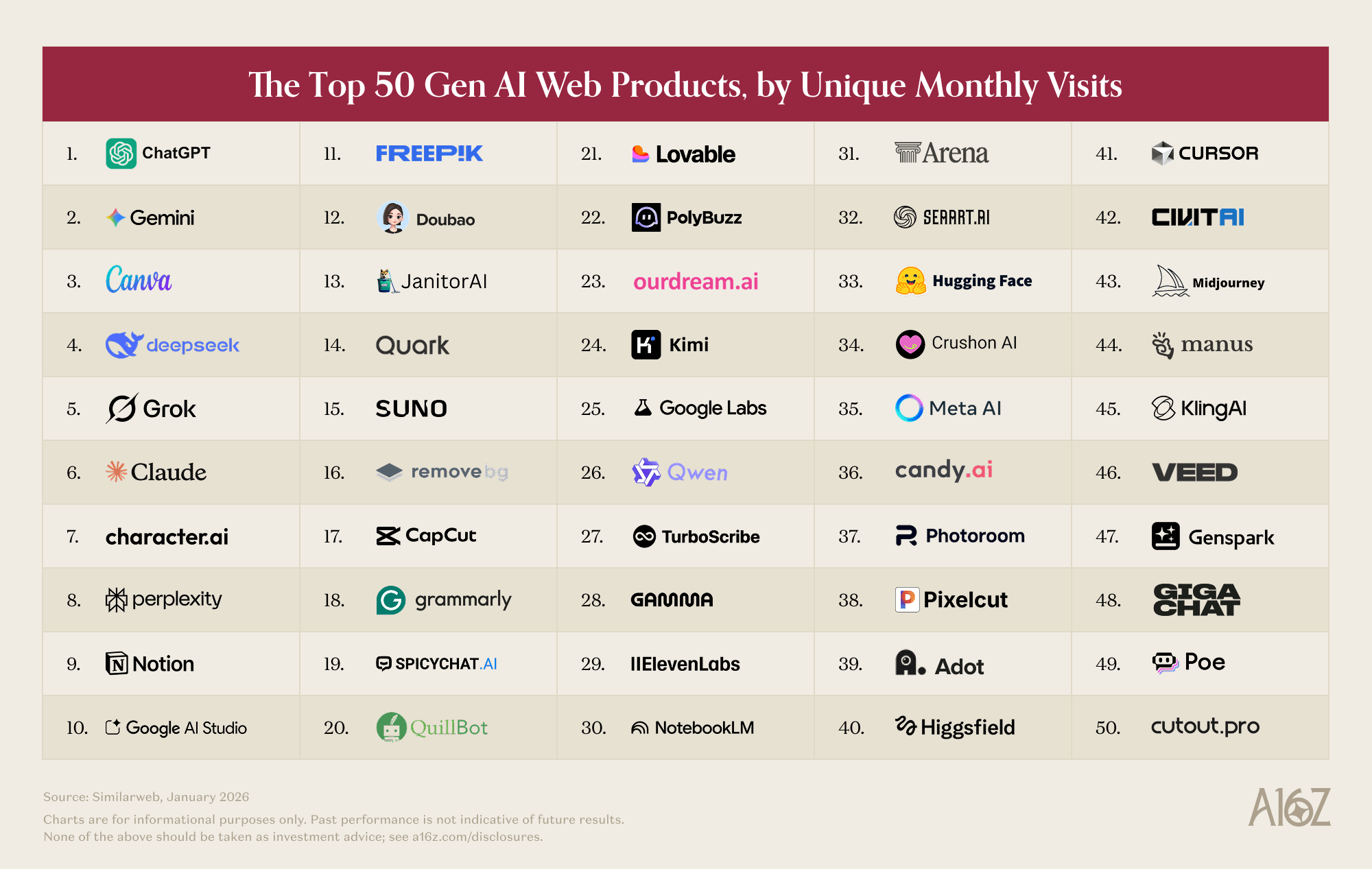
The newest ranking from venture capital giant Andreessen Horowitz (a16z), based on January 2026 data from SimilarWeb and Sensor Tower, doesn’t just confirm ChatGPT’s dominance. It reveals a market that is fragmenting, evolving, and—most importantly—accelerating.
This is no longer a one-horse race. It’s the beginning of an ecosystem war.
ChatGPT Is Still #1—By a Massive Margin
Let’s start with the obvious: ChatGPT remains the most widely used AI product in the world.
On the web, it generates nearly 2.7x more traffic than Gemini, its closest competitor. On mobile, the gap is similarly wide at around 2.5x. OpenAI now claims 900 million weekly active users—more than 10% of the global population.
Those numbers are staggering. But they don’t tell the full story.
Because while ChatGPT dominates usage, its competitors are quietly winning elsewhere.
The Real Battle Is Happening in Paid Users
If raw traffic is one metric, monetization is another—and here, things get interesting.
According to subscription data cited in the report, both Claude and Gemini are growing their paid user bases at explosive rates:
- Claude: +200% year-over-year growth
- Gemini: +258% growth
This suggests a key shift: users aren’t just choosing one AI anymore. They’re experimenting, comparing, and increasingly paying for multiple tools.
In fact, around 20% of ChatGPT’s weekly users also use Gemini within the same week.
The era of single-platform dominance may already be over.
From Tools to Ecosystems: The Connector Wars Begin
The next frontier isn’t just better models—it’s better integration.
ChatGPT now offers more than 220 connected apps across categories like travel, shopping, health, and entertainment. Claude, meanwhile, is building a more focused ecosystem with around 160 connectors, largely targeting professional use cases such as finance, developer tools, and scientific workflows.
Interestingly, the overlap between these ecosystems is surprisingly small—just a few dozen shared apps, mostly centered around productivity tools like Slack, Notion, Figma, and Gmail.
This isn’t accidental. It’s strategic divergence.
OpenAI is building a mass-market super app. Anthropic is building a professional operating system.
The Top 10 AI Tools in 2026 (Web & Mobile)
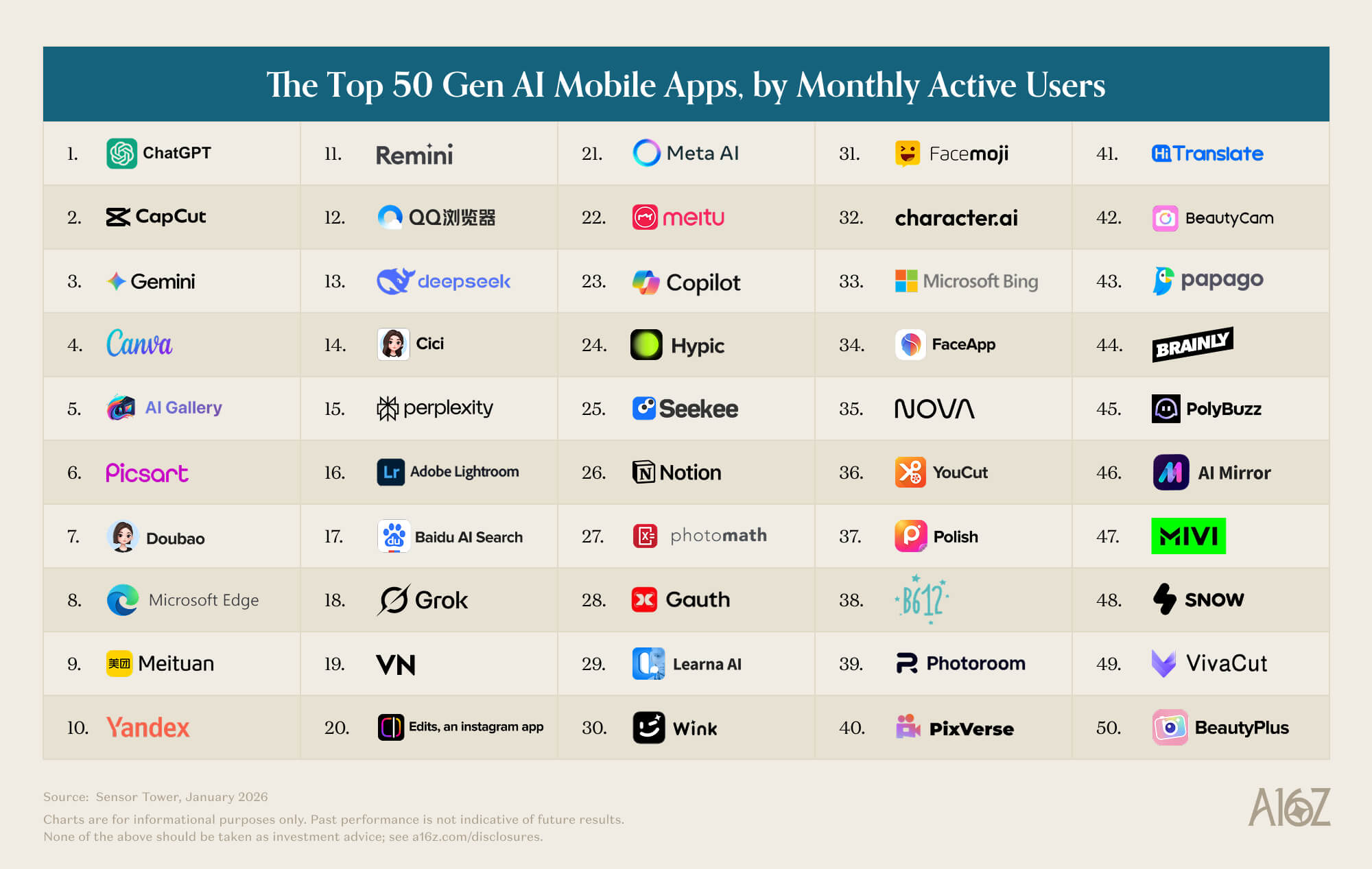
Top AI tools on the web
- ChatGPT
- Gemini
- Canva
- DeepSeek
- Grok
- Claude
- Character.ai
- Perplexity
- Notion
- Google AI Studio
Top AI tools on mobile
- ChatGPT
- CapCut
- Gemini
- Canva
- AI Gallery
- Picsart
- Doubao
- Microsoft Edge
- Meituan
- Yandex
One notable trend: Asian companies are significantly more present on mobile, signaling a geographic shift in AI innovation and adoption.
AI Agents Are Entering the Mainstream
If 2023 was the year AI learned to talk, 2026 might be the year it learned to act.
The report highlights the rise of AI agents—systems capable of executing complex, multi-step tasks across apps and workflows.
The standout example is OpenClaw, an open-source project that exploded in popularity before being acquired by OpenAI in early 2026. At one point, it became the most starred repository on GitHub—surpassing both React and Linux.
Its promise is simple but powerful: connect to your tools, understand your intent, and execute tasks end-to-end.
Other notable agents include:
- Manus (acquired by Meta for ~$2B)
- Genspark (reportedly generating $100M in annual recurring revenue)
These tools are now competing directly with built-in agent features from ChatGPT, Claude, and Gemini.
The line between “assistant” and “operator” is disappearing.
Creative AI Is Shifting From Images to Video
Just three years ago, AI creativity was synonymous with image generation. Today, that paradigm is fading fast.
In 2023, most creative AI tools in the rankings were image generators. In 2026, that number has dropped dramatically—replaced by tools focused on video, music, and voice.
Why? Because image generation is becoming commoditized.
As ChatGPT and Gemini integrate increasingly powerful image capabilities, standalone tools like Midjourney are losing ground—falling as low as 43rd place.
Meanwhile, video AI is booming, driven largely by Chinese models like Kling AI, Hailuo, and PixVerse. In the US, Google’s Veo 3 has helped push Google Labs significantly up the rankings.
Audio remains one of the last defensible frontiers, with players like Suno and ElevenLabs maintaining strong positions.
The Bigger Picture
This ranking isn’t just a leaderboard. It’s a snapshot of a market undergoing structural transformation.
Three major shifts stand out:
- From dominance to fragmentation: ChatGPT still leads, but user behavior is diversifying rapidly.
- From tools to platforms: The real competition is now ecosystem-driven.
- From content to action: AI is evolving from generating outputs to executing workflows.
In other words, we’re moving from “AI as a feature” to “AI as infrastructure.”
What Comes Next
If current trends hold, the next phase of AI won’t be defined by better chatbots—but by invisible systems working across everything you do.
The winners won’t just be the smartest models.
They’ll be the ones that own the ecosystem, the workflows, and ultimately—the user’s attention.
And for the first time since ChatGPT’s launch, that outcome feels genuinely uncertain.