

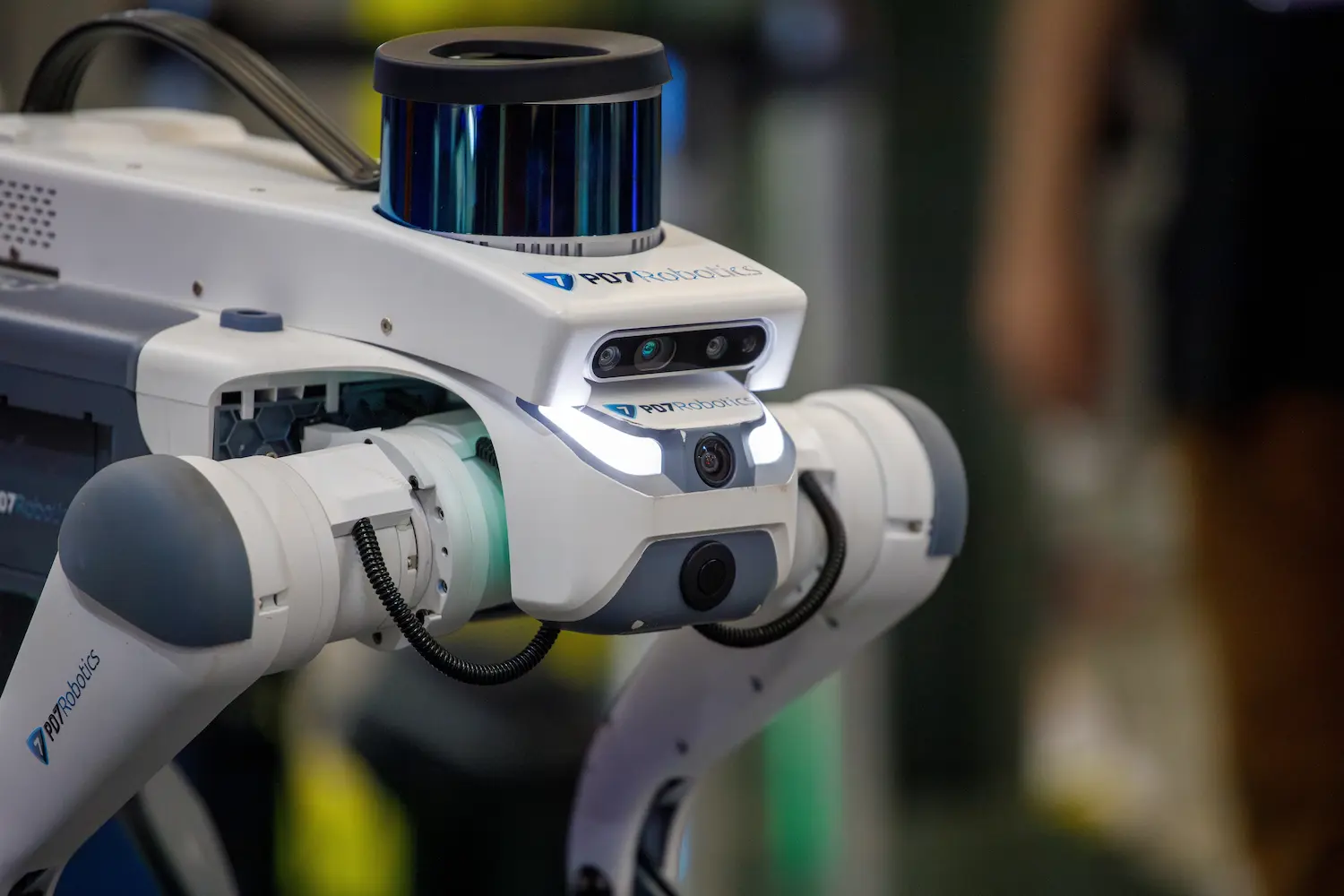
The data centers running ChatGPT, Gemini, and Claude have a new type of employee. They don’t take sick days, don’t go on vacation, and patrol perimeters through the night without complaint. They’re quadruped robots — four-legged machines the size of large dogs — and they’re showing up in force at AI infrastructure sites across the United States.
The trend was surfaced by Business Insider in mid-March 2026 and spread quickly through the tech press. Boston Dynamics, maker of the widely recognized Spot robot, confirmed that demand from data center operators has surged over the past year.
The timing is hardly coincidental: North America currently has 35 gigawatts of data center capacity under construction, and cumulative AI infrastructure investment across the US has approached $700 billion — a figure comparable to the GDP of a mid-sized developed country.
AI models are now being protected by robots that will, in turn, become smarter as those same AI models improve. The feedback loop is real — and the economics are pushing it forward faster than any policy framework anticipated.
Why data centers need robot dogs?
The scale of modern AI campuses makes traditional security genuinely difficult. Some facilities span the equivalent of hundreds of football fields — Meta’s forthcoming Hyperion data center will cover roughly four times the area of Central Park. Staffing human patrols across that kind of footprint around the clock is a logistical and financial problem that quadrupeds solve more elegantly than CCTV grids or expanded guard rosters.
Beyond perimeter security, the robots are being used for industrial inspection, site mapping, thermal anomaly detection, leak identification, and construction monitoring. Boston Dynamics describes Spot’s capabilities as “360° perception and athletic intelligence” — the ability to navigate uneven terrain, tight corridors, and outdoor environments that wheeled systems can’t handle. Novva Data Centers, based in Utah, has already publicly deployed a team of Spot units across its 140,000 m² campus.
Ghost Robotics, whose Vision 60 quadruped competes directly with Spot, sees the sector as a major growth driver. With over 5,000 data centers already operating in the US and 800 to 1,000 more under construction, Ghost Robotics’ chief growth officer told Business Insider he expects sustained commercial expansion ahead.
The economics are hard to argue with
Pricing for these systems isn’t trivial. Spot runs between $175,000 and $300,000 per unit depending on configuration. Ghost Robotics’ Vision 60 comes in around $165,000. But Boston Dynamics estimates that its robots recoup their cost within two years when weighed against the ongoing expense of human security personnel — which Ghost Robotics puts at approximately $150,000 per guard annually when factoring in salary, benefits, and turnover.
Robotics manufacturers are careful to frame quadrupeds as complements to human guards, not replacements. But when one robot covers more ground than two humans and pays for itself in under two years, the “complement” framing has a shelf life.
| System | Manufacturer | Unit price | Estimated ROI |
|---|---|---|---|
| Spot | Boston Dynamics | $175,000 – $300,000 | < 2 years |
| Vision 60 | Ghost Robotics | ~$165,000 | Comparable |
| Human guard | — | ~$150,000/year | Ongoing cost |
A feedback loop with no obvious off-switch
The broader context is worth sitting with. These robots are protecting the servers that train the AI models that will make the next generation of robots more capable. It’s a self-reinforcing cycle — not conspiratorial, just the compounding logic of technology adoption meeting economic incentive.
Quadrupeds have been deployed in law enforcement and military contexts for years. Ghost Robotics openly markets its systems for military reconnaissance, intelligence, and surveillance applications. The data center use case is comparatively benign, but it normalizes the presence of autonomous patrol systems in civilian infrastructure at a moment when the broader societal debate about that normalization is still unresolved.
Longer-term projections from Deloitte suggest the industrial robotics market could grow from roughly 500,000 annual unit shipments today to 1 million by 2030, with revenues reaching $21 billion — and a more speculative $5 trillion projection by 2050. Whether those numbers prove accurate or not, the directional shift is already visible in the parking lots of Utah data centers: the machines are here, they’re working the night shift, and the business case for more of them gets stronger every quarter that AI infrastructure investment compounds.
Sources
Business Insider / Jake Angelo, “Robot dogs priced at $300,000 a piece are now guarding some of the country’s biggest data centers” (March 2026)
Les Numériques / Aymeric Geoffre-Rouland, “Des robots-chiens à 300 000 $ patrouillent dans les data centers” (March 2026)
In These Times / Stephen Prager, “AI-Powered Robot Dogs Guarding Reviled Data Centers Is Where We Have Arrived” (March 2026)
