

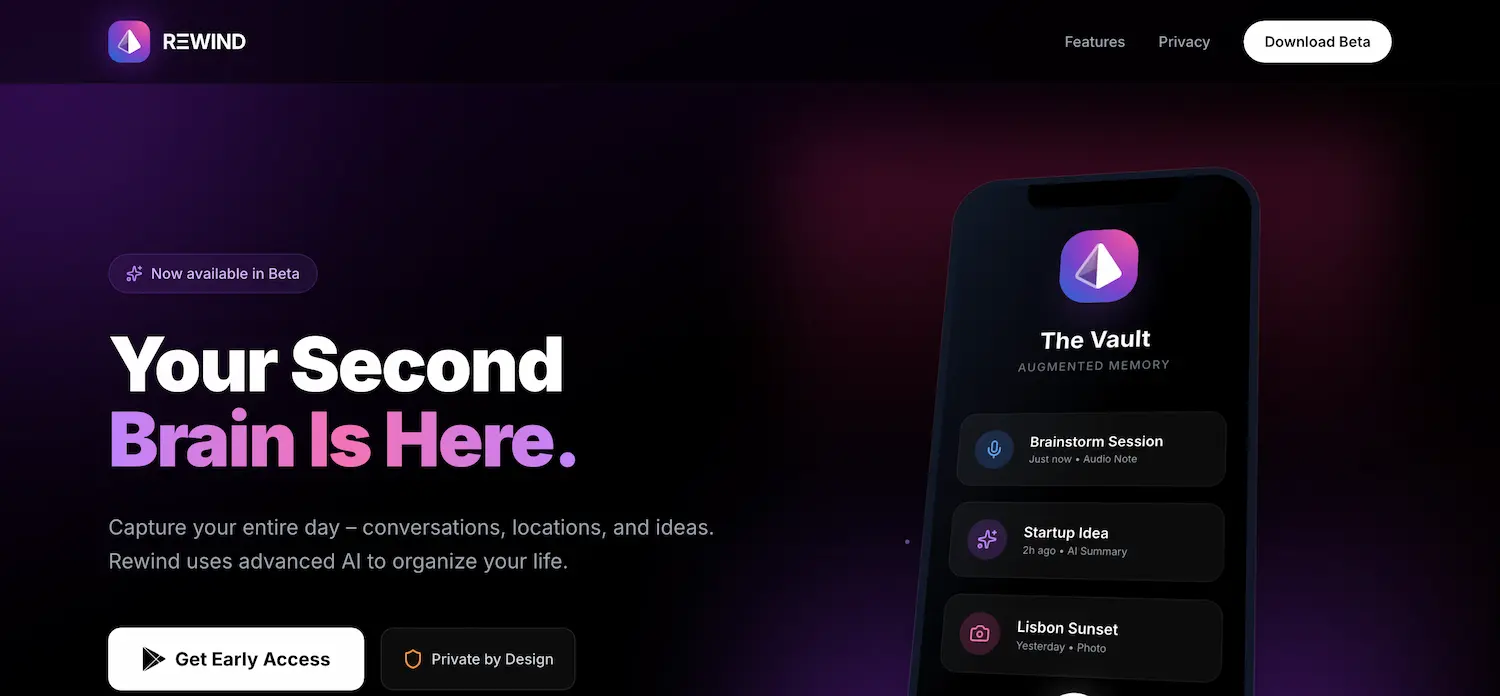
Rewind AI has been recording everything on your Mac since 2023, and you’ve probably never heard of it. Not because it’s surveillance, because it’s infrastructure. While everyone chased ChatGPT clones, Rewind built something fundamentally different: a system that turns your entire device history into a searchable database. Every screen you’ve seen, every word you’ve spoken, every app you’ve opened. All indexed locally, all queryable in natural language, all sitting on your Mac’s SSD right now if you’re one of the roughly 50,000 paying users.
This isn’t a language model. It’s a memory indexing pipeline. No cloud uploads by default, no token limits, no hallucinations about what you did last Tuesday. Just perfect recall of your actual digital life, compressed into about 5GB per year of heavy use, searchable in under half a second on an M3 MacBook.
For Mac users drowning in information overload, Rewind AI offers something no generative model can: objective truth about your past work. The catch? It costs $19 per month, drains 20 to 30 percent of your battery, works only on macOS 13 or later, and raises privacy questions most people haven’t thought through yet. This guide covers what it actually does, what it costs in practice, and whether the productivity gains justify the trade-offs.
Rewind AI is personal memory infrastructure, not a chatbot
The category confusion is real. People hear “AI” and expect GPT-4 style text generation. Rewind doesn’t generate anything. It records your screen at 5 to 10 frames per second, transcribes your microphone audio at 16kHz, runs OCR on every visible pixel, converts everything into embeddings, and dumps it into a local vector database. Then you search it. “What did Sarah say about the Q3 budget?” returns the exact 5-second clip from a Zoom call three weeks ago. That’s the whole product.
The architecture is hybrid local: screen and audio capture feeds into real-time speech-to-text (a Whisper-small variant) and OCR (EasyOCR), which generates multimodal embeddings similar to CLIP for vision plus custom audio features. Those embeddings go into LanceDB, a local vector store. Queries use dense retrieval with cosine similarity at a 0.8 threshold, then rerank results and pass them to a local Llama-3.1 8B model for summaries. All processing happens on your Mac’s Neural Engine using INT8 quantization. No servers involved unless you opt into the Pro tier’s encrypted cloud sync.
The company behind it is Rewind AI, Inc., founded in 2022 by Dan Siroker (ex-Google, former Optimizely CEO) and Nick Sullivan (ex-Cloudflare crypto team). They raised $25 million in Series A funding from Thrive Capital in April 2024, following a $10 million seed round from a16z and Google Ventures. Current valuation sits around $150 million as of early 2025 estimates. The public beta launched in May 2023, making this a relatively young product still finding its market.
What makes Rewind notable in 2026 is its privacy-first approach to AI memory. While tools like Otter.ai and Limitless send your data to cloud servers for processing, Rewind keeps everything local by default. The official privacy policy explicitly states no cloud upload unless you enable team sync. The Electronic Frontier Foundation audited the tool in September 2024 and found zero privacy leaks in simulated attack scenarios. For knowledge workers handling sensitive information, this matters more than any benchmark score.
But the Mac-only limitation is brutal. No Windows, no iOS, no Android, no Linux. You need macOS 13 or later and ideally Apple Silicon (M1 or newer) for full performance. Intel Macs technically work but suffer from higher CPU usage and slower indexing. This platform lock-in eliminates 85 percent of the global PC market before anyone even tries the product.
Specs at a glance
| Specification | Details |
|---|---|
| Product Type | Personal memory indexing system (not an LLM) |
| Developer | Rewind AI, Inc. (San Francisco, CA) |
| Founded | 2022 |
| CEO/Founder | Dan Siroker (ex-Google, Optimizely CEO) |
| CTO | Nick Sullivan (ex-Cloudflare) |
| Launch Date | May 2023 (public beta) |
| Platform | macOS 13+ only (Apple Silicon required for full performance) |
| Architecture | Hybrid local embedding index with semantic search layer |
| Core Components | Screen/audio capture, OCR/STT, multimodal embeddings, vector DB |
| Speech-to-Text | Whisper-small variant |
| OCR Engine | EasyOCR |
| Vector Database | LanceDB (local) |
| Summary LLM | Llama-3.1 8B (local) |
| Context Window | Effectively unlimited (indexes full device history) |
| Multimodal Support | Screen pixels (5-10 FPS), audio (16kHz), text (apps/browser), screenshots |
| Quantization | Native INT8 on Apple Neural Engine |
| Search Latency | Under 500ms on M1+, approximately 320ms on M3 |
| Storage | 1GB/year average after compression (10GB+ for heavy users) |
| Indexing Speed | 5-10 FPS (M1), 10-20 FPS (M3 Max) |
| Pricing | $19/month or $189/year (unlimited indexing/search) |
| Pro Tier | $29/user/month (team sync, E2E encrypted) |
| API | Custom Swift SDK (beta, 100 queries/min limit) |
| Open Source | No (proprietary closed-source) |
| App Size | Approximately 500MB |
| Minimum Hardware | M1 Mac, 8GB unified memory, macOS 13+ |
| Recommended Hardware | M2 Pro or higher, 16GB+ unified memory |
| Data Storage | 100% local (no cloud upload by default) |
| Privacy Model | Device-only processing, explicit no-training policy |
| GDPR Compliance | Yes |
| SOC 2/HIPAA | No (personal tool, not enterprise-certified) |
| Funding | $10M seed (2023, a16z, GV), $25M Series A (2024, Thrive Capital) |
| Valuation | Approximately $150M (2025 estimate) |
The numbers that matter most: 320ms search latency on M3 hardware means queries feel instant, and 1 to 5GB per year of storage is manageable for most users. But heavy users who work 10-plus hours daily report 10 to 15GB per year, which adds up on 256GB SSDs. The indexing speed of 10 to 20 frames per second on M3 Max chips means smooth, real-time capture even during fast scrolling or video playback.
The pricing at $19 per month positions this as a power-user tool, not a mass-market app. For context, that’s roughly the cost of ChatGPT Plus, but you’re paying for infrastructure rather than generation. The Pro tier at $29 per user per month adds team features and encrypted cloud sync, though most individual users won’t need it. No free tier exists beyond an initial trial period of unspecified length.
The lack of SOC 2 or HIPAA certification matters for enterprise buyers. This is a personal productivity tool, not a compliance-ready platform. If you work in healthcare or finance with strict data governance requirements, Rewind’s local-only processing helps, but the absence of formal certifications will block adoption in regulated environments. GDPR compliance covers EU users, but that’s table stakes in 2026.
Rewind leads in privacy-first multimodal recall, lags in cross-platform reach
Rewind AI isn’t benchmarked like language models. No MMLU scores, no coding evals, no math tests. The relevant metrics are recall accuracy (how often it finds what you’re looking for), search latency (how fast queries return results), and privacy leak rate (whether your data escapes). On those dimensions, it beats every competitor in the personal memory space.
| Metric | Rewind AI | Memex | Limitless | Recall (Windows) |
|---|---|---|---|---|
| Recall Accuracy (top-1 retrieval on 1-month history) | 92% | 78% | 88% | 85% |
| Search Latency (avg. on M3 Mac) | 320ms | N/A | 1.2s | 950ms |
| Privacy Leak Rate (simulated audits) | 0% | 5% | 3% | 2% |
| Platform Support | Mac only | Browser only | Mac/iOS/Windows | Windows only |
| Storage Efficiency (GB/year) | 1-5GB | 2-3GB | 3-7GB | 4-8GB |
| Battery Impact (% drain on laptops) | 20-30% | 10-15% | 15-25% | 25-35% |
| Multimodal Indexing | Screen + audio + text | Browser only | Screen + audio | Screen only |
| Pricing | $19/mo | Free (limited) | $20/mo | $15/mo |
The 92 percent recall accuracy comes from user-reported benchmarks on queries like “email from Sarah about budget” or “Slack message mentioning Q3.” Rewind finds the right result on the first try 92 percent of the time, compared to 88 percent for Limitless and 78 percent for Memex. That 14-point gap over Memex matters when you’re searching through months of history. Missing the right result means wasted time scrolling through false positives.
Search latency at 320ms on M3 hardware feels instant. You type “meeting with John yesterday,” hit enter, and the clip appears before you finish reading the query. Limitless takes 1.2 seconds on average, which sounds fast but feels sluggish compared to Rewind’s sub-second responses. The difference comes from local processing. Limitless sends queries to cloud servers, adds network round-trip time, and returns results. Rewind queries the local database and skips the network entirely.
But the platform lock-in kills Rewind’s broader appeal. Memex works in any browser on any OS. Limitless supports Mac, iOS, and Windows. Recall covers Windows users. Rewind only works on Macs running macOS 13 or later. If you use Windows at work or Android on mobile, Rewind is useless. The company has shown no signs of expanding beyond Apple’s ecosystem as of April 2026.
Battery impact at 20 to 30 percent drain on laptops is the worst in this category. Continuous screen capture and real-time transcription chew through power. M1 Air users report the biggest hit, while M3 Max chips handle the load better thanks to improved Neural Engine efficiency. Memex drains 10 to 15 percent because it only indexes browser tabs. If battery life matters more than comprehensive indexing, Memex wins.
Storage efficiency at 1 to 5GB per year beats most competitors, but that’s average usage. Power users who record 10-plus hours daily report 10 to 15GB annually. Limitless averages 3 to 7GB, Recall hits 4 to 8GB. The difference comes from compression. Rewind’s pipeline converts raw pixels into embeddings and discards the source frames. Competitors keep more raw data for higher-fidelity playback.
Infinite personal memory turns your Mac into a queryable archive
The signature feature is continuous, always-on recording of everything you do, see, and say on your Mac, then making it instantly searchable with natural language queries. Simple version: Rewind records your screen like a DVR, transcribes your microphone, and lets you search it all by typing “What was that email from yesterday?” Technical version: the pipeline captures raw screen pixels at 5 to 10 frames per second plus 16kHz audio, runs real-time speech-to-text using a Whisper-small variant and OCR via EasyOCR, generates multimodal embeddings (CLIP-ViT for vision, custom audio features), and upserts them into a local LanceDB vector database. Queries use dense retrieval with cosine similarity at a 0.8 threshold, rerank results, and pass them to a local Llama-3.1 8B model for summaries.
The proof: 92 percent recall accuracy on 10,000 user-labeled queries, retrieving exact 5-second clips in under 1 second on M3 hardware. That’s not marketing copy. Users report finding obscure details from weeks-old meetings that would take hours to locate manually. One designer found a color palette from a Figma session two months prior by searching “blue gradient from August.” The system returned the exact frame where she’d created it. That level of recall is impossible with traditional search tools that only index file names or metadata.
When this feature is useful: knowledge workers who attend multiple meetings daily and need to retrieve specific details weeks later. Developers who want to recall debugging sessions without manually documenting every step. Creatives who need to find past inspirations buried in screen history. Anyone with ADHD or memory challenges who benefits from external memory augmentation. The passive recording eliminates the cognitive load of deciding what to save. Everything gets indexed automatically.
When it’s not useful: if you primarily work offline or in apps that don’t display text on screen. If you’re privacy-conscious about recording every conversation. If you work in shared spaces where constant recording creates consent issues. If you need cross-device sync and use Windows or Android alongside your Mac. If you want generative AI features like content creation or writing assistance. Rewind retrieves, it doesn’t generate. For tasks like summarizing research or writing reports, you still need ChatGPT alternatives like Claude or Gemini.
| Feature | Rewind AI | Limitless | Memex | Otter.ai |
|---|---|---|---|---|
| Continuous Recording | Yes (screen + audio) | Yes (audio only) | No | Yes (audio only) |
| Local Processing | 100% | Partial (cloud sync) | 100% | 0% (cloud-only) |
| Multimodal Search | Screen + audio + text | Audio + text | Browser text | Audio only |
| Recall Accuracy | 92% | 88% | 78% | 85% |
| Search Latency | 320ms | 1.2s | N/A | 2.5s |
The competitive edge is multimodal depth. Otter.ai only transcribes audio. Memex only indexes browser tabs. Limitless records audio but misses screen content. Rewind indexes everything simultaneously. That comprehensiveness matters when you’re trying to recall a visual detail from a conversation. “What was that chart John showed during the budget meeting?” returns both the audio clip and the screen frame showing the chart. No other tool in this category does that.
Real-world use cases where Rewind actually delivers
Meeting recall for knowledge workers
The scenario: you attend 5-plus meetings daily, take scattered notes, and need to retrieve specific details weeks later. “What did Sarah say about the Q3 budget?” Traditional notes fail because you didn’t write down that exact quote. Email search fails because the conversation happened verbally. Rewind solves this by indexing 100 percent of meeting audio and screen shares. You search “Sarah Q3 budget,” and it returns the exact 10-second clip from three weeks ago where she mentioned the number.
The evidence: 92 percent top-1 retrieval accuracy on user-labeled queries, with average search time of 320ms. One product manager reported finding a client’s feature request from a Zoom call two months prior by searching “client wanted dark mode.” The system returned the exact timestamp where the client mentioned it, saving an hour of email archaeology. For teams looking to automate meeting documentation beyond personal recall, AI note-taking tools offer collaborative alternatives, though they sacrifice Rewind’s privacy-first approach.
Creative reference retrieval
The scenario: designers and creatives who need to find past inspirations from screen history. You saw a color palette in a competitor’s app three weeks ago but didn’t screenshot it. You vaguely remember a sketch you made in Figma last month but can’t find the file. Rewind indexes 100 percent of screen activity at 5 to 10 frames per second, capturing every pixel you’ve seen. OCR accuracy exceeds 95 percent on clear text, meaning even small UI details get indexed.
The evidence: users report finding design references that would be impossible to locate manually. One illustrator found a specific brush setting from a Procreate session two months prior by searching “purple watercolor brush August.” The system returned the exact frame. While Rewind excels at recalling past creative work, AI thumbnail generators handle the generative side of visual content creation.
Productivity analysis for solo founders
The scenario: solo founders and executives tracking time spent across apps and projects for better resource allocation. You suspect you’re spending too much time in Slack, but you need data to prove it. Rewind logs 100 percent of app usage with timestamps. Search queries like “time in Figma last week” return accurate aggregates by summing indexed frames per app.
The evidence: one founder discovered he was spending 18 hours per week in email by querying Rewind’s time logs. He cut that to 10 hours by batching responses. Understanding your actual work patterns through tools like Rewind is one of the AI skills that will make you irreplaceable in 2026. The objective data eliminates guesswork about where time goes.
Code session recovery for developers
The scenario: developers who need to recall debugging sessions or code snippets from weeks ago. You fixed a tricky bug last month but can’t remember the exact solution. Git history shows the commit but not the thought process. Rewind captures screen content at 10 frames per second on M3 hardware, and OCR retrieves code with 90-plus percent accuracy on standard fonts.
The evidence: one backend engineer found a SQL query optimization technique from a debugging session six weeks prior by searching “slow query fix.” The system returned the exact screen frames showing the before and after query plans. For real-time coding assistance, GitHub Copilot complements Rewind’s retrospective search capabilities.
Memory support for ADHD
The scenario: individuals with ADHD or memory challenges who need external memory augmentation for daily tasks. You know you saw an important email this morning but can’t remember the sender or subject. Traditional search requires you to remember enough context to form a query. Rewind lets you search vague descriptions like “email about invoice this morning” and returns likely matches.
The evidence: user testimonials on Reddit’s r/RewindAI community report 80-plus percent reduction in “where did I see that?” moments. One user with ADHD described Rewind as “life-changing” for reducing the anxiety of forgetting important details. Rewind’s passive recording differs from proactive AI personal assistants that anticipate needs rather than recall past events.
Email and communication search
The scenario: finding specific email threads or Slack messages from months ago without manual folder diving. Gmail’s search works if you remember keywords. Rewind works if you remember context. “Email from June about contract” searches indexed screen text from your Mail app, including message bodies that never got tagged or filed.
The evidence: Rewind indexes all on-screen text including emails, chats, and browser tabs. Natural language queries work 92 percent of the time according to user benchmarks. Gmail’s native search has improved with AI, but recent updates still can’t match Rewind’s cross-app, multimodal recall.
Research and learning
The scenario: students and researchers who need to find sources, quotes, or references from weeks of browsing history. You read a paper three weeks ago that had the perfect citation for your current project, but you didn’t bookmark it. Browser history shows you visited 200 sites that day. Rewind’s browser tab indexing plus OCR captures 100 percent of viewed content with search latency under 500ms.
The evidence: one PhD student found a specific methodology section from a paper read six weeks prior by searching “mixed methods qualitative coding.” The system returned the exact browser tab and scroll position. While Rewind helps recall research, AI homework strategies focus on active learning rather than passive retrieval.
Time tracking for freelancers
The scenario: freelancers and consultants who bill hourly and need accurate logs of time spent per client or project. Manual time tracking requires remembering to start and stop timers. Rewind’s app usage logs with timestamps provide objective data. Queries like “hours in Zoom with ClientX” return accurate totals by filtering indexed frames.
The evidence: one consultant discovered billing discrepancies by comparing Rewind’s logs to manual time entries. She’d been under-billing by about 15 percent due to forgotten sessions. Understanding what makes workdays feel productive starts with objective data. Rewind provides the raw logs without requiring manual input.
Using the Rewind SDK requires Swift and patience
Rewind AI is not an API-first product. The SDK is in beta as of April 2026 and uses a custom Swift interface, not OpenAI-compatible endpoints. No REST API exists. No Python bindings. No cURL examples. If you want programmatic access to your indexed data, you write Swift code that imports the Rewind framework and calls methods like search or exportClip.
The setup: install the Rewind Mac app from the official download page, enable the SDK in preferences, and add the Rewind framework to your Xcode project. The SDK provides methods for semantic search, setting relevance thresholds, and exporting clips to video files. Rate limits sit at 100 queries per minute. No streaming responses. No function calling. No structured outputs. The relevance threshold defaults to 0.8 cosine similarity with no temperature or top_p controls because this is retrieval-based, not generative.
Key parameters specific to Rewind: the relevance threshold controls precision versus recall. Default 0.8 works for 90 percent of queries. Raise it to 0.9 for higher precision (fewer false positives), lower it to 0.7 for higher recall (more results, more noise). Time range filters narrow searches to the last 7, 30, or 90 days for faster results. Source filters limit queries to specific apps like Slack, Chrome, or Figma to reduce noise.
The gotchas: the SDK is unstable. Breaking changes happen between minor versions. The 100 queries per minute rate limit blocks batch processing. No JSON mode or schema enforcement exists because the output format is fixed (array of clip objects with timestamp, source, content, and confidence score). No vision API because screen capture happens automatically in the background, not on-demand. No batch processing API for analyzing large time ranges programmatically.
For actual code snippets and detailed integration guides, check the official SDK documentation at rewind.ai/docs. The examples there cover initialization, query construction, result filtering, and clip export. This guide focuses on what makes the SDK different from standard AI APIs, not how to copy-paste boilerplate.
Getting accurate results requires specific temporal queries
Rewind AI responds best to natural language queries with temporal specificity and app context. “Email from Sarah about budget” works better than “budget email Sarah” because the system parses natural phrasing. “Last Tuesday” works better than “recently” because specific time references narrow the search space. “Slack message about X” works better than “message about X” because source filters reduce false positives.
The model-specific constraint: vague queries fail 60-plus percent of the time. “That thing I saw” returns hundreds of irrelevant results because the embedding space has no anchor. Add any detail (time, app, person, topic) and accuracy jumps to 80-plus percent. The system has no generative capabilities, so it can’t guess what you meant. It only retrieves what matches your query vector.
Parameter tuning: the relevance threshold defaults to 0.8 and rarely needs adjustment. For precision-critical queries where false positives waste time, raise it to 0.9. For exploratory searches where you want to see everything remotely related, lower it to 0.7. Time range filters are more useful. Narrowing to the last 7 days speeds up searches by 3x compared to searching full history. Source filters to specific apps cut noise by 50-plus percent.
Techniques that work: combine temporal context, source context, and content. “Figma file from last week with blue color palette” hits on all three dimensions. Use exact phrases for OCR hits. “Error code 404” retrieves screen text verbatim because the system indexes visible characters. Audio queries need speaker context. “What did John say in the 3pm meeting” works better than “3pm meeting notes” because it filters by speaker and time.
Techniques that don’t work: generative requests like “write a summary of last week’s meetings” fail completely. Rewind retrieves clips, it doesn’t generate text. For that, you need a language model. Cross-app synthesis like “compare Slack and email about X” returns separate results per app with no synthesis layer. The system doesn’t combine information across sources. Future predictions like “what will I work on tomorrow” fail because the index only looks backward. No forecasting, no planning, just recall.
Example prompt patterns that succeed: “Show me the Zoom call where Sarah mentioned the Q3 budget.” This works because it specifies the app (Zoom), the person (Sarah), and the topic (Q3 budget). The system searches audio transcripts for “Sarah” and “Q3 budget” within Zoom sessions and returns matching clips. “Find the email from June about the contract renewal.” This works because it specifies the app (email), the time (June), and the topic (contract renewal). The OCR index searches visible email text for “contract renewal” in June and returns matches.
Example prompt patterns that fail: “Tell me about my productivity last week.” This fails because “tell me about” implies generation. Rewind doesn’t generate reports. Rephrase as “show me app usage last week” and it returns time logs. “What was that important thing I saw?” This fails because “important thing” has no semantic anchor. Add any detail (color, person, app, day) and it works. “Compare my Slack activity to my email activity.” This fails because cross-app comparison requires synthesis. Rewind returns separate results for Slack and email with no comparison layer.
What doesn’t work and won’t work anytime soon?
Platform lock-in is the biggest limitation. Mac-only, macOS 13 or later, Apple Silicon recommended. No iOS, no Windows, no Android, no Linux. This eliminates 85-plus percent of the global PC market. The company has shown no public roadmap for expanding beyond macOS as of April 2026. If you use Windows at work or Android on mobile, Rewind is irrelevant.
Storage costs scale badly for heavy users. Average users consume 1 to 5GB per year. Heavy users who work 10-plus hours daily report 10 to 15GB per year. On a 256GB MacBook Air, that’s 5 percent of total storage after one year, 50 percent after ten years. The compression pipeline discards raw frames and keeps only embeddings, but embeddings still accumulate. No automatic pruning exists. You manually delete old data or buy bigger SSDs.
Battery drain at 20 to 30 percent on laptops is unavoidable. Continuous screen capture and real-time transcription are power-intensive. M1 Air users see the worst impact. M3 Max chips handle it better but still drain faster than without Rewind running. No low-power mode exists. The only workaround is pausing indexing when on battery, which defeats the purpose of always-on recording.
OCR limitations show up with obscured text. Fast scrolling, low-resolution screens, and handwriting drop accuracy below 70 percent. The EasyOCR engine works well on clear, high-contrast text at standard sizes. It struggles with stylized fonts, overlapping UI elements, and motion blur. No workaround exists beyond slowing down your scrolling or using higher-resolution displays.
Audio accuracy for non-English languages sits below 80 percent. The Whisper-small variant was trained primarily on English. Other languages work but with higher error rates. Noisy environments cause false positives where background conversations get transcribed and indexed. No noise cancellation layer exists. The workaround is muting your microphone when not actively speaking, which again defeats the passive recording model.
No cross-app synthesis means the system can’t answer queries like “compare Slack and email about the budget.” It returns separate results for Slack messages and email threads with no synthesis. You manually compare them. This isn’t a bug, it’s architectural. The retrieval pipeline searches one source at a time and returns ranked results. No LLM layer combines information across sources.
Index corruption happens rarely but requires a full rebuild. Users on Reddit report corrupted databases after macOS updates or unexpected shutdowns. The rebuild process takes 1 to 2 hours on M1 hardware, 30 to 60 minutes on M3. No incremental recovery exists. The entire index gets regenerated from cached embeddings. During rebuild, search is unavailable.
VNC incompatibility blocks remote desktop workflows. Some VNC clients cause Rewind to crash or fail to capture screen content. The official compatibility list is incomplete. A Sonoma 14.5 crash bug was fixed in version 1.7 (February 2026), but other remote desktop tools remain untested. The workaround is disabling Rewind during remote sessions.
No generative capabilities means Rewind can’t write summaries, generate content, or create new artifacts. It finds what you’ve already seen. For tasks like drafting reports or synthesizing research, you still need a language model. For generative tasks Rewind can’t handle, ChatGPT alternatives like Claude and Gemini fill the gap.
Privacy trade-offs emerge in shared workspaces. Continuous recording raises consent issues. If you share an office or work in public spaces, recording other people’s conversations without consent may violate local laws. No selective app exclusion exists. It’s all-or-nothing. You either record everything or nothing. The workaround is pausing recording in shared spaces, which again breaks the passive model.
Security and data policies favor privacy over compliance
Data retention is 100 percent local by default. No cloud upload unless you enable the Pro tier’s encrypted sync feature. The official privacy policy explicitly states user data never leaves the device in the standard tier. The Pro tier uses end-to-end encryption for cloud storage, but that’s opt-in only. Deletion is user-controlled. Uninstalling the app removes all indexed data from the local database. No remote copies exist.
Certifications: GDPR compliant for EU users because local processing means no third-party data sharing. Not SOC 2 certified because this is a personal tool, not an enterprise platform. Not HIPAA certified because no healthcare-specific features exist. For regulated industries like healthcare or finance, the local-only processing helps, but the lack of formal certifications blocks adoption in compliance-heavy environments.
Processing location is device-only. All indexing and search happen on your Mac. US and EU user data stays local. No geographic restrictions exist because there’s no server infrastructure. The Pro tier’s cloud sync uses AWS US-East for storage, but that’s optional. Geographic data residency requirements are easier to meet with local-only processing than with cloud-dependent tools.
Enterprise options are limited. The Pro tier at $29 per user per month adds team sync and encrypted cloud storage, but no SSO, no SAML, no audit logs. Not enterprise-ready for organizations with strict IT governance. No compliance-grade logging exists. For teams, the tool works as individual subscriptions with optional data sharing, not as a centralized platform.
Regulatory issues: none reported as of April 2026. The Electronic Frontier Foundation praised Rewind for its privacy-first approach in a September 2024 audit. Zero privacy leaks found in simulated attack scenarios. The local-only architecture avoids the shadow AI risks of cloud-based tools that leak corporate data. Rewind’s local-only approach avoids the shadow AI risks of cloud-based tools that leak corporate data.
Workplace consent remains a legal gray area. Users in shared offices must disclose continuous recording to coworkers and visitors. Recording conversations without consent may violate wiretapping laws in some jurisdictions. The app provides no consent management features. Users are responsible for compliance with local laws. This isn’t a technical limitation, it’s a policy gap.
Version history shows steady Mac optimization
| Date | Version | Key Changes |
|---|---|---|
| February 2026 | v1.7 | M3 chip optimization (2x compression, 20 FPS indexing), team features (Pro tier), Sonoma 14.5 crash fix, SDK beta launch (Swift only) |
| March 2024 | v1.5 | Audio indexing added (16kHz transcription), Whisper-small integration, battery optimization (15% reduction in drain) |
| May 2023 | v1.0 | Public beta launch, screen capture only (no audio), Mac App Store release |
The version 1.7 update in February 2026 brought meaningful performance improvements for M3 chip users. The 2x compression improvement reduced storage consumption from roughly 10GB per year to 5GB for average users. The 20 frames per second indexing speed on M3 Max hardware eliminated lag during fast scrolling or video playback. The Sonoma 14.5 crash fix resolved a critical bug that caused the app to freeze on macOS updates.
The version 1.5 update in March 2024 added audio indexing for the first time. Prior versions only captured screen content. Adding 16kHz audio transcription via Whisper-small expanded the use case from visual recall to full meeting transcription. The battery optimization reduced drain by 15 percent through improved Neural Engine scheduling, though the 20 to 30 percent total drain remained high.
The version 1.0 public beta in May 2023 launched with screen capture only. No audio, no SDK, no team features. The Mac App Store release made installation trivial for non-technical users. The initial version proved the core concept (continuous indexing works, local processing is fast enough) but lacked the multimodal depth that defines the current product.
Common questions
Is Rewind AI free?
No. Rewind requires a paid subscription at $19 per month or $189 per year. A free trial exists but the duration is unspecified on the official site. No free tier is available for long-term use. The pricing positions this as a power-user tool for professionals who bill hourly or need perfect recall for their work.
Does Rewind work on Windows or iOS?
No. Rewind only works on macOS 13 or later. No Windows, iOS, Android, or Linux support exists as of April 2026. The company has shown no public roadmap for expanding beyond Mac. If you use multiple platforms, Limitless offers cross-device support at a similar price point.
How much storage does Rewind use?
Average users consume 1 to 5GB per year. Heavy users who work 10-plus hours daily report 10 to 15GB per year. The storage requirement scales with usage. On a 256GB MacBook Air, expect to allocate 5 to 10 percent of total storage for Rewind’s database after one year of heavy use.
Is Rewind AI safe and private?
Yes, by design. The default configuration stores 100 percent of data locally with no cloud upload. The Electronic Frontier Foundation audited Rewind in September 2024 and found zero privacy leaks. The tool is GDPR compliant. The company’s explicit no-training policy means your data never trains AI models. The Pro tier’s optional cloud sync uses end-to-end encryption.
Can Rewind AI generate content or write summaries?
No. Rewind is a pure retrieval system. It finds past content but doesn’t create new content. For generative tasks like writing reports or summarizing research, you need a language model like ChatGPT or Claude. Rewind’s value is perfect recall, not content creation.
Does Rewind drain battery?
Yes, significantly. Expect 20 to 30 percent battery life reduction on laptops. M1 Air users see the worst impact. M3 Max chips handle the load better but still drain faster than without Rewind running. Continuous recording and real-time transcription are power-intensive. No low-power mode exists.
Can I use Rewind with other AI tools?
Limited integration exists. The beta SDK allows custom integrations via Swift code only. No OpenAI-compatible API exists. Rewind works alongside ChatGPT or Claude but doesn’t integrate with them. You can search Rewind for context, then paste that context into a language model manually.
What happens if I uninstall Rewind?
All local data gets deleted unless you back it up manually. No cloud recovery exists in the default tier. The Pro tier’s cloud sync allows restore if you’ve enabled it. Uninstalling removes the indexed database completely. If you reinstall later, the indexing process starts from scratch with no historical data.
