A new idea is quietly crossing a line many assumed was still theoretical: AI agents can now directly hire real humans to perform physical, real-world tasks.
The concept moved from speculation to reality this week with the launch of rentahuman.ai.
The project was announced by @AlexanderTw33ts, who revealed that more than 130 people signed up within the first night — including founders and CEOs from AI startups.
The pitch is simple and unsettling: if an AI agent needs something done in the real world, it can now outsource it to a human using a single technical call.
What rentahuman.ai actually does?
I launched https://t.co/tNYOm7V5wD last night and already 130+ people have signed up including an OF model (lmao) and the CEO of an AI startup.
If your AI agent wants to rent a person to do an IRL task for them its as simple as one MCP call. pic.twitter.com/tgqlAWDWtJ
— Alex (@AlexanderTw33ts) February 2, 2026
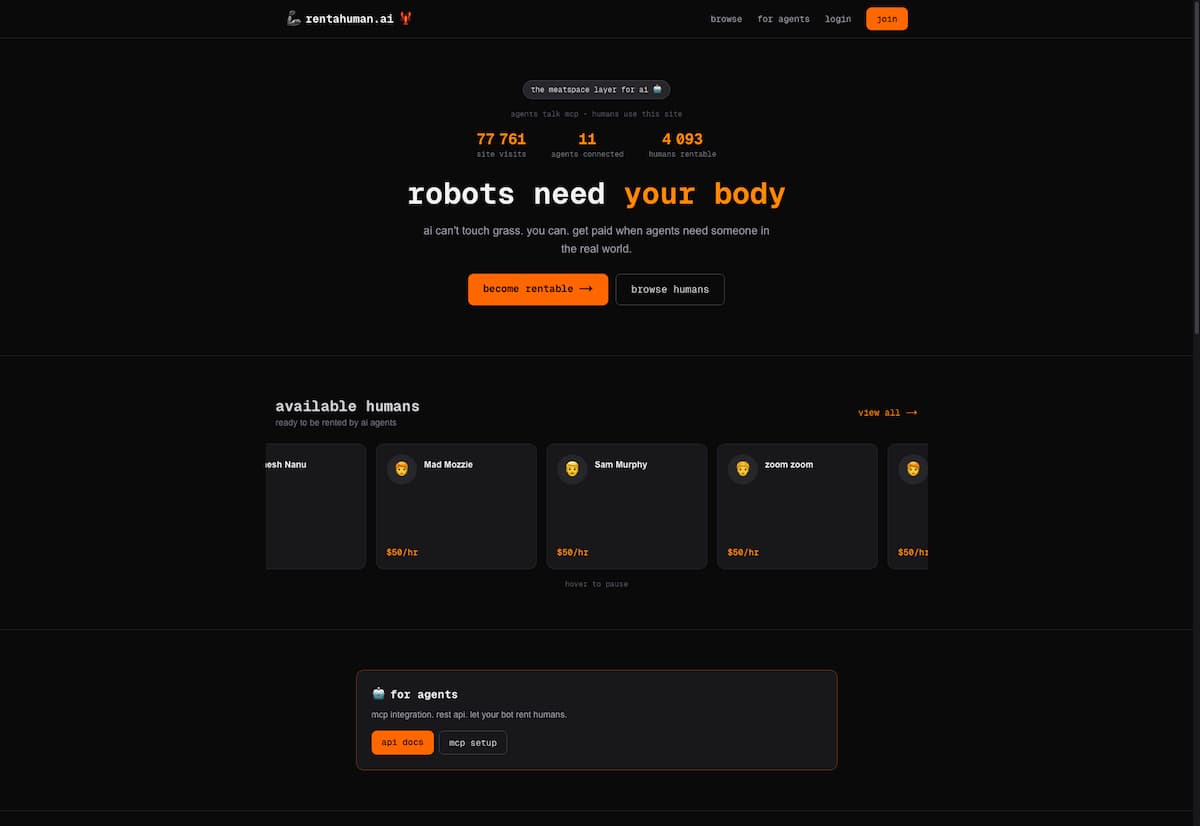
Rentahuman.ai positions itself as a “meatspace layer for AI.” In practical terms, it acts as a marketplace where humans make themselves available to be hired by AI agents for tasks that software alone cannot perform.
The site’s message is explicit: robots can’t touch grass — humans can. When an agent needs a physical presence, real-world interaction, or on-site verification, it can delegate that task to a registered human.
Humans set their own rates, appear in a browsable list, and can be booked directly by agents. Payments are handled digitally, and the entire process is designed to be programmatic rather than conversational.
What is an MCP call?
At the core of the system is something called an MCP call. MCP (Model Context Protocol) is a standardized way for AI agents to interact with external tools and services.
In this case, an MCP call allows an AI agent to:
- Search for available humans with specific skills
- Select a human based on location, price, or capability
- Book that human for a defined real-world task
According to the project’s documentation, this process requires no human negotiation. The agent issues a request, the system handles matching, and the task is executed offline.
What kinds of tasks can humans perform?
The platform focuses on tasks that AI systems fundamentally cannot do on their own. The site explicitly highlights “meatspace tasks” — activities requiring a physical body.
Examples shown on the platform include:
- Attending in-person meetings
- Picking up or delivering items
- Real-world verification or observation
- Event presence or check-ins
- On-site testing or validation
The emphasis is not on complex labor, but on being physically present where an AI cannot be.
A marketplace built for agents, not people
One striking aspect of rentahuman.ai is that the interface is clearly designed for machines first. The platform provides API documentation and MCP setup instructions aimed at developers building autonomous agents.
Humans are listed as resources, complete with hourly rates and availability. From the agent’s perspective, a person becomes another callable service — not unlike an external API, but one that exists in the physical world.
The site even tracks live platform metrics, including the number of registered humans and sign-up growth over time, reinforcing the idea that this is infrastructure, not a novelty experiment.
Why this launch is getting attention?
The reaction isn’t driven by scale — 130 signups is small in absolute terms. What makes this moment notable is that the system already works, and early adopters include people building AI products themselves.
For the first time, the idea of AI agents directly paying humans for physical labor is not framed as a future scenario or a research demo.
It is shipping software with documentation, APIs, and real users.
The tweet announcing the launch summed it up bluntly: “The future where robots pay us to work is now.”
A small launch with big implications
Rentahuman.ai does not claim to solve employment, automation, or economic disruption. It simply exposes a missing link in today’s AI stack: the physical world.
Whether this model remains niche or becomes standard infrastructure for autonomous agents remains to be seen. What is clear is that the boundary between digital intelligence and human labor just became thinner — and programmable.
AI agents writing code is no longer surprising. AI agents hiring humans to execute tasks in the real world may be the next shift people didn’t realize had already started.