

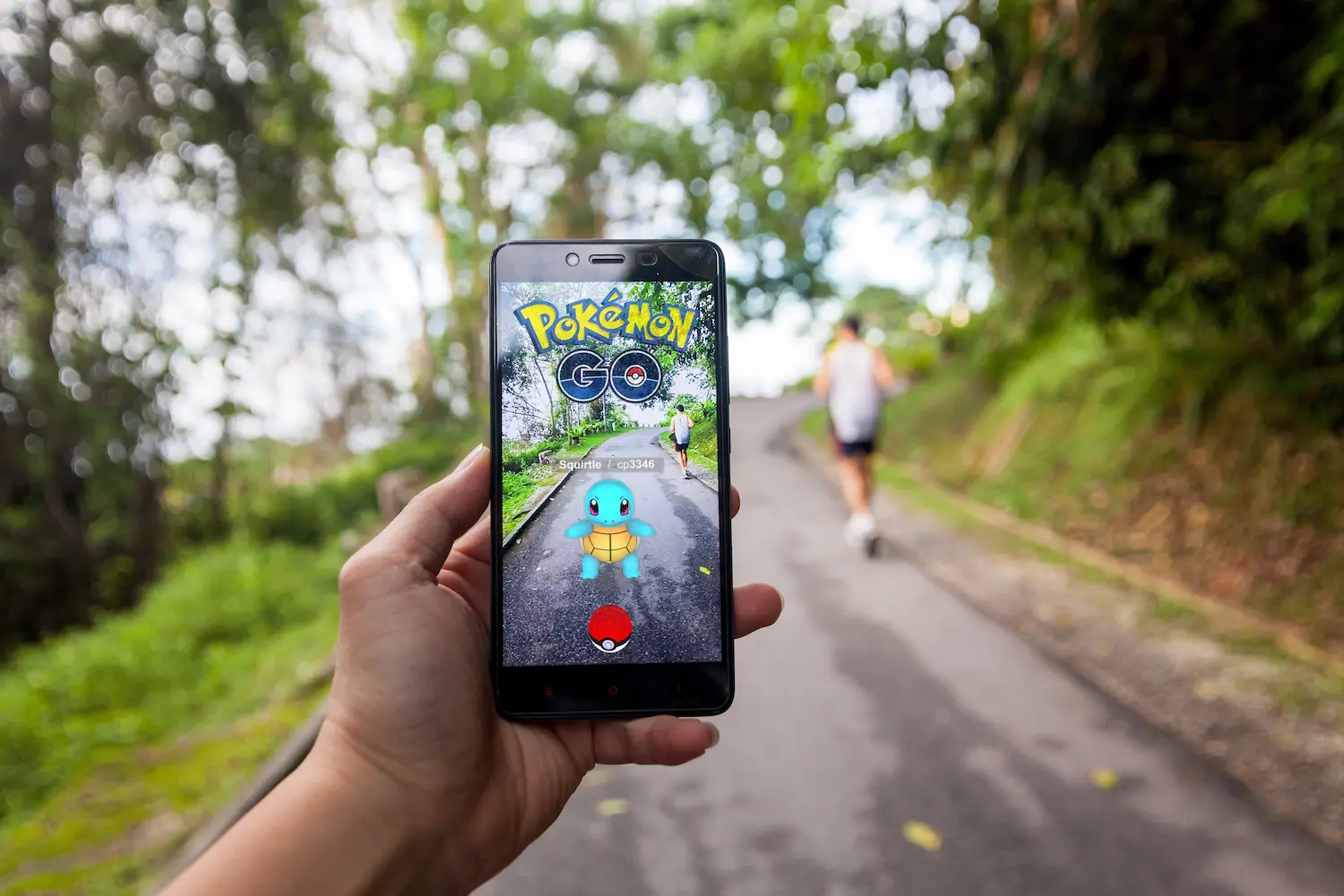
In the summer of 2016, millions of people wandered streets, parks, and shopping centers with their phones pointed at the world around them — convinced they were chasing digital creatures. They weren’t entirely wrong. But they were also doing something else entirely: building the most comprehensive spatial database ever assembled, one PokéStop scan at a time.
Niantic, the company behind Pokémon Go, has just revealed what many had suspected but few had spelled out this clearly. The gameplay mechanic that had players scanning statues, storefronts, and park benches wasn’t just for immersion. It was data collection at civilizational scale — and that data is now being sold to the companies building tomorrow’s autonomous delivery robots.
The GPS Problem Nobody Talks About
Autonomous robots navigating sidewalks face a fundamental technical constraint that GPS alone can’t solve. Standard satellite positioning is accurate to within a few meters — enough to get a car onto the right road, but catastrophically imprecise for a robot navigating curbs, bollards, parked bikes, and pedestrians at ground level. Robots have already tipped over, collided with poles, and failed in real-world deployments because of this gap.
The solution isn’t better satellites. It’s better maps — specifically, centimeter-accurate 3D models of the physical world that a robot can cross-reference with its live camera feed in real time. Instead of asking “where am I according to the sky?”, the robot asks “does what I’m seeing right now match the detailed scan of this exact location?” The difference in reliability is enormous. The cost of building such a map from scratch, across millions of locations worldwide, would be staggering.
💡 Key Insight
Niantic solved the mapping cost problem by making it a game. Players voluntarily scanned their physical surroundings millions of times per day, generating spatial data that would have cost billions to collect through any conventional means. The entertainment was real — but it was also the incentive layer on top of a large-scale data operation.
300 Billion Images, One Million Locations
The scale of what Pokémon Go players collectively produced is difficult to fully absorb. Over the course of the game’s lifespan, more than 300 billion images were submitted by players — not just photos, but georeferenced, multi-angle visual scans of real-world landmarks. The result is a spatial database covering over one million locations mapped to centimeter-level precision. It is, by any measure, the largest dataset of its kind ever created.
Niantic calls this the Niantic Visual Positioning System, and the company has begun licensing it commercially. Among the early customers: Coco, a sidewalk delivery robot company, whose machines can now navigate using Niantic’s scan data rather than relying on satellite positioning alone. The robot compares its live camera view against the pre-existing scan of the same location and orients itself accordingly — a system built entirely on data generated by players who thought they were catching Pikachu.
→ What this means
Niantic has turned a consumer entertainment product into an infrastructure business. The game generates ongoing scan data; the data feeds a spatial intelligence platform; the platform is sold to robotics and AR companies. Players remain the supply chain — most without realizing it.
The Template for the Next Data Harvest
What makes this story important beyond Niantic specifically is what it reveals about the structural logic of free consumer apps. When the product is free and the engagement loop is compelling, the question worth asking is not “what am I getting?” but “what am I providing?” In Pokémon Go’s case, the answer was spatial data. In other apps, it’s behavioral patterns, social graphs, voice samples, or biometric information.
Niantic’s operation was particularly elegant because it wasn’t deceptive in any simple sense — players genuinely had fun, and the PokéStop scanning mechanic was disclosed as part of the game. But the gap between what players understood they were contributing and what was actually being built with that contribution was vast. That gap is the template.
💡 Key Insight
The next time a free app asks you to interact with the physical world — scan, point, tap, walk — it’s worth asking what infrastructure your behavior is quietly building. The entertainment layer and the data layer are increasingly the same product, designed by the same team, for different customers.
The Pokémon Go revelation isn’t a scandal. It’s a case study. Niantic built real value for players and extracted different, larger value for itself — and is now monetizing that extraction by enabling an entirely new industry. The delivery robots rolling down sidewalks in the coming years will navigate a world that millions of people mapped for free, on their weekends, because it was fun. That’s not dystopia. But it is a dynamic worth understanding clearly before the next version of it arrives.
