


Is the logistical burden of recording studio-quality audio slowing down your operational output? This Murf AI review investigates how the platform’s Gen 2 neural models replace traditional workflows with instant, professional-grade narration.
We analyze the cost-benefit ratio of its 200+ voices to determine if this software is the high-performance asset your enterprise needs to scale.
The essential takeaway: Murf AI leads the 2026 text-to-speech market through its advanced Gen 2 neural models, delivering hyper-realistic voice synthesis that effectively mimics human emotion. This technology empowers content creators to reduce production costs by up to 80% and accelerates workflows significantly, eliminating the need for complex studio setups. Validated by a strong 4.7/5 user rating, the platform transforms audio generation into a strategic asset, ensuring professional brand credibility and scalable engagement for global enterprises.
Murf AI Review: Why This Platform Leads The Text-to-Speech Market In 2026?
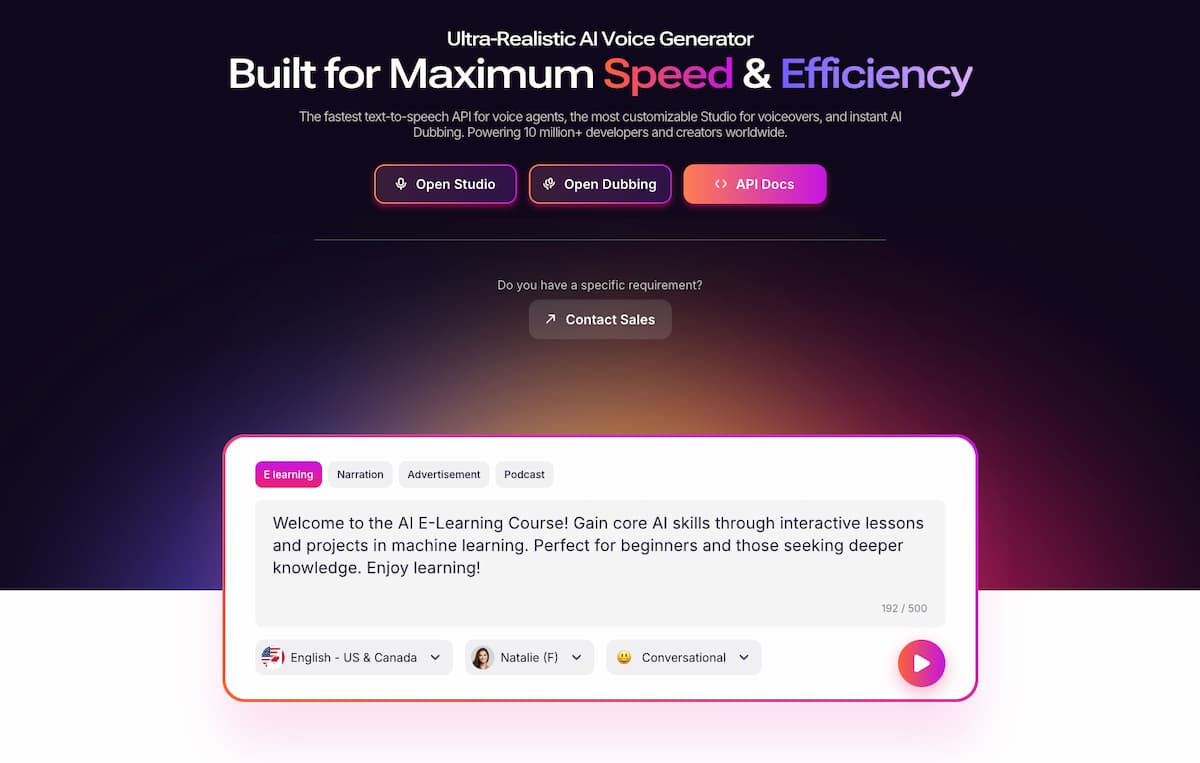
Audio is no longer an optional layer in content creation; it is the central pillar of digital engagement. If you treat voiceovers as an afterthought today, you are actively sabotaging your content’s performance.
The shift toward hyper-realistic voice synthesis
We used to accept robotic, flat narration as the standard cost of automation. Those days are over. Neural models now process text to decode emotional context like joy, empathy, or authority. It is no longer just reading; it is actual performance simulation.
Audience retention hinges entirely on this specific audio fidelity. In a saturated feed, a synthetic-sounding voice guarantees an immediate skip. Listeners demand a human-grade connection to remain engaged.
To meet this strict demand, Murf AI uses a second-generation TTS model to create ultra-realistic voiceovers. This technology captures subtle inflections and rhythms. It bridges the gap between a written script and a convincing execution.
Why realism matters for modern content creators
E-learning modules and YouTube videos fail without natural narration. A monotonous voice causes listener fatigue within seconds. You lose the audience before the real value is ever delivered.
Consider your brand’s credibility for a moment. A cheap, glitchy AI voice signals a low-quality product to your customer instantly. Trust is hard to build but easy to destroy with bad audio. It is a risk you simply cannot take.
Efficiency is the final piece of this puzzle. Tools like Google Vids show how AI simplifies global video production. Murf aligns with this workflow, cutting production time by up to 45%.
Rating: ⭐4.5/5 – Summary of Our Murf AI Review
We give Murf AI a solid 4.5/5 rating. It operates as a versatile powerhouse for corporate communication. You get professional audio without the logistical headache.
The voice realism is undeniable across the board. The interface remains intuitive for non-technical teams. It handles global projects with robust multilingual support. Here is what drives the value:
- Studio quality without microphones
- Library of 200+ voices
- Simplified video synchronization
However, premium quality commands a premium price. The upper-tier plans can feel expensive for smaller creators. You might find the ROI lower if your volume is low.
Social proof backs up our internal assessment. Users consistently praise the platform’s reliability. It dominates the professional sector for a reason.
Murf AI is rated 4.7/5 on G2, proving its dominance in the professional speech synthesis segment.
This isn’t just our opinion. Thousands of users report similar efficiency gains. You can verify these claims directly.
Murf AI is rated 4.7/5 on G2 based on over 1000 customer reviews.
Murf AI Pricing: Evaluating The Cost Of Professional Voice Synthesis
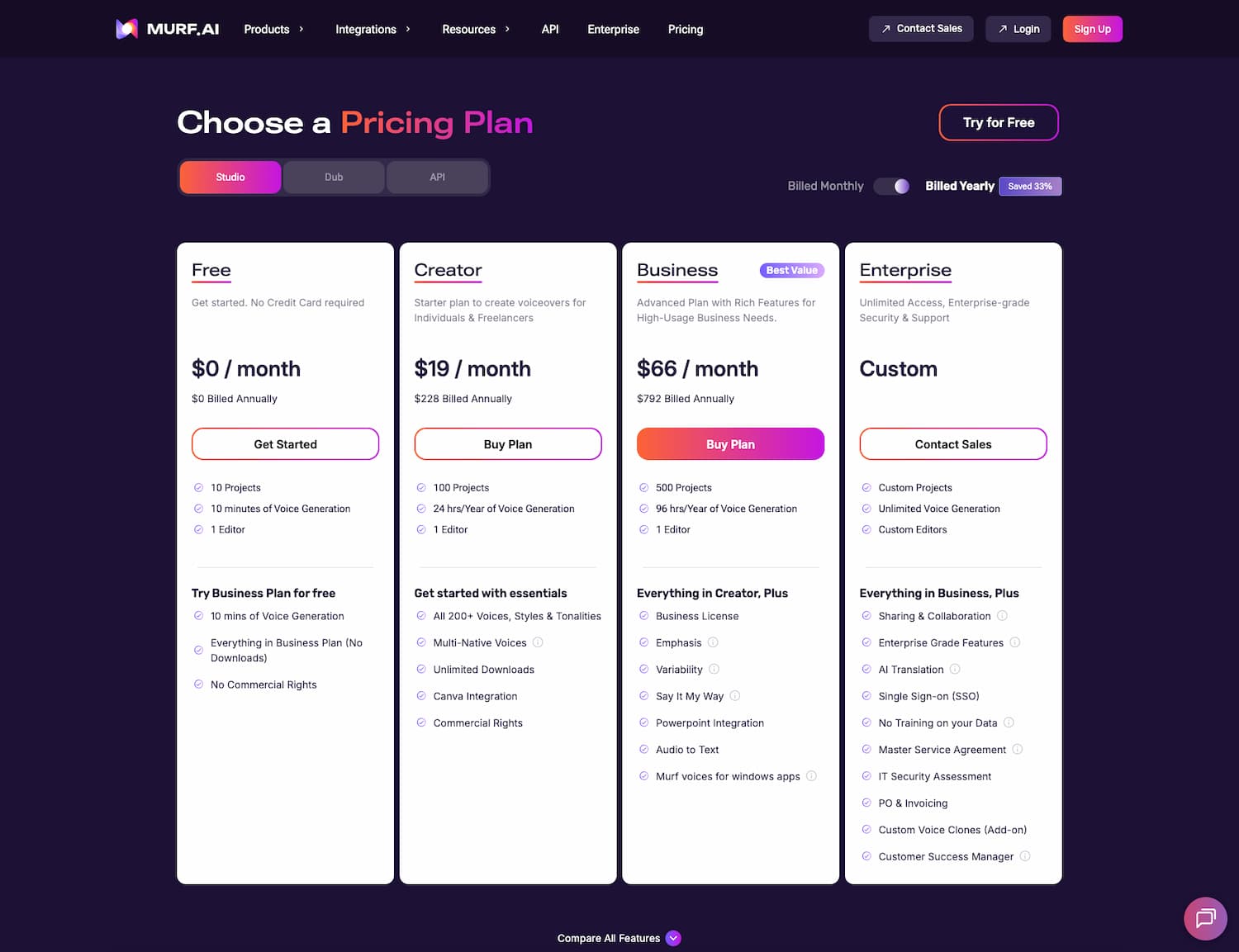
After establishing the functional value, we must examine the financial reality of integrating this tool into your corporate workflow.
The different models and pricing formulas
The Free plan exists strictly for validation, allowing you to test the voice quality without financial commitment. However, serious production workflows demand the Creator or Business tiers to be viable. These paid subscriptions unlock the actual utility required for professional output.
Here is a critical detail regarding your budget: unused generation minutes often do not roll over to the next billing cycle. This creates a “use it or lose it” dynamic that requires careful planning. You must forecast your monthly volume accurately to avoid wasting your allocated budget.
| Plan | Price (Yearly) | Voice Generation/Year | Key Feature |
|---|---|---|---|
| Free | $0 | 15 mins (Trial) | Testing only |
| Creator | $24/mo | 24 hours | Basic usage |
| Business | $79/mo | 96 hours | Collaboration |
| Enterprise | Custom | Unlimited | SSO & Security |
You cannot monetize content on the Free plan; that is a strict limitation of the platform’s licensing terms. Commercial rights are exclusively locked behind the paid subscriptions. This makes the upgrade non-negotiable for any YouTube creator, marketer, or corporate entity publishing public content.
Do not expect to walk away with a finished file using the zero-cost option. The Free plan allows you to generate and listen to audio, but downloading that file requires a paid account. It is purely a sandbox environment for evaluation.
Our assessment of the value-to-cost ratio
Hiring a human voice actor and booking studio time costs hundreds of dollars for a single session. Murf flips this economics model entirely. If you produce more than two videos a month, the software pays for itself immediately compared to outsourcing.
The jump to the Business tier is justified primarily if you work within a team structure. It adds necessary collaboration tools and centralized billing. For solo users, the Creator plan usually suffices for standard workload requirements.
Murf Studio allows for a 70% reduction in voice production costs compared to traditional methods.
This isn’t just marketing hype; internal data suggests companies reduce voice production costs by 70% by switching to AI. That efficiency scales massively when you consider the elimination of retakes and scheduling conflicts common with human talent.
For agencies managing multiple client accounts, the ROI is undeniable. You eliminate the latency of third-party vendors. This speed, combined with the cost savings, creates a significant competitive margin for high-volume content production.
Murf AI : Who Should Use It?
But is this tool actually built for your specific workflow, or is it just another shiny tech gadget?
Content Creators. YouTube and TikTok algorithms favor relentless consistency. Murf allows you to produce high-quality narration without investing in expensive microphones or worrying about background noise ruining your recording session.
Instructional Designers. E-learning demands absolute clarity and neutrality. This software masters that balance, delivering articulate voiceovers that keep the learner’s focus on the material rather than the speaker’s performance.
Global Marketing Teams. Scaling campaigns across languages often creates quality control issues. Murf solves this by acting as a unified collaboration platform, maintaining a cohesive brand identity across every region.
- Podcasters needing polished intros and outros.
- Developers building voice agents via API.
- HR Managers standardizing corporate training.
Advertising Agencies. Speed is your currency. You can generate rapid scratch tracks to validate scripts with clients before committing the budget to professional human talent for the final production.
A hard truth. If you are a narrative podcaster seeking deep emotional range, this is not for you. The AI is precise, but it still lacks the raw, visceral connection required for heavy storytelling.
Features: A Deep Dive Into The Murf Studio Environment
Let’s get into the engine. Murf Studio isn’t just a text field to fill; it is a genuine mixing console.
High-fidelity voice cloning and ethical safeguards
The essential takeaway: Scalability meets identity. Cloning your own voice allows you to maintain a consistent sonic brand without spending endless hours chained to a microphone. It effectively digitizes your vocal presence for rapid content deployment, freeing you from physical recording constraints. This is efficiency at its peak.
Security is paramount. Murf enforces rigid verification protocols to prevent malicious deepfakes and protect intellectual property. This isn’t the Wild West; it’s a controlled environment designed to safeguard your digital assets against misuse. You operate within a safe perimeter.
Explicit consent is mandatory. Before any cloning occurs, the platform requires a recorded consent statement. For enterprises, this acts as a critical liability shield, ensuring no unauthorized voice replication takes place within your organization’s workflow. It mitigates legal risk effectively.
This shift in workflow represents The Invisible Revolution in corporate communications. Automation handles the heavy lifting, allowing human creativity to focus on strategy rather than repetitive recording tasks, fundamentally changing how we produce assets.
Professional AI voice changer and translation tools
Upgrade your raw audio. The Voice Changer feature takes a mediocre phone recording and instantly transforms it into a polished studio-quality track. You bypass the need for expensive hardware entirely, turning amateur input into professional output. It is impressive.
Global reach made simple. With support for over 20 languages, adapting a single piece of content for Spanish or German markets becomes a trivial task. You scale your message globally without the logistical nightmare of hiring new talent. Speed to market increases dramatically.
Users have access to a choice of over 200 voices in 35+ languages. This diversity ensures you find the exact tonal match for your specific demographic, regardless of the region or the complexity of the script.
Synchronization matters. The AI dubbing engine preserves the original video’s rhythm, effectively eliminating the jarring disconnect often seen between image and sound. It maintains the viewer’s immersion throughout the experience, preventing the audience from disengaging.
Advanced customization with pitch and emphasis controls
Fine-tune the delivery. The pitch and speed sliders offer granular control over the output. Slowing a sentence down by just 5% often changes the message from frantic to authoritative, altering how your audience perceives the core information. Control is absolute.
Direct the listener’s attention. The emphasis tool lets you highlight specific words, mimicking natural human speech patterns. This is where the “robotic” stigma dies and true audio realism begins, creating a genuine connection with the listener. Nuance is key.
Protect your brand equity. The pronunciation library is indispensable; it ensures the AI never butchers your company name or technical jargon. You define the phonetics once, and the system obeys, preventing embarrassing errors in client-facing materials.
Just as Google NotebookLM optimizes research, these tools optimize audio production. They turn a standard text-to-speech engine into a precise instrument for professional communication, saving significant time during the editing phase. Efficiency drives results.
Technical Performance And Ecosystem Integrations
A standalone tool is useless if it operates in a silo. Let’s examine how Murf connects to your daily software stack to bridge that gap.
Seamless workflows with Canva and PowerPoint
The Canva integration allows you to inject AI voiceovers directly onto your designs without ever leaving the interface. You stop wasting time toggling between tabs or managing clumsy file uploads. It streamlines the creative process significantly for visual creators.
For corporate environments, the PowerPoint plugin is a massive efficiency booster for automated presentations and webinars. You transform silent slides into narrated assets instantly, keeping animations and transitions intact without exporting notes manually.
Murf officially integrates with tools like Canva and PowerPoint to validate these strategic partnerships.
Synchronization happens in blocks, aligning audio with specific slide elements. This granular structure makes last-minute corrections painless since you don’t have to re-render the entire audio track for a single typo.
Enterprise-grade security and API efficiency
Security is often the deal-breaker for large organizations, but Murf checks the right boxes with SOC 2 Type II and GDPR compliance. Data is encrypted at rest using AES-256, satisfying strict IT procurement standards regarding data privacy.
The Falcon API is engineered specifically for conversational AI agents requiring near-zero latency. With a model latency of just 55ms, it handles high-volume requests without the lag that typically kills user experience in IVR systems.
Technical benchmarks confirm that Murf Falcon API features 130ms end-to-end latency for demanding real-time applications.
Developers can leverage the Python SDK available on GitHub to automate production at scale. It supports asynchronous calls, making it viable for building complex, responsive voice applications that require robust error handling.
Long-term ROI And Ethical Voice Cloning
Beyond practicality, let’s talk money and responsibility. Is this a smart calculation over two or three years?
Comparing AI voices to professional human talent
Hiring a human voice actor typically costs between $300 and $500 per finished hour. In contrast, Murf operates on a fixed subscription model. For high-volume projects, the math is undeniable; you slash production costs by up to 80%.
Then there is flexibility. Changing a single sentence with AI takes ten seconds of rendering. Rebooking a human for a studio session takes days and costs extra.
Murf Studio allows you to accelerate voice-over production by a factor of 10.
Finally, consider scalability. AI never gets tired or loses its voice, unlike human vocal cords which have physical limits.
Safety measures and data privacy standards
Your voice data is encrypted end-to-end. Murf guarantees that your custom voice clones remain locked to your account and are never utilized without your specific access key.
Let’s discuss commercial usage. The licensing terms are transparent, protecting you from legal headaches during broadcast. Whether for TV or web distribution, you own the commercial rights to the generated content on paid plans.
This security extends to internal systems. Many enterprises deploy this for Interactive voice response technology within their corporate telephony networks to ensure data integrity.
Data privacy isn’t just a cost; it is a strategic investment for brand reputation, especially as we look toward 2026.
Real-World Feedback From The Creative Community
Let’s step away from the marketing claims for a second. With a 4.7/5 rating on G2, the verdict from the creative community is loud and clear. Users consistently praise the intuitive “drag-and-drop” interface, noting that you do not need a degree in audio engineering to get results. It is built strictly for efficiency.
Is it perfect? Not exactly. Some feedback points to the Enterprise plan being a heavy investment for smaller budgets. Yet, these same users admit the customer support is ultra-responsive, effectively balancing the higher sticker price with professional reliability.
Digging deeper into the user reviews, three technical wins stand out repeatedly:
- Quality of regional accents (especially UK and Australian).
- Impressive rendering speeds that cut production time.
- The ease of importing scripts directly.
For global creators, the feedback regarding localization is surprisingly positive. While many tools fumble with non-English languages, users appreciate the precision of the French and German voices, which often sound far less robotic than the industry standard.
Is Murf AI The Right Investment For Your Workflow?
Murf AI dominates the sector by balancing hyperrealistic Gen 2 audio with surgical control tools. You get granular command over pitch and timing. It remains the gold standard for precision.
For frequent content creators, bypassing this tool means losing hours to manual recording. The paid tiers justify their cost by slashing production expenses by up to 80%. However, casual users should stick to the Free Plan. Occasional usage rarely warrants a monthly subscription.
Streamlining audio is only half the battle. Pair this capability with the Best AI summary tools to fully optimize your content pipeline. This combination creates a truly formidable productivity stack.
Murf transcends the status of a simple TTS gadget to become a legitimate production partner. Its ability to integrate directly with Canva and PowerPoint fundamentally shifts your workflow. You stop managing files and start engineering global communication. It redefines your output potential.
This platform represents a solid strategic asset. Commit to the upgrade if you intend to bypass expensive studio sessions and elevate your brand’s voice immediately.
This analysis of Murf AI validates its capacity to streamline production via hyper-realistic synthesis and enterprise security. For creators prioritizing an 80% reduction in costs, integrating this studio remains the optimal strategy. Elevate your brand’s auditory presence today to secure a lasting competitive advantage.
FAQ
Is Murf AI completely free to use?
Murf AI offers a Free plan designed primarily for evaluation and testing purposes. While it grants access to the studio and allows for 15 minutes of voice generation to assess quality, you cannot download the final audio files without upgrading to a paid subscription.
Can I use Murf AI voices for commercial projects and YouTube monetization?
Commercial rights are exclusively reserved for users on paid subscription plans. If your objective is to monetize content on platforms like YouTube, or to utilize the audio for corporate presentations, advertisements, and e-learning modules, you must migrate from the free version to a paid tier to ensure legal compliance.
How realistic is the voice quality generated by Murf?
Murf utilizes a second-generation (Gen 2) neural text-to-speech model engineered to deliver hyper-realistic, human-like fidelity. The engine captures subtle nuances, pauses, and intonations, making the output suitable for professional environments where robotic synthesis would otherwise degrade the user experience.
Is Murf AI safe and ethical regarding voice cloning?
The platform adheres to strict ethical guidelines and security protocols, particularly concerning its voice cloning technology. Murf requires rigorous verification to ensure consent, preventing the creation of unauthorized deepfakes, and prioritizes the protection of user data and intellectual property.
Does Murf AI integrate with other content creation tools?
Murf is built to streamline professional workflows through robust integrations with industry-standard software. It connects seamlessly with platforms such as Canva, Google Slides, and Microsoft PowerPoint, allowing you to embed high-quality voiceovers directly into your presentations and designs without switching applications.
