


Are you struggling with AI video tools that produce rubbery movements or drain your budget with expensive token costs? This minimax io review explores how this Shanghai based powerhouse challenges the status quo with its high-fidelity Hailuo engine and competitive M2.5-Lightning pricing.
You will discover how its hybrid-attention architecture and 1-million token context window provide a professional edge for cinematic generation and complex agentic workflows.
The essential takeaway: Minimax io emerges as a formidable AI powerhouse, scoring an 8.5/10for its unmatched physics engine While the “use it or lose it” credit policy remains a hurdle, its M2.5-Lightning model offers a massive competitive edge, delivering top-tier coding performance at a fraction of the cost of GPT-4 or Gemini. With a 1-million token context window and 456 billion parameters, it is a high-ROI solution for pros needing consistent, cinematic B-roll and complex logic.
Summary of our Minimax io review – ⭐8.5/10
The global AI hierarchy is shifting fast. Our minimax io review awards this Shanghai-based powerhouse a solid 8.5/10. Developed by the MiniMax Group, Inc., which is deeply rooted in China’s tech hub, it stands as a formidable competitor in video generation and complex reasoning.
Its physics engine delivers a genuine “wow” factor during media creation. While not entirely flawless, the realism often surpasses Western benchmarks. It effectively challenges the current status quo in the creative AI space.
The platform offers unmatched physics and competitive pricing for serious creators. Whether you are a pro or a hobbyist, the tool provides a high-performance alternative to mainstream models. It is a robust choice for those seeking cutting-edge visual output.
Pricing of Minimax io
Move from the general hype to the cold, hard numbers that determine if this tool actually fits into a professional budget.
Subscription models and credit systems
You buy a specific monthly allocation of credits. These units power every generation across the platform. Be careful, as unused credits typically expire when your billing cycle resets.
Users choose between Standard vs Fast generation modes. Fast mode significantly slashes waiting times but consumes more credits. It is a trade-off between speed and your remaining balance.
The M2.5-Lightning model offers impressive cost efficiency. It remains much cheaper than using GPT-4 or Gemini for similar tasks. You can check the MiniMax M2.5-Lightning pricing for the latest benchmarks.
Our take on the Minimax io pricing
The free tier works for basic testing but feels very restrictive. Paid plans provide much better transparency. You also get higher priority in the generation queue during peak hours.
For hobbyists, the cost might feel steep. If you only generate content occasionally, the monthly commitment is hard to justify.
Pros will find a high ROI here. It is a solid investment for creators needing consistent, high-quality B-roll. Here is my honest view on the setup:
“The credit system is transparent enough, but the ‘use it or lose it’ policy on monthly allocations remains a pain point for irregular users.”
Minimax io: who is it for?
Now that the costs are clear, let’s identify exactly who should be hitting that “Subscribe” button and who should pass.
Target content creators and filmmakers first. They will love the cinematic output. Use visual consistency as a key selling point for this group.
Address developers and tech-savvy users. The API and reasoning models make it a playground for building autonomous agents. It’s not just a video tool; it’s a logic engine.
Mention who should avoid it. If you need perfect human hand animations or historical archive upscaling, you might find better specialized tools elsewhere.
Stay ahead by tracking the latest AI trends. Integrating this into a top-tier productivity stack ensures you don’t fall behind. The tech moves fast; don’t get left in the dust.
- Social media managers needing quick B-roll
- Developers building AI agents
- Indie filmmakers on a budget
- Marketing agencies testing rapid concepts
List of key features
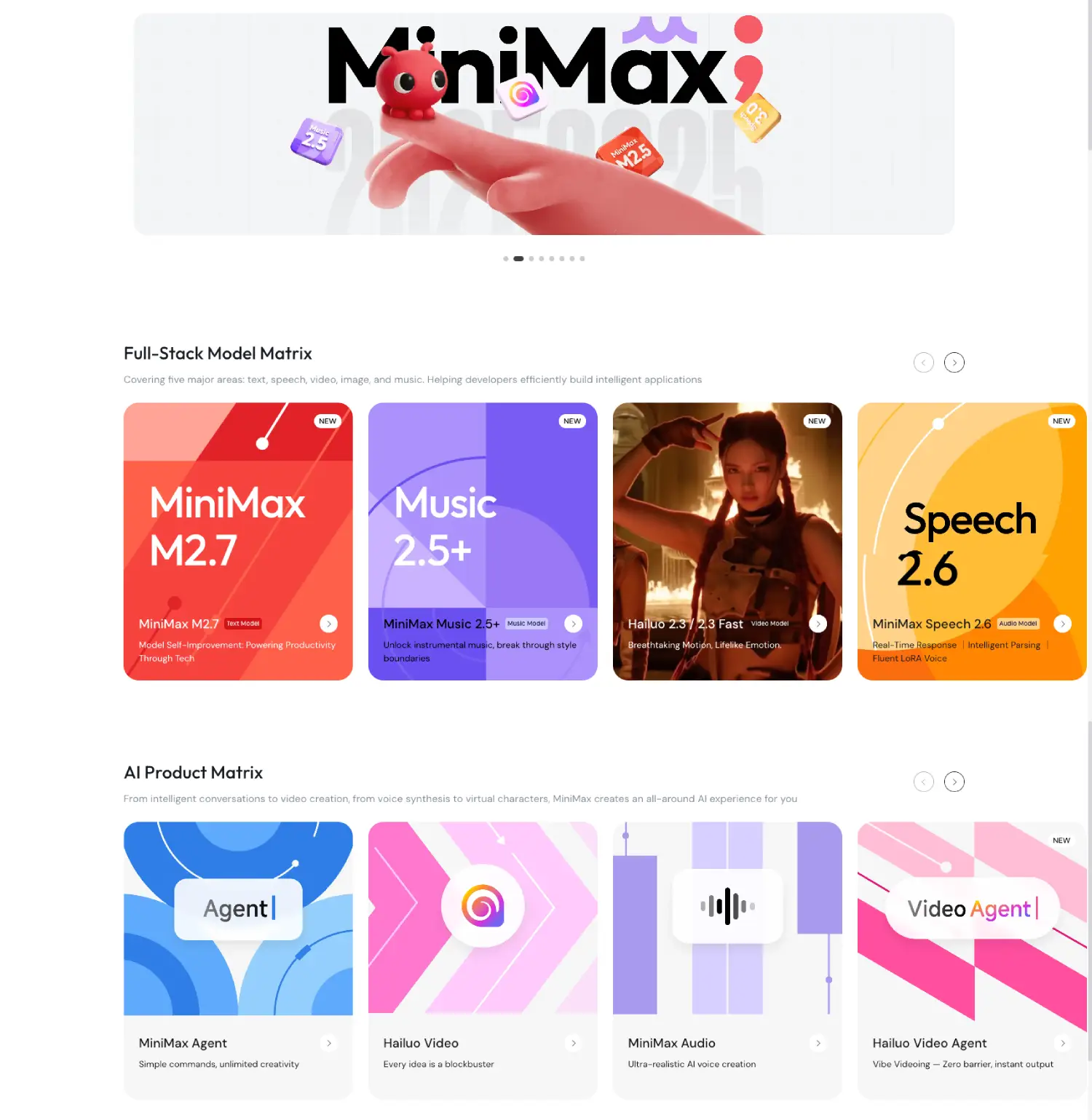
To understand why the ratings are so high, we need to look under the hood at the specific tech driving these results.
Hybrid-attention reasoning models
MiniMax utilizes M1 and M2 architectures. These hybrid-attention models leverage a Mixture-of-Experts (MoE) design. The M1 model stands out with a massive 456 billion parameter count.
The system features a 1-million token context window. This allows the AI to retain vast amounts of data. Such capacity is vital for complex coding or long-form storytelling projects requiring deep memory.
The reasoning capabilities excel at multi-step logic. It handles intricate tasks with high precision. You can look at SWE-bench scores to see its proven coding prowess via the MiniMax-M1 open-weights model.
High-fidelity video generation and physics
The “Hailuo” video engine powers the visual side. It is famous for realistic physical movements. Water splashes and hair blowing look remarkably natural compared to older, static AI models.
Visual consistency remains a top priority here. Keeping a character’s face identical across multiple clips is the ultimate goal. Minimax handles this better than most competitors, though it is not perfect yet.
Use descriptive motion keywords for better results. Try phrases like “cinematic handheld pan” or “dynamic lighting.” Check this honest video generation review for more on physics and consistency claims.
Agentic workflows and API integration
This goes beyond a simple chatbot. You can set up “agentic” workflows. These agents perform tasks autonomously by utilizing the advanced logic found in the M2 model series.
The API is accessible even for non-coders. Tools like Zapier or Make connect easily to Minimax. This makes automation possible without writing a single line of Python code for your business.
Memory management is a standout feature. Agents maintain context over long, complex interactions. This is essential for business workflows, much like integrating AI notes into your workflow to keep history organized.
Customer reviews
Beyond our own testing, what is the broader community saying about their daily experience with Minimax?
Platform ratings and community sentiment
Trustpilot scores currently hover around 3.2 stars. Users generally praise the output quality for initial drafts. The consensus is that it’s a top-tier video generator for visual concepts.
Technical requirements are straightforward for most. You need a modern browser and a stable connection. It’s cloud-based, so your local GPU doesn’t do the heavy lifting during rendering.
The interface earns points. Most users find the interface intuitive and clean. It feels professional.
Analysis of specific feedback and technical hurdles
Let’s address the elephant in the room. System overloads happen during peak hours. Some users report failed generations that still consume credits, which is frustrating and costly.
Transparency remains a sticking point. Users often ask about training data and copyright. The platform needs more transparency on how it handles media usage rights for commercial projects.
Physics still hit snags. Complex movements like dancing still look “rubbery” sometimes. It struggles with high-speed motion.
| Metric | User Rating | Key Comment |
|---|---|---|
| Video Physics | 3.5/5 | Occasional rubbery motion |
| Logic/Reasoning | 4.0/5 | Strong prompt adherence |
| Pricing Fairness | 2.5/5 | Credit expiration issues |
| UI Accessibility | 4.5/5 | Very beginner friendly |
Final verdict
So, after all the tests and community feedback, where does Minimax io actually stand in the hierarchy?
The 8.5/10 score remains justified. It is a powerhouse for video and logic. If you can handle the occasional system lag, the output is worth it. It is a formidable competitor to Western AI.
Weigh the pros against the cons. The physics engine is the star. The credit expiration is the main drawback. But overall, the value proposition is solid for most professional creators.
Use it if you need high-end B-roll or complex AI agents. Keep an eye on their roadmap. This platform is evolving fast and won’t stay at version 2.5 for long. You should start small.
Minimax io isn’t just another AI tool; it’s a glimpse into a future where physics-accurate video generation becomes a commodity for every creator.
Stay updated with the latest AI insights and business strategies. New models drop weekly. Keeping your edge requires constant monitoring of these shifts. Don’t get left behind by the tech curve.
With its unmatched physics engine and high-performance reasoning, this ecosystem offers a powerful, cost-effective alternative for creators. Start with the free tier to build your proof-of-concept before scaling your cinematic projects. This minimax io review confirms that physics-accurate generation is finally within your reach.
FAQ
What exactly is Minimax io and who is behind it?
Minimax io is an advanced AI platform developed by the Shanghai-based MiniMax Group. It has quickly gained a reputation as a serious contender in the AI landscape, particularly for its high-fidelity video generation and sophisticated reasoning capabilities. With a solid 8.5/10 internal rating, it challenges the current Western status quo by offering powerful tools for both creative media and complex logic.
How does the credit system and pricing work?
The platform operates on a credit-based subscription model where you purchase a monthly allocation of credits. It is important to note that unused credits typically expire at the end of your billing cycle. Users can choose between Standard vs Fast generation modes; the Fast mode significantly reduces waiting times but consumes your credit balance more quickly.
Is Minimax io a cost-effective alternative to GPT-4?
Yes, for many use cases, Minimax io offers a very competitive pricing structure. Specifically, the M2.5-Lightning model is designed to be significantly more affordable than rivals like GPT-4 or Gemini. While the free tier is useful for basic testing, professionals often find that the paid plans provide the necessary priority and transparency needed for consistent workflows.
What are the standout technical features of the model?
The platform is powered by the MiniMax-M1 architecture, a hybrid-attention model featuring a massive 456 billion parameters. One of its most impressive technical feats is the 1-million token context window, which allows the AI to retain and process vast amounts of data. This makes it exceptionally strong for multi-step reasoning, long-form storytelling, and complex coding tasks.
How realistic is the video generation physics?
The “Hailuo” video engine is widely praised for its realistic physical simulations. It excels at rendering natural movements, such as water splashes or hair blowing in the wind, with much higher fidelity than older AI models. While achieving perfect visual consistency across multiple clips remains a challenge for the entire industry, Minimax is currently one of the top performers in maintaining character stability.
Can I integrate Minimax io into my existing business workflows?
Absolutely. Beyond simple chat or video generation, the platform supports “agentic” workflows using the M2 model’s logic to perform tasks autonomously. For those who aren’t developers, the API can be connected to automation tools like Zapier or Make. This allows businesses to build sophisticated AI agents that maintain context, which is essential for professional environments.
What are the common complaints or limitations to watch out for?
Some users have reported technical hurdles, such as system overloads during peak hours that can lead to failed generations. There have also been instances where users felt the “use it or lose it” credit policy was frustrating. Additionally, while the physics engine is top-tier, complex human movements like dancing can still occasionally appear “rubbery” or unnatural.
