
Are you struggling to launch your web application because hiring a developer is too expensive or manual coding takes far too long?
This lovable review examines how this highly sophisticated AI engineer leverages a professional React and TypeScript stack to transform your natural language prompts into functional, production-ready software.
You will discover exactly how the “vibe coding” workflow accelerates prototyping cycles and whether the specific credit-based pricing model offers a sustainable return on investment for founders looking to scale their MVPs without any technical friction or traditional software engineering bottlenecks.
The bottom line: Lovable.dev functions as a sophisticated full-stack AI engineer, transforming natural language prompts into professional web applications built on React and TypeScript. This platform accelerates development by handling 80% of the heavy lifting, enabling the rapid launch of functional MVPs while ensuring full code ownership through GitHub sync. Its seamless integration with Supabase provides industrial-grade scalability for modern digital products. However, success requires strategic communication to manage the credit-based model effectively and avoid costly debugging loops during intense development sessions.
Why Lovable is the AI Engineer You Didn’t Know You Needed
Moving from manual syntax to AI collaboration isn’t just a trend; it’s a fundamental shift in how we build software today, turning the tool into a true partner.
The Tech Stack Behind the Magic
Lovable.dev acts as a full-stack AI engineer. It goes beyond simple low-code builders. Think of it as a sophisticated partner for your development workflow.
The platform relies on a modern foundation. It utilizes React, Tailwind CSS, Vite, and TypeScript. These tools ensure your web applications remain fast and responsive.
This specific stack guarantees professional, industry-standard output. It allows your projects to scale without hitting technical walls.
From Vibe Coding to Real Products
Vibe Coding replaces rigid manual syntax with natural language. You describe your vision through simple prompts. This approach accelerates the initial development phase. It turns abstract ideas into functional code almost instantly.
Prototyping cycles shrink from weeks to minutes. Founders can witness their concepts come to life without touching a keyboard.
This workflow accelerates the design process by handling 80% of the heavy lifting. It removes friction from complex UX builds.
Summary of Our Lovable Review
Moving from technical theory to a practical, hands-on evaluation of the tool’s actual performance and value proposition.
Lovable stands out as a formidable AI engineer for rapid web development. It delivers impressive results if you approach it with a structured architectural mindset. Success depends on guiding the AI rather than expecting magic from a single prompt.
The development speed is genuinely startling for building React and Vite applications. You get surprisingly clean TypeScript code that remains readable for human developers. Integrating Supabase for authentication and database management feels native and effortless. It effectively bridges the gap between a prompt and a functional prototype.
The credit-based pricing model can become expensive during intensive debugging sessions. Sometimes the AI enters a repetitive looping cycle when fixing complex logic errors. You must monitor your consumption closely to avoid burning through your monthly allowance too quickly.
| Feature | Verdict | Best For |
|---|---|---|
| Speed | 5/5 | Blazing fast MVPs |
| Code Quality | 4/5 | Clean React output |
| Backend Ease | 5/5 | Smooth Supabase sync |
| Pricing | 3/5 | Careful credit management |
Lovable Pricing Plans
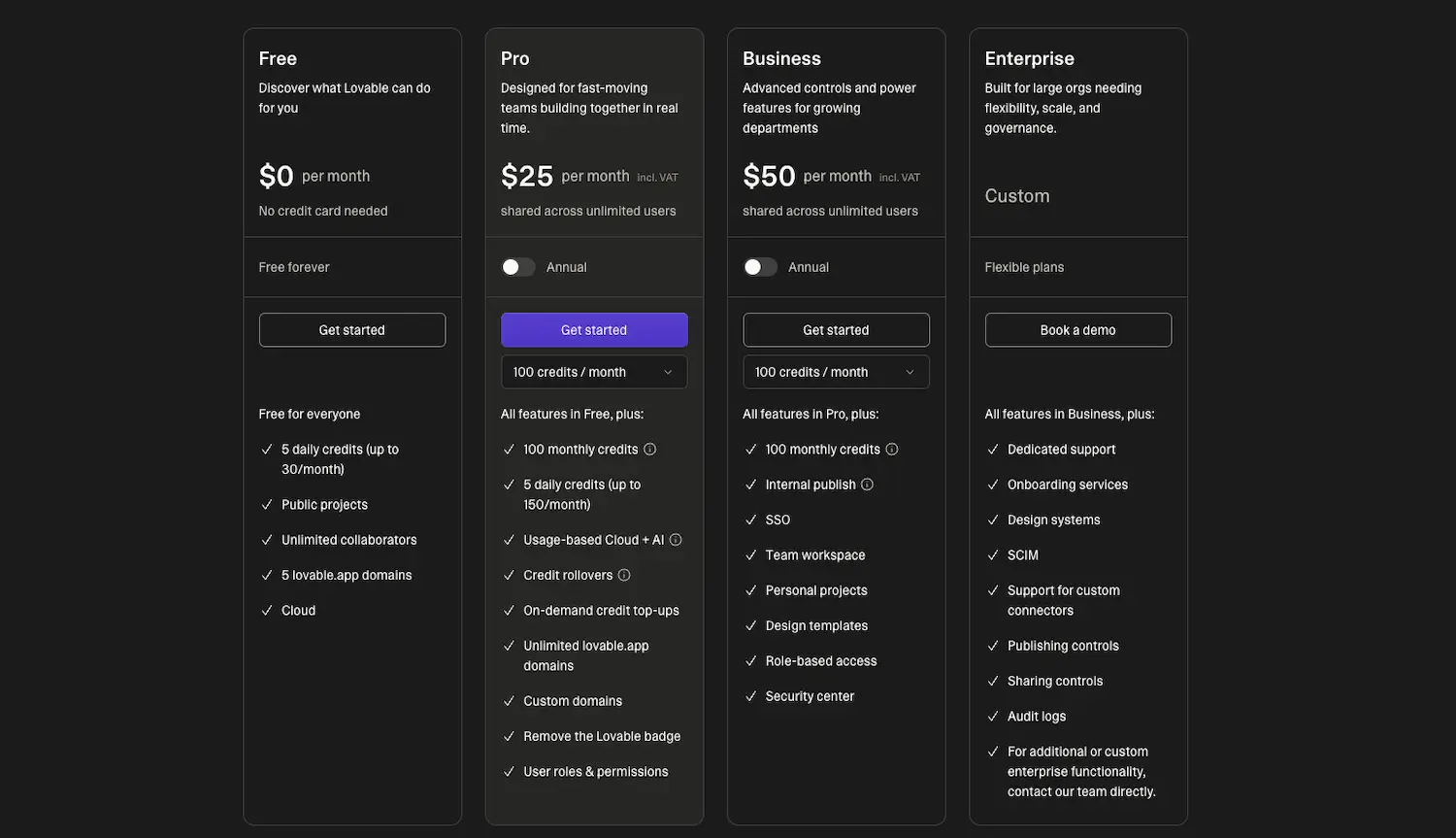
Shifting gears from technical performance to the actual bill. Keeping this “AI engineer” on your payroll requires understanding its metered heartbeat.
The Different Tiers and Credit Model
Start with the Free tier to kick the tires. It offers five daily credits for small experiments. Serious builders eventually need the Pro or Business plans for real projects.
Every interaction consumes credits based on task complexity. Simple button tweaks cost less than adding full authentication. These points vanish quickly during intense debugging sessions. You must track your burn rate constantly to avoid unexpected mid-build stalls.
Downgrading your plan triggers an immediate credit cleanup. Unused monthly balances typically expire once the billing cycle ends. You might also lose access to private projects or custom domains.
The credit system is the heartbeat of Lovable; managing your prompts effectively is just as important as the code itself.
Our Verdict on Lovable’s Value
The cost-to-performance ratio is strong for solo founders. Paying twenty-five dollars monthly beats hiring a part-time developer for a week. It accelerates the messy early prototyping phase significantly.
Watch out for the “Try to Fix” loops during debugging. Automated error correction can drain your wallet if the AI gets stuck. Monitor these cycles closely to prevent credit exhaustion on a single bug. Smart prompting saves money.
Compared to other low-code tools, the React and TypeScript output is top-tier. You get clean, portable code that developers actually respect. The price justifies the high-quality architectural results.
Master the prompting logic on the free plan first. Only upgrade once you have a clear roadmap.
Who is Lovable For?
Now that we know the cost, let’s identify which types of users will actually get the most out of this investment.
Non-technical founders find a distinct advantage here. It turns abstract ideas into functional MVPs without the immediate headache of hiring a CTO. You validate your market fit before burning through capital or equity.
Professional developers also gain significant speed. Think of it as a high-speed scaffolding engine that handles the repetitive setup. It skips the tedious boilerplate, letting you focus on unique logic instead of basic configuration.
Integrating AI tools like Lovable effectively makes them the ultimate tireless team member for your startup. They handle the grunt work 24/7 without ever needing a coffee break or a salary bump.
- Solopreneurs building SaaS
- UX Designers prototyping complex flows
- Product Managers creating internal tools
- Developers needing quick React boilerplate
But it isn’t for everyone. Large enterprises stuck with legacy monolithic systems will likely find the platform too restrictive for their specific requirements. It thrives on speed, not ancient architecture.
Key Features and Capabilities
Let’s break down the specific features that make this tool stand out in the crowded AI development market.
Prompt to Prototype Workflow
You describe your idea in plain English. The AI immediately translates these words into functional code. This process turns abstract concepts into real, interactive user interfaces without any manual coding.
Visual cues help the engine understand your style. You can upload Figma screenshots or UI inspiration. This guides the AI’s aesthetic choices effectively. It guarantees the final result matches your brand vision perfectly. It saves hours of manual design work.
This engine allows you to transform concepts into functional app skeletons within seconds. It creates forms, tables, and lists instantly. Speed is the primary advantage advantage found within this platform.
Most people look for the best wireframing tools to start projects. But Lovable goes much further by generating live code instead of static images. It bridges the gap between a sketch and a working application right here starting from today.
Visual Editor and Chat Mode
The Figma-like editor is a massive win. Non-technical users can click and tweak UI elements directly. You don’t need to touch the underlying code to make styling changes at all.
Chat Mode functions as your real-time debugging companion. You can ask for specific logic changes through a simple conversation. It handles the heavy lifting of backend adjustments. This keeps the development momentum high without ever hitting any technical walls.
The “Try to Fix” button is a lifesaver for errors. It attempts to resolve console bugs automatically with one click. This feature saves hours of manual troubleshooting every single day.
The visual editor bridges the gap between design and development, making real-time iteration feel like a conversation rather than a chore.
This guarantees every team member can contribute effectively. It turns complex coding tasks into simple visual updates.
Supabase and GitHub Integration
Setting up Supabase is remarkably straightforward. It handles your database and authentication needs automatically. You get a robust backend with almost zero manual configuration or extra effort.
GitHub sync is vital for professional version control. It guarantees you actually own the repository and the code. You can export your project whenever you want. This prevents vendor lock-in and gives you full control over your intellectual property.
The platform integrates with backend solutions like Supabase to manage user interactions. It creates schemas and tables based on your prompts. Data management becomes incredibly simple for everyone.
Following cloud security tips is easier with this setup. Supabase helps maintain data integrity while Lovable handles the connection logic. Your application remains secure and scalable from the very first day. It is a professional-grade stack for modern developers.
Technical Limits and Code Ownership
While the features are impressive, every tool has its boundaries that you need to understand before going all-in.
Escaping the AI Debugging Loop
Users often encounter a frustrating “looping” cycle. The AI resolves a specific bug but inadvertently triggers a fresh conflict elsewhere. This repetitive back-and-forth stalls your actual development progress significantly.
The “Try to Fix” button has clear operational ceilings. In intricate scenarios, clicking it repeatedly might drain your message credits. This happens without delivering a functional solution. You risk burning through your monthly budget while the logic remains fundamentally broken.
Expert analysis suggests that this tool cannot replace human expertise for complex data science. Deep engineering tasks still require a developer’s touch. AI struggles with high-level architectural decisions.
Handling Complex Backend and SEO
Lovable handles standard CRUD applications with remarkable speed. But projects requiring heavy custom backend logic often hit a wall. The platform struggles when you move beyond basic database operations.
Connecting custom domains is straightforward, yet SEO requires careful attention. The output is a Single Page App. Search engines must execute JavaScript to see content. This client-side rendering approach can sometimes delay indexing or affect your overall search visibility.
Code portability remains a major advantage for professional users. Because the stack uses standard React and Vite, you can export the entire codebase. This prevents any long-term vendor lock-in.
User Feedback and Market Reception
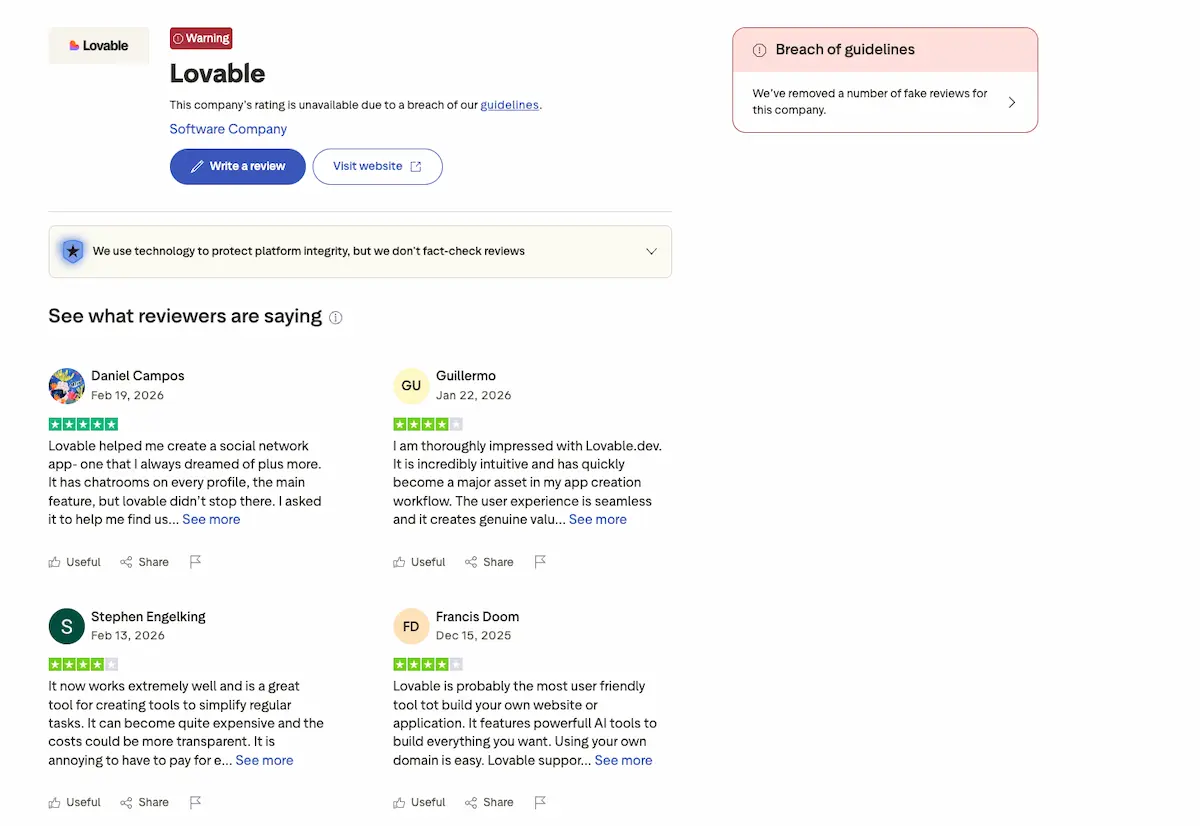
Let’s see how the broader community is reacting to Lovable’s approach to “Vibe Coding.”
Most early adopters conducting a lovable review are genuinely startled by the raw execution speed. The platform transforms basic text descriptions into functional prototypes in mere seconds. This rapid output creates a powerful first impression for non-technical founders.
Users frequently highlight the need for a traditional drag-and-drop interface. While text prompts work, visual positioning remains a recurring request. Better mobile-first design workflows are also high on the community wishlist. These additions would bridge the gap between AI generation and manual refinement.
The tool has been praised for understanding complex UX language from detailed prompts. It captures nuance that generic LLMs often miss. This precision helps in building sophisticated interfaces without touching a single line of code.
Users report varied experiences across the platform. Key takeaways include:
- High marks for UI consistency
- Mixed reviews on credit pricing
- Praise for GitHub sync
- Requests for Figma design token support
Final Verdict on Lovable.dev
After weighing the pros, cons, and costs, here is our definitive take on whether you should use Lovable.
Lovable stands out as a top-tier choice for rapid development. It is a must-try for anyone looking to build a web app quickly in 2025. You should definitely give it a spin.
We recently analyzed several best productivity tools, placing Lovable at the top of the list for modern creators. The speed of generating React and Tailwind code is unmatched. It simplifies the entire deployment workflow. This tool genuinely saves hours of manual labor.
Success with this AI engineer depends largely on how clearly you communicate. Mastering prompt engineering is the real secret sauce here. Be specific with your instructions to avoid credit-wasting loops.
Lovable isn’t just a tool; it’s the future of building software. Try it today.
Lovable masters rapid prototyping with clean React code and seamless backend integration. Start with the free tier to refine your prompting logic immediately. This lovable review confirms that adopting this AI partner today ensures you ship professional products and lead the future of software creation.
FAQ
What exactly is Lovable.dev and how does it build web applications?
Lovable.dev is an AI-powered platform that functions as a full-stack engineer, transforming natural language prompts or visual screenshots into functional web applications. It utilizes a professional tech stack—including React, Tailwind CSS, Vite, and TypeScript—to ensure that the generated output meets modern industry standards for performance and scalability.
How does the credit system work in Lovable’s pricing plans?
Lovable operates on a consumption-based model where every message or “fix” request costs credits. The Free plan provides 5 daily credits (capped at 30 per month), while paid plans like Pro ($25/month) and Business ($50/month) offer higher monthly limits and the ability to roll over unused credits. Complex requests, such as adding authentication, typically consume more credits than simple UI tweaks.
Can I integrate a database and handle user authentication with Lovable?
Yes, Lovable is designed to integrate seamlessly with Supabase for backend services. This integration handles your database management and authentication needs with almost zero manual configuration, allowing you to build data-driven applications and manage user interactions effectively.
Do I own the code generated by Lovable, and can I export it?
You maintain full ownership of your project through GitHub synchronization. Because Lovable generates standard React and TypeScript code, you are not locked into the platform; you can sync your project to your own repository and host it on any provider if you decide to move beyond the Lovable environment.
What should I do if the AI gets stuck in a debugging loop?
When the AI repeatedly fails to fix an error, it is best to use the “Plan Mode” to ask for an audit or a step-by-step strategy before implementing changes. You can also use the rollback feature to return to a stable version of your code, which prevents wasting credits on unproductive “Try to Fix” cycles.
Is Lovable suitable for non-technical founders building an MVP?
Absolutely. Lovable is a powerful tool for non-technical founders as it allows them to build a functional MVP without hiring a developer immediately. The combination of a visual editor and a chat-based interface makes real-time iteration feel like a conversation, though users should focus on clear prompting to get the best results.
What are the technical limitations I should be aware of?
While Lovable excels at building CRUD applications and prototypes, it may struggle with highly complex backend logic or deep data science tasks. Additionally, since it primarily builds Single Page Applications (SPAs), users should consider the specific SEO implications and performance requirements of their particular project before going all-in.