

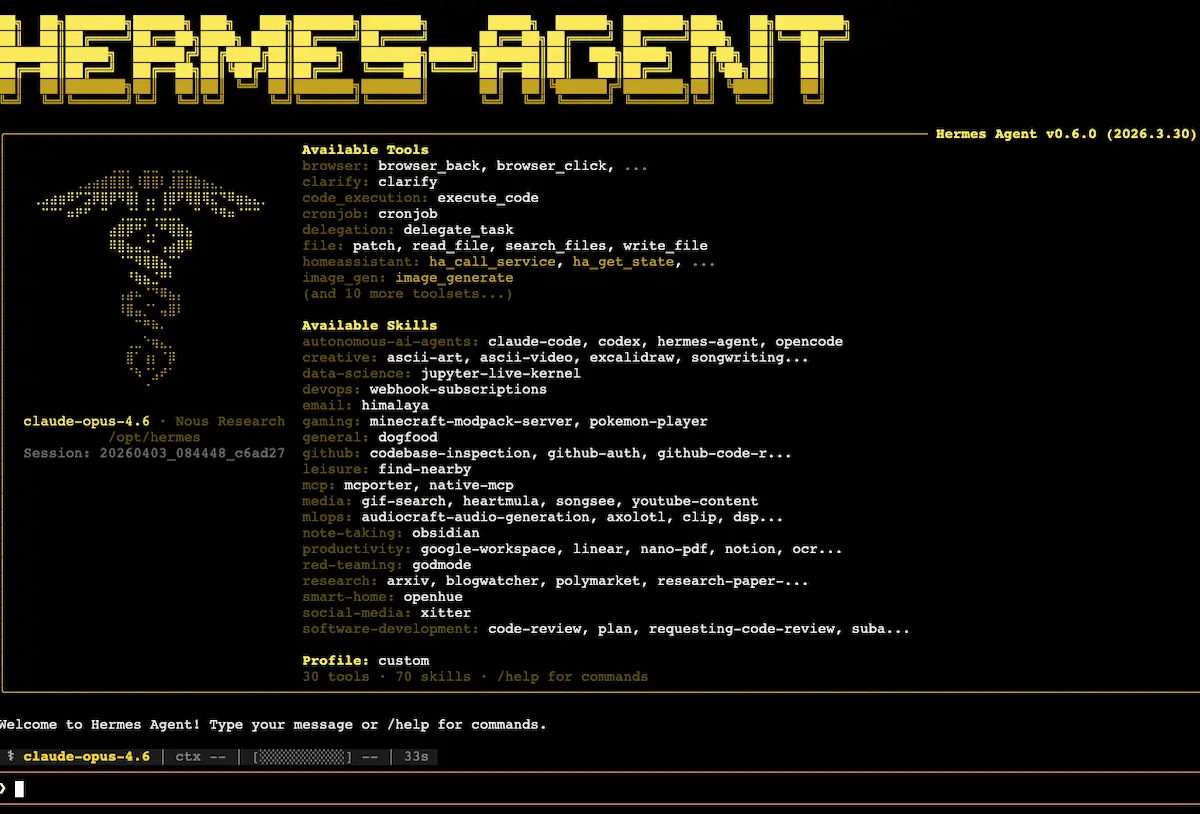
Hermes Agents released a new feature called Mixture of Agents presets this week. The shorthand is that you can now configure Hermes to route a single query through several language models in parallel, then have a designated “aggregator” model synthesize the responses into one output. The feature ships with named presets, configurable from the terminal or the dashboard, and works across whatever model providers you have connected.
That is the shipping news. The more interesting question is why the timing matters.
The gating problem this solves
Recent months have seen the top end of the frontier model market move in a direction that makes life harder for everyone who is not a research partner of one of the big labs.
Fable 5, Anthropic’s most capable model after the public launch in May, has been gradually re-restricted. Initial access through paid plans was time-limited and the model is now available only to roughly one hundred approved partners through Project Glasswing. GPT-5.6, OpenAI’s reported next-generation system, is in limited preview without a confirmed public release date. The signal across the category is that frontier-tier capability is becoming gated rather than commercially available.
This creates a specific problem for power users of agent harnesses like Hermes. The harness itself is capable enough to make use of frontier-tier reasoning when it is available. The frontier-tier reasoning is increasingly not available to use.
Mixture of Agents is a structural response to this problem. Instead of waiting for access to a single more capable model, the technique combines the models you already have access to into a system that, on certain workloads, exceeds the performance of any single one of them.
What Mixture of Agents actually is
The architecture is straightforward enough that the panel metaphor used to explain it generally works.
You have a query that needs answering. You hand the same query to several “reference” models in parallel. Each one produces its own response. A separate “aggregator” model reads all of the responses and produces a single synthesized answer drawing on what each reference contributed.
The intuition behind why this works: a panel of competent experts producing independent answers, with a sharp chair synthesizing them, generally outperforms any single member of the panel working alone. The aggregator gets the benefit of multiple takes without the failure modes of any single model’s blind spots.
This is not a new pattern in machine learning. Mixture-of-experts architectures have been a routine technique inside model training for years. Mixture-of-agents applies the same idea at the inference layer, treating multiple already-trained models as the experts and adding an aggregator on top.
The shift this represents is moving from “use the best model you can access” to “combine the models you can access.” The first approach is bounded by what one provider chooses to release. The second is bounded by your willingness to pay for parallel inference.
How it works inside Hermes specifically
Hermes ships the feature as named presets, which means the work of figuring out which models pair well is done for you. The current implementation pairs two models per preset, with one acting as aggregator and one as reference.
To use it, the standard pattern is:
- Run
hermes updatefrom the terminal to ensure the installation is current. - Run
hermes modelsto see available presets, including the new MOA configurations. - Switch your active configuration to one of the presets.
- Use Hermes normally. The multi-model routing happens transparently underneath.
The presets can also be configured directly from the dashboard’s model settings, and the feature is reachable from the desktop application. Slash-style commands let you swap presets per-task, for example using one MOA configuration as the default and another for review-style work.
The implementation is provider-agnostic. It does not lock you to Hermes’s own model gateway (Nous Portal). Any model you can connect to Hermes through its standard configuration is available as a reference or aggregator in a preset.
The benchmark claim, reported carefully
Hermes is launching the feature alongside an announcement of an upcoming benchmark called Hermes bench, designed to measure agentic workloads specifically. According to Hermes’s own statement, their reference MOA configuration scores 8 percent higher than Anthropic’s Opus 4.8 and 11 percent higher than OpenAI’s GPT-5.5 on this benchmark.
The honest caveat: this is the tool maker’s benchmark of their own feature. The methodology is not yet public. Independent reproduction is not yet possible. The claim is plausible given the broader pattern of mixture-of-agents results in the academic literature, but the specific numbers should be treated as a first-party claim, not as settled performance data.
The best-performing preset Hermes highlights pairs Opus 4.8 with an older GPT model variant as the reference panel, with Opus serving as the aggregator. This is interesting on its own terms. The fact that the strongest combination is not “two frontier models in parallel” but “a frontier model plus a meaningfully cheaper model” suggests the gains come from cognitive diversity rather than raw capability stacking.
This is a broader pattern, not just a Hermes feature
Hermes is not the first to ship mixture-of-agents tooling, and naming a few alternatives is worthwhile for readers evaluating the category.
Fusion is a separate tool that has been building in this direction for several months. Sakana AI’s Fugue, released this week, similarly claims frontier-tier output through model combination. The architectures differ in implementation detail but converge on the same core insight: orchestrated multi-model inference beats single-model inference on a meaningful range of tasks.
The takeaway is not “Hermes invented this.” The takeaway is that the mixture-of-agents pattern is now mature enough to be appearing as a shipping feature in multiple consumer-accessible products at the same time, which is generally a sign that the underlying technique works well enough to merit the engineering investment.
The bigger thesis: stop chasing the model
The framing the Hermes team and other proponents are using around MOA is worth taking seriously even when discounting the marketing tone.
The argument: the dominant pattern of “wait for the next, more capable model release to unlock the next tier of capability” is increasingly a losing strategy in 2026. Frontier releases are gated. Access is limited. Costs at the top end are climbing. The marginal capability improvement from each new model release is smaller than it was even a year ago. Waiting is not free. It has an opportunity cost that compounds.
The proposed alternative: stop optimizing for which model you can access. Start optimizing for the system you build around the models you already have. The models are the swappable part. The system is the part you own.
Mixture of Agents is one expression of this pattern. Loop engineering is another. Connected tool integration is another. Each one squeezes more capability out of the same underlying models by changing what surrounds them rather than what they are.
The frontier-quality output that currently requires partner-tier access at the top labs may be achievable on commodity-tier model access with the right architecture around it. The cost of this approach is more inference, not better models. For most users, that trade is favorable.
The honest caveats
The pattern works but the trade-offs are real.
Higher token costs. A query that previously consumed one model’s inference now consumes two or three models’ inference plus the aggregator’s pass. The token bill rises proportionally. For tasks where the quality lift is meaningful, this is worth paying. For tasks where the single-model output was already good enough, MOA is overhead.
Higher latency. Parallel inference helps, but the aggregator’s pass cannot start until the reference models have finished. End-to-end response time will typically be longer than a single-model call.
Benchmark caveats. The specific 8-percent and 11-percent figures come from the tool maker’s own forthcoming benchmark. They should be treated as first-party claims pending independent reproduction. The qualitative direction is well-supported in the broader literature. The specific numbers are not yet independently verified.
Configuration complexity. MOA introduces another layer of decision-making into your agent setup: which models to combine, which to use as aggregator, which preset to use for which task. The presets reduce this load substantially, but it does not disappear entirely. Users who have been running a single-model Hermes setup will need to spend some time tuning their MOA configuration to get the best results.
None of these caveats is disqualifying. They are the cost of the capability lift. The point is to be explicit about them so users can decide where the trade is worth it for their specific workload, rather than enabling MOA across the board and being surprised by the bill.
Frequently Asked Questions
What is Mixture of Agents?
A technique that combines responses from several language models on the same query, using an aggregator model to synthesize them into a single output. The result, on a range of tasks, exceeds the output of any single member model. Hermes now offers this as named presets in its standard configuration.
How is this different from Mixture of Experts?
Mixture of Experts is a model-architecture technique applied inside a single model during training. Mixture of Agents applies a similar idea at the inference layer, treating multiple already-trained models as the experts. The naming is similar. The implementation layer is different.
Do I need access to Fable 5 or GPT-5.6 to benefit from this?
No, which is part of the appeal. MOA presets work with models that are commercially available today. The benchmark claim from Hermes is specifically that an MOA configuration of widely-available models can match or exceed the performance of currently-gated frontier models on agentic workloads.
How much does this cost compared to running a single model?
Roughly two to three times the token cost per query, depending on the preset (number of reference models plus the aggregator pass). For tasks that benefit from the quality lift, the trade is favorable. For tasks where single-model output was already sufficient, it is overhead.
Is this Hermes-exclusive?
No. Fusion, Sakana AI’s Fugue, and several other tools implement variants of the same pattern. The Hermes implementation is notable for being integrated into an existing agent harness rather than offered as a separate product, which reduces friction for existing Hermes users.
What is the best MOA preset to start with?
The strongest performer Hermes highlights pairs Opus 4.8 as the aggregator with a meaningfully cheaper reference model. This is also notable as a cost-efficient configuration: most of the inference passes through the cheaper model, with the more expensive aggregator running once. For users new to MOA, this is a reasonable default to start with before tuning further.
