


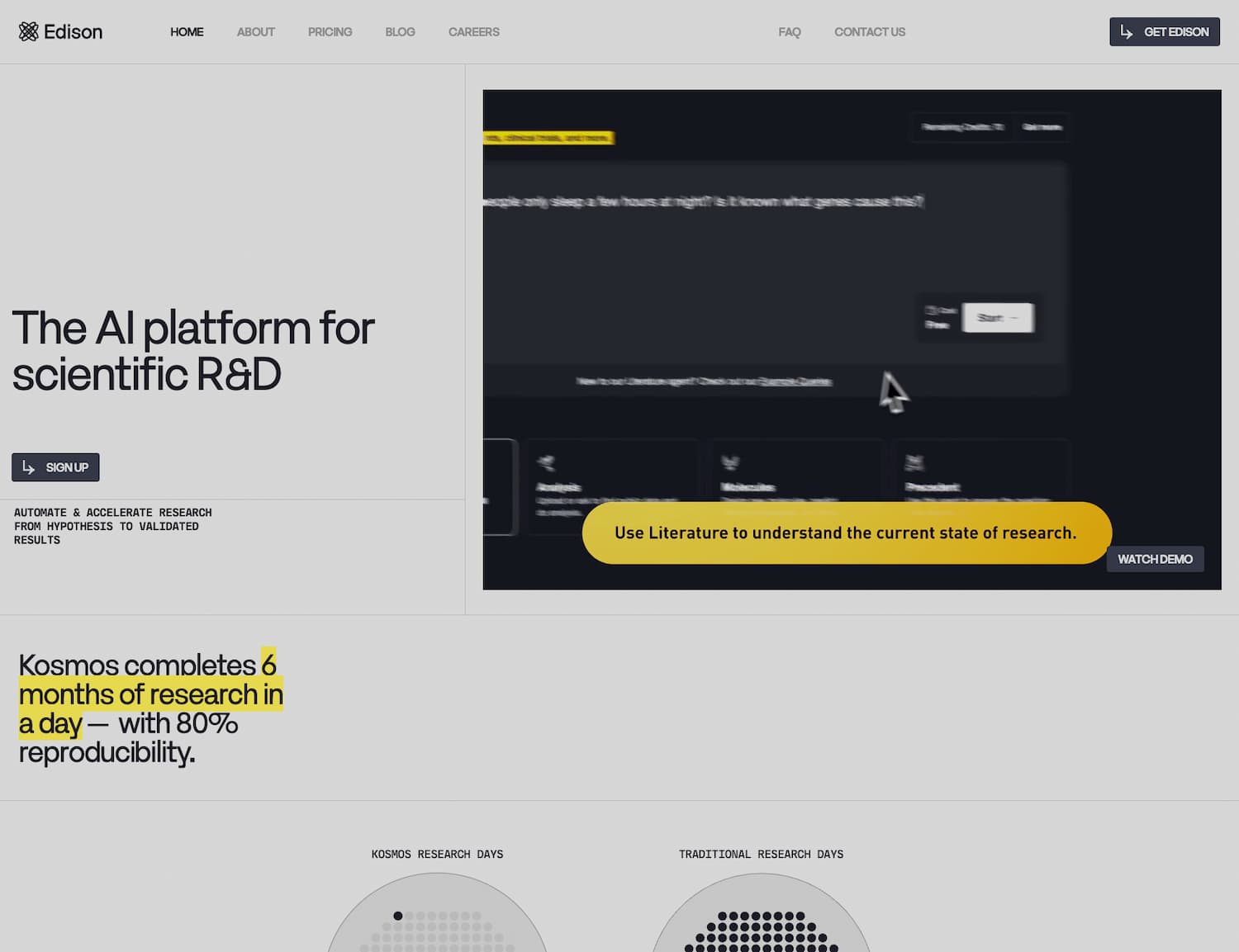
Edison Scientific is transforming biotechnology by condensing months of traditional laboratory research into just twenty-four hours. By leveraging the autonomous Kosmos platform, this FutureHouse spinout achieves an impressive eighty percent reproducibility rate in biological findings.
Here is how this AI-driven approach is currently accelerating therapeutic discoveries for complex conditions while maintaining rigorous scientific standards.
The bottom line: Edison Scientific’s Kosmos platform transforms drug discovery by turning the autonomous AI Scientist concept into a scalable commercial reality. This system accelerates research cycles by integrating literature review and data analysis without human fatigue, providing a transparent, auditable path to new therapeutic targets. Most impressively, Kosmos compresses six months of traditional research into just 24 hours, achieving an 80% reproducibility rate while reading 1,500 papers and executing 42,000 lines of code per run.
Edison Scientific and Its Evolution From FutureHouse Research
While traditional laboratories often face physical constraints, the shift toward a digital frontier has allowed Edison Scientific to lead the charge in automated discovery.
From Non-Profit Roots to a Commercial R&D Entity
Edison Scientific emerged as a commercial spinout from FutureHouse. This transition scales research while keeping its scientific DNA, much like using a top-tier AI tool for deep analysis.
Leadership manages both entities under strict controls to prevent conflicts. This structure preserves research integrity while accelerating the deployment of autonomous agents for the global pharmaceutical industry’s urgent needs.
The core mission involves injecting rigorous academic standards into the fast-moving, competitive world of modern biotech commercialization efforts.
Success requires elite professional networking in tech. It bridges the gap between lab-bench theory and market-ready therapeutic solutions.
The Philosophy of the Autonomous AI Scientist
Within the Kosmos platform, the AI Scientist isn’t a mere digital assistant. It operates as an autonomous agent, capable of independent reasoning and generating its own biological hypotheses from datasets.
The long-term vision focuses on automating biological hypothesis generation. By doing so, the system effectively strips away human bias from the earliest, most critical discovery phases.
Moving beyond traditional human-led bioinformatics, Edison Scientific aims for 24/7 research cycles. These autonomous systems work without fatigue, compressing timelines that previously took years into mere days.
Speed Metrics: 6 Months of Research in 24 Hours
While the philosophy is bold, the raw numbers behind Kosmos’s performance are what truly disrupt the status quo.
Achieving Eighty Percent Reproducibility in Biological Results
Scientific reliability often falters in manual academic settings. But Kosmos hits a massive 80% reproducibility benchmark. This performance effectively solves the persistent crisis found in this scientific study of Kosmos.
Traditional research timelines usually span several months for a single project. Kosmos handles these complex workloads in just one day of processing. Human teams simply cannot match this speed. Efficiency gains here are fundamentally transformative for biotech.
The system operates with precision. It maintains consistency over millions of tokens.
Kosmos can execute approximately 292 independent analysis trajectories in 24 hours, effectively doing the work of two bioinformaticians in one night.
These findings provide a stable foundation for clinical applications. Researchers can trust these outputs to drive downstream drug discovery with high confidence.
Autonomous Reproduction of Landmark Scientific Papers
Edison validates the system by having it replicate classic, landmark studies without human intervention. This autonomous approach confirms the AI masters existing knowledge. It proves the platform’s baseline capability.
Automated verification establishes undeniable technical authority. It demonstrates that the AI follows rigorous logic rather than generating hallucinations. This methodology confirms that the system produces verifiable scientific truth.
The scale of processing is immense. Each run involves deep data synthesis.
- read 1,500 papers per run
- Execution of 42,000 lines of code
- 79.4% accuracy rate validated by humans
A specific case study from February 2026 focused on gene expression in autism spectrum disorders. Kosmos analyzed genotype-driven similarities during development. This work showcased the platform’s ability to handle intricate biological puzzles.
Technical Breakdown of PaperQA3 and the Analysis Agent
To understand how these speeds are possible, we need to look under the hood at the individual agents driving the discovery.
Processing RNA-seq and Complex Multimodal Datasets
The Edison Analysis Agent tackles high-dimensional genomic data. It parses massive RNA-seq datasets with ease. This tool identifies patterns that human bioinformaticians might overlook. It transforms raw biological sequences into actionable insights for drug discovery teams.
PaperQA3 goes beyond simple text extraction. It interprets complex figures and dense tables found in scientific literature. This multimodal approach ensures no critical data remains hidden in supplements.
Reinforcement learning powers the growth of the agent in chemical reasoning. It refines its logic through iterative feedback loops. Over time, the system predicts molecular behaviors with increasing precision and reliability.
Automated workflows significantly reduce data interpretation errors. This precision is vital when validating complex biological hypotheses across various therapeutic areas.
Decision Transparency Through Reasoning Traces
Reasoning traces expose the logic behind every agent decision. Researchers track the exact path taken from hypothesis to conclusion. This visibility eliminates the mystery often associated with AI outputs.
Auditability remains a non-negotiable requirement in high-stakes scientific environments. Black-box systems fail to earn the trust of clinical regulators. Verified evidence must back every single therapeutic claim.
This transparency fosters a robust partnership between human experts and AI agents. Scientists intervene at critical junctions to guide the discovery process. It creates a collaborative model where technology augments human intuition.
Comparing Kosmos to legacy bioinformatics reveals a stark performance gap. The following table illustrates how this platform outperforms traditional methods across key research metrics and operational standards.
| Feature | Traditional Bioinformatics | Kosmos AI Platform |
|---|---|---|
| Speed | 6 Months | 1 Day |
| Reproducibility | ~50% | 80% |
| Reasoning Transparency | Black Box | Full Reasoning Traces |
| Data Volume | Human Capacity | 1,500+ Papers per Run |
3 Therapeutic Areas Using Kosmos AI for Discovery
Theory and speed are great, but the real test is whether this platform can actually find cures.
Accelerating Heart Failure and Neurodegeneration Studies
In heart failure research, Kosmos pinpointed a fresh therapeutic target. Human experts missed this specific pathway for years. The AI spotted patterns across massive datasets that remained hidden.
Regarding neurodegeneration, the system mapped Tau protein mechanisms. It identified new brain connectivity pathways. This revealed exactly when extracellular matrix proteins drop during Alzheimer’s progression.
The platform masters complex pathology by merging transcriptomic and proteomic data. It sees the big picture of disease. This integration helps identify why certain neurons are vulnerable to early damage. It effectively bridges the gap between raw data and biological reality.
Reinforcement Learning for Protein and Molecular Design
Reinforcement learning drives protein engineering. The AI learns which folds stay stable. It treats sequence design like a game, searching for effective molecular shapes.
Chemical reasoning focuses on lead optimization. The goal is making drugs safer. It refines molecules by predicting how small changes impact overall performance.
The system then moves from discovering targets to planning actual molecular synthesis. It maps out the practical steps.
Kosmos maintains consistency over 200 agent iterations, ensuring that molecular designs remain biologically viable throughout the process.
Can the Kosmos Platform Autonomously Test Hypotheses?
As we move toward a future of “closed-loop” science, the questions of data safety and physical lab integration become paramount.
Data Privacy and the No-Training Policy for Private Sets
Edison Scientific enforces strict security protocols. Private user data remains isolated and is never used to train base models. This protects all intellectual property.
A generous free tier exists for academics. Biotech partners can currently access the platform for high-value discovery projects.
The Roadmap Toward Autonomous Synthetic Chemistry Labs
FutureHouse spinout Edison aims for full wet lab automation. The goal is an AI that executes physical experiments independently. This creates a truly autonomous discovery cycle.
Upcoming frontiers include single-molecule sensing and high-content screening. These technologies will integrate directly into the Kosmos workflow.
By condensing months of complex research into a single day, Edison Scientific provides a scalable solution that ensures both speed and scientific integrity through transparent discovery. As the industry moves toward automated wet labs, adopting these autonomous capabilities will be a strategic step for organizations aiming to lead in modern drug development.
FAQ
What exactly is Edison Scientific and its connection to FutureHouse?
Edison Scientific is a commercial spinout from the non-profit research organization FutureHouse. While FutureHouse continues to focus on fundamental biology and philanthropic research, Edison Scientific was established to scale and deploy autonomous AI technologies for the commercial biotech and pharmaceutical sectors. This transition allows the team to meet the high-throughput demands of industry partners while maintaining the academic rigor of its origins.
How does the Kosmos platform accelerate the scientific discovery process?
The Kosmos platform is designed to function as an autonomous “AI Scientist” capable of performing six months of traditional research in just 24 hours. It achieves this by integrating literature reviews, data analysis, and hypothesis generation into a single, cohesive workflow. In a typical 12-hour execution, Kosmos can read 1,500 scientific papers and run over 42,000 lines of analysis code, effectively doing the work of multiple bioinformaticians overnight.
Is the data generated by Kosmos reliable and reproducible?
Reliability is a cornerstone of the platform, which boasts an 80% reproducibility rate. Independent benchmarks have validated that approximately 79.4% of the claims made in Kosmos reports are accurate. To ensure full transparency, the system provides “reasoning traces,” allowing human researchers to audit every conclusion by tracing it back to the specific primary literature or source code that generated the insight.
What technical capabilities does the Edison Analysis Agent have for complex datasets?
Powered by the PaperQA3 algorithm, the platform features advanced multimodal capabilities. It doesn’t just process text; it can read and interpret figures, tables, and complex biological datasets such as RNA-seq. This allows the agent to navigate high-dimensional genomic data and chemical reasoning tasks with a level of depth that surpasses traditional, text-only AI models.
How does Edison Scientific handle the privacy of sensitive research data?
Edison Scientific implements a strict data privacy policy to protect proprietary research. The company does not train its base models on the private scientific data or files uploaded by users without explicit consent. While account and interaction data help improve service delivery, your specific therapeutic discoveries and datasets remain secure and are not used to benefit other users or competitors.
What are some real-world applications of the Kosmos AI in drug discovery?
Kosmos has already demonstrated significant success in several therapeutic areas. For instance, it identified SOD2 as a novel therapeutic target for heart failure and uncovered a new mechanism in neurodegeneration involving flippase proteins in Alzheimer’s disease. Additionally, the platform is used for lead optimization and protein engineering, using reinforcement learning to design stable and functional molecular structures.
