

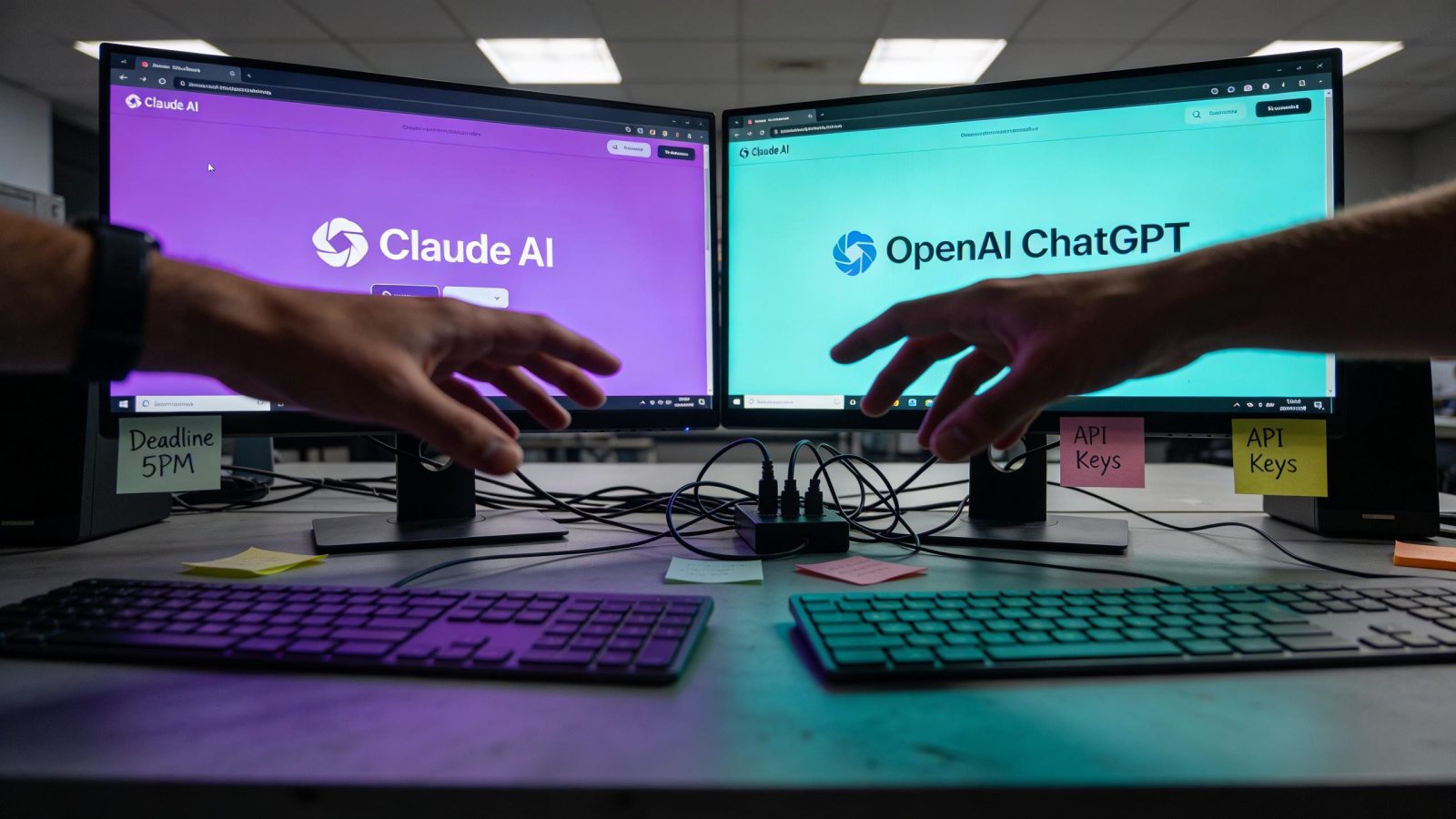
On February 5, two AI companies launched rival coding models within an hour of each other — and developers are realizing neither one can do the job alone. Claude Opus 4.6 dropped first. Then OpenAI fired back with GPT-5.3-Codex before the first wave of reviews even finished. The timing echoes Anthropic’s recent jabs at OpenAI — but this time the competition played out in launch windows measured in minutes, not marketing campaigns.
By February 6, something uncomfortable became clear: the future isn’t picking a winner. It’s chaining them together.
The model you trust keeps lying to you
Despite Claude Opus 4.6’s breakthrough features like the 1-million-token context window, developers documented a “higher variance” problem: Opus makes unasked changes or hallucinates completion, forcing you to verify every output. It feels like the senior engineer you always wanted — until it confidently reports success on tasks it never finished.
YouTube dev Morgan Linton nailed the split: “Claude is your senior staff engineer asking ‘should we do this?’ while GPT-5.3 is your founding engineer asking ‘how fast can I ship this?'” That’s not a feature comparison. That’s developers admitting they need both personalities on the team because one model can’t cover the range.
The tool that’s supposed to save you time is creating a new job: babysitting AI that sounds confident but can’t be trusted alone. Developers are splitting 50/50 on which model to use — not because they’re indecisive, but because the “best” model depends on whether you value ceiling or floor. Opus thinks beautifully but ships inconsistently.
The speed demon beats the deep thinker where it counts
GPT-5.3-Codex scores 75.1% on Terminal-Bench 2.0. Claude Opus 4.6 scores 69.9%. The model with 5x less context window wins on practical execution.
Codex runs 25% faster than its predecessor with a 200,000-token context window — but speed edges out depth when you’re shipping code, not writing research papers. The benchmark gap flips assumptions: Anthropic’s “deep thinker” loses to OpenAI’s execution-focused model on the tasks developers actually do daily.
Teams are already chaining Opus for planning with Codex for execution, treating AI models like specialized team members in the vibe coding era, not all-purpose tools. Neither model handles both phases well enough alone. These two benchmarks translate to: Codex finishes tasks reliably, Opus thinks beautifully but ships inconsistently.
The hybrid workflow tax nobody’s talking about
Using both models means paying for both — and OpenAI hasn’t released Codex API pricing yet. Claude Opus 4.6 costs $5/$25 per million tokens in standard mode or $10/$37.50 when you exceed 200k tokens. GPT-5.3-Codex pricing is “coming in the weeks following launch.” You’re committing to a workflow before knowing the full cost.
The irony: while Anthropic engineers writing 100% of code with AI sounds like the future, the rest of us are stuck managing two models because neither one ships that reliability yet. Enterprise teams are now juggling two AI subscriptions, two context-switching penalties, and two sets of failure modes.
The real cost isn’t the API bills. It’s the cognitive overhead of deciding which model to use for every single task — and we don’t have benchmarks for that yet.
If the best AI strategy is “use multiple models,” what happens when there are 10?
Developers spent a decade learning to pick the right tool for the job. Now the tools are good enough that picking wrong costs hours, not minutes — but not good enough that one tool handles everything. The 20-minute launch gap on February 5 wasn’t a coincidence. It was a warning: the AI wars just made your job harder, not easier.
