

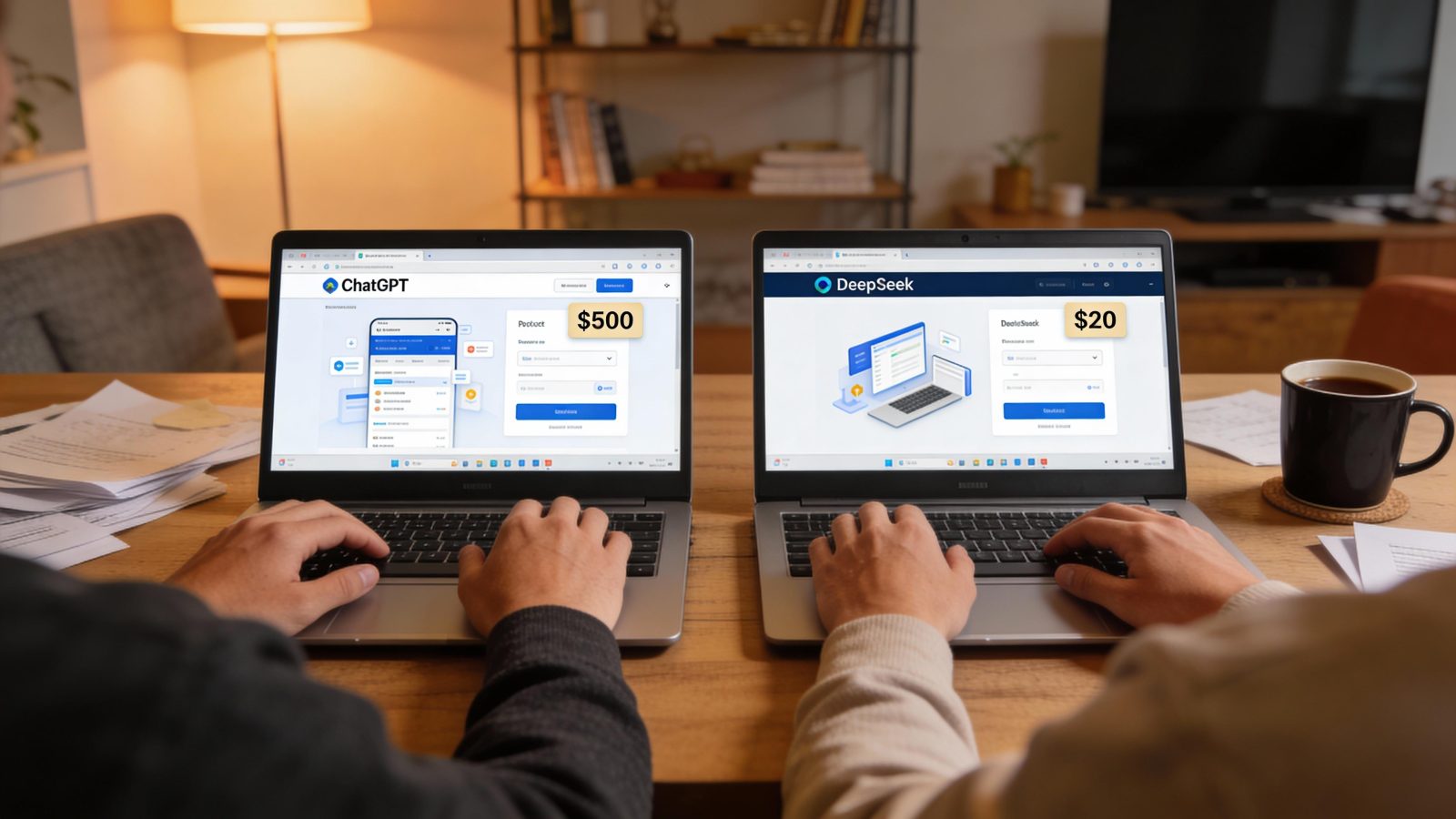
DeepSeek R1 just matched ChatGPT’s performance on key benchmarks while costing 96% less per token—trained for $5.5 million on 2,048 chips versus OpenAI’s $100 million+ on 16,000+.
For developers running high-volume coding or math tasks, that’s not a rounding error.
It’s the difference between a $500 monthly API bill and $20.
The efficiency gap sounds like vaporware until you see the architecture: Mixture-of-Experts activates only 37 billion parameters per query instead of burning through a full dense model’s 671 billion.
Early adopters in STEM fields are already switching for tasks like R/Python debugging, where DeepSeek’s specialized Coder model ties at 96th percentile performance.
The catch? This isn’t a ChatGPT replacement for most people—it’s a scalpel, not a Swiss Army knife.
ChatGPT Still Wins Where It Counts for 90% of Users
DeepSeek crushes logic puzzles and compiles cleaner code, but ask it to write a compelling email subject line or generate an image and you’ll remember why ChatGPT costs more.
The efficiency model lacks conversational fluency, image generation, and the plugin ecosystem that makes ChatGPT a daily driver for content creators and marketers. Benchmarks show near-parity on math (79.8% vs 79.2%), but ChatGPT dominates in natural language tasks where “vivid writing” and “multi-topic engagement” matter more than proof accuracy.
The real divide: DeepSeek is a dev tool optimized for technical precision; ChatGPT is a productivity assistant built for breadth. If your workflow involves storytelling, brainstorming, or multimodal tasks like handwritten notes, DeepSeek’s China-hosted censorship and missing features make it a non-starter. No consensus winner exists because they’re solving different problems—one for engineers, one for everyone else.
The Catch Nobody’s Talking About: Zero Real-World Proof
Here’s what’s missing from every DeepSeek comparison: actual case studies. No developer communities have publicly reported switching from ChatGPT with concrete savings like “$12K in 3 weeks” or performance disasters from censorship-blocked projects.
Search results show general cost advantages but lack emotional testimonials or verified switches. OpenAI hasn’t announced API price cuts, leaked competitive memos, or shown signs of a price war—suggesting the threat isn’t material yet. The “holy shit” censorship moments affecting Western developers?
They don’t appear in results. This feels like a tool that’s technically impressive but adoption-wise still niche, raising questions about shadow AI adoption by power users who know exactly what they need. The MoE efficiency breakthrough is real, but without social proof of teams migrating at scale, it’s unclear if DeepSeek’s cost edge translates to market disruption.
When to Use DeepSeek (and When to Stick with ChatGPT)
Use DeepSeek if you’re running high-volume API calls for coding, math proofs, or logic-heavy automation where accuracy matters more than polish. The 27x cost savings on output tokens ($2.19 vs $60 per million) make it a no-brainer for startups burning through tokens on backend tasks. Stick with ChatGPT for creative writing, brainstorming, image generation, or any workflow requiring plugins and multimodal support.
The ecosystem gap is real—DeepSeek’s open-source R1 model rivals OpenAI’s o1 on self-correcting math, but it won’t integrate with your Slack, generate DALL-E images, or handle sensitive topics without censorship risk. Bottom line: DeepSeek is the efficiency king for technical users who know their constraints, much like how AI automation risks are reshaping high-skill roles. ChatGPT remains the versatile daily driver for everyone else. The debate isn’t “which is better”—it’s “which problem are you solving today?”
