

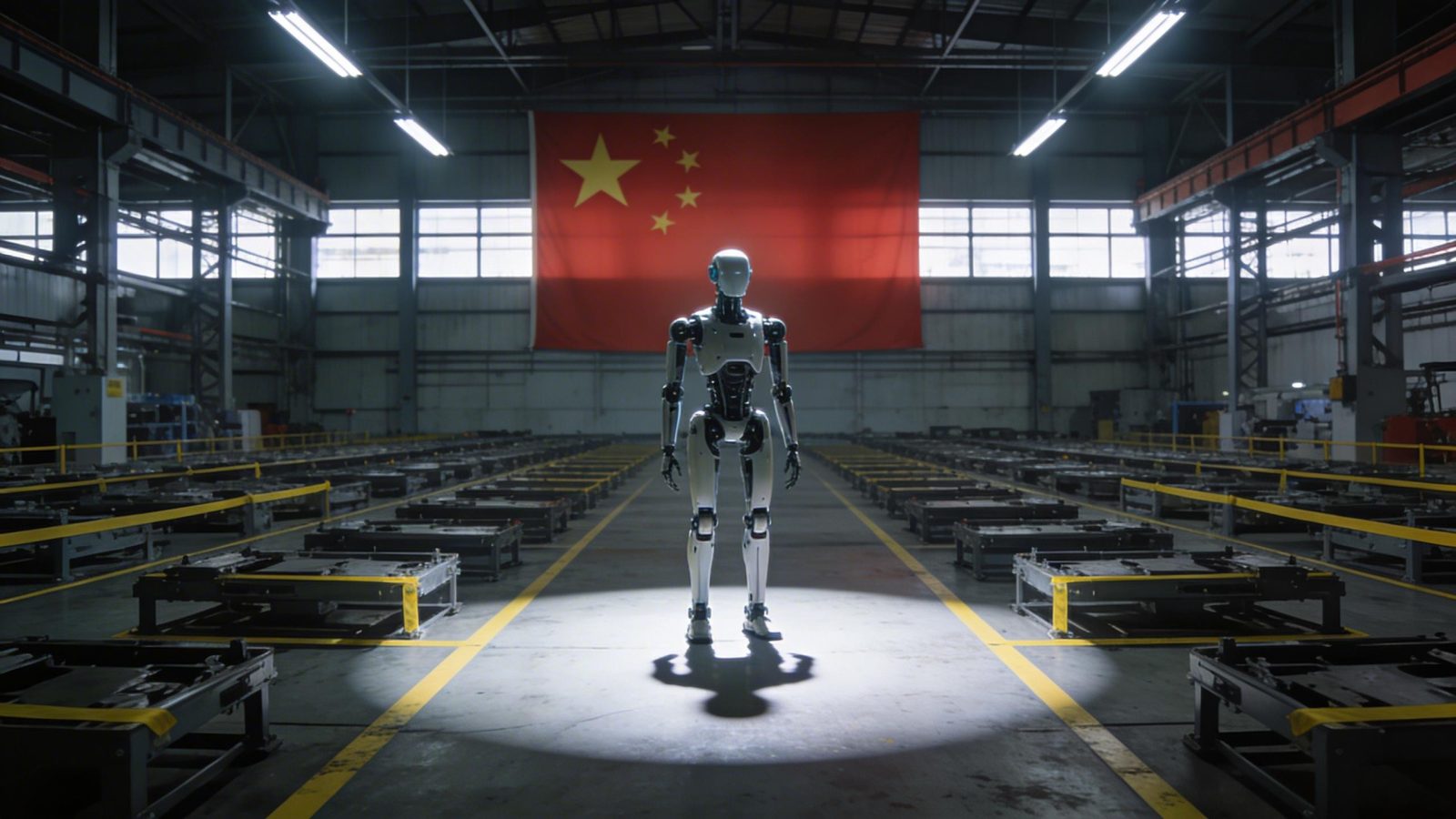
Dozens of humanoid robots performed synchronized kung-fu routines on China’s primetime Spring Festival Gala on February 17, 2026—not because someone built better joints, but because engineers spent three months teaching AI models how to move like stunt performers. Unitree Robotics shipped 5,500+ humanoid robots in 2025, while China shipped 13,000 humanoid robots in 2025 total. America’s most advanced humanoid manufacturer can’t deliver units until 2027.
That’s the production gap that matters.
The gala performance wasn’t just entertainment—it was a proof-of-concept disguised as spectacle. Engineers pretrained a stunt-motion model starting in November 2025, then fine-tuned it for coordinated multi-robot deployment. The result: millisecond-level synchronization across dozens of robots executing martial arts choreography that looked disturbingly human. This wasn’t a hardware redesign. It was pure software.
China shipped 13,000 humanoid robots in 2025. America shipped almost none.
While Unitree alone shipped 5,500+ units and China’s total exceeded 13,000, Boston Dynamics’ entire 2026 Atlas production is already allocated to two customers: Hyundai and Google DeepMind. Hyundai got every 2026 Atlas robot, with additional deployments pushed to early 2027.
This isn’t about capability. It’s about who’s actually manufacturing at scale.
The upgraded cluster control platform that powered the gala performance required network communication, different operating systems, and embedded device coordination—but it delivered end-to-end automation from choreography planning to real-time execution. That’s the software leap Western manufacturers are chasing while struggling to ship hardware. And it’s why China is treating primetime entertainment as industrial R&D: every coordinated robot on screen is a deployment test disguised as a cultural event.
The training timeline tells the story. Engineers started prepping the stunt-motion model in November 2025—three full months before the February broadcast. Better robots came from better software abstraction, not better joints.
The $25,000 price tag makes fleet economics impossible for most manufacturers
EngineAI’s T800 humanoid, announced at CES 2026, starts at $25,000 with mid-2026 shipments. Boston Dynamics’ Atlas can lift 110 pounds with a reach of 7.5 feet, featuring 56 degrees of freedom and 360° rotational joints. Impressive specs.
But if you can’t buy it, specs don’t matter.
The real barrier isn’t technology—it’s cost-per-unit multiplied by the fleet size needed to justify integration, training, and maintenance overhead. A single robot is a prototype. Ten robots are a pilot program. One hundred robots are an operational deployment. And at $25,000+ per unit, small manufacturers can’t afford the math. China’s advantage isn’t better engineering; it’s shipping units cheap enough that factories can actually test them at scale.
The gala robots can’t actually work an 8-hour factory shift
Unitree’s G1 has a 2-3 kg arm payload and 2-hour battery life—making sustained physical labor impractical, according to industrial analysis. The cluster control platform that achieved millisecond synchronization still required network communication, different operating systems, and embedded device coordination. This wasn’t autonomous swarm behavior. It was heavily engineered choreography.
Rough.
The performance was entertainment, not proof of industrial deployment. And that’s the honest limitation Western manufacturers won’t admit about their own units either. The question isn’t whether humanoid robots will replace factory workers—it’s whether they’ll ever work reliably enough to justify the cost, a pattern we’re seeing across AI’s impact on high-skill jobs. Battery life kills the dream before payload capacity even becomes an issue.
China is shipping robots for spectacle and calling it industrial capability. America is building robots for industry and can’t ship them at all. Which strategy wins when neither can prove real-world ROI yet?
