


The global market for no-code AI solutions is projected to reach significant valuation by 2026, driven by the democratization of complex machine learning models. Identifying the best ai agent platforms for non-developers 2026 requires a rigorous evaluation of visual logic interfaces and native ecosystem connectivity.
Operational efficiency often suffers when teams struggle with rigid automation tools that require manual syntax. This guide analyzes high-performance platforms designed to bridge the technical gap, facilitating rapid deployment of autonomous agents without a single line of code.
- Selection Metrics for Best AI Agent Platforms for Non-Developers 2026
- Zapier Central: Natural Language Automation for App Ecosystems
- Make.com: Visual Logic for Complex Business Operations
- Relevance AI: Multi-Agent Workforce Orchestration
- Fine-Tuner.ai: Prompt-Based Custom Agent Deployment
- MindOS: Context-Retention and Memory for Support
- AgentGPT: Browser-Based Accessibility for Prototyping
- Security Protocols and ROI Evaluation for Business Agents
Selection Metrics for Best AI Agent Platforms for Non-Developers 2026
Zapier Central and Make.com lead the 2026 market for non-technical users, offering SOC 2 compliance and native Slack/CRM integrations. Success relies on choosing between natural language prompts or visual logic builders for workflow orchestration.
Contrast prompt-based builders (marketing preference) with visual drag-and-drop canvases (operations preference).
Categorization of No-Code Versus Low-Code Interfaces
Platform selection depends on the user interface model. Prompt-based builders utilize natural language for agent creation. Marketing leads typically prefer these conversational interfaces. Conversely, operations leads favor visual drag-and-drop canvases for complex logic.
Technical thresholds define these categories. No-code tools require zero syntax knowledge. This architecture eliminates the traditional learning curve. Non-technical founders can deploy functional agents immediately without programming expertise.
Natural language interfaces prioritize immediate usability. Users describe tasks to generate workflows. This contrasts with the structured thinking required for visual builders. Ease of adoption remains the primary driver for no-code growth.
Integration Density and Software Ecosystem Connectivity
Native connections facilitate seamless data exchange. Platforms prioritize Slack, Gmail, and Salesforce. These pre-built connectors save weeks of development time. Connectivity remains the backbone of best AI agent platforms for non-developers 2026.
API extensibility ensures long-term viability. Non-developers utilize webhooks for proprietary software. This approach maintains accessibility while expanding utility.
Pre-built templates enable rapid deployment. Templates reduce configuration errors during setup. This efficiency accelerates the launch of initial agents. Speed of implementation is a critical performance metric.
- Communication: Slack
- Productivity: Gmail
- Data: CRM (Salesforce)
Security Compliance and Data Residency Standards
Enterprise adoption requires SOC 2, GDPR, and HIPAA certifications. These standards are non-negotiable for customer data handling. Leading platforms now offer these certifications by default. Compliance ensures legal and operational safety.
Data isolation protocols protect intellectual property. Sensitive information is partitioned within the platform. Private instances prevent data leakage into public models. This architecture maintains strict confidentiality for corporate users.
Internal governance features control agent autonomy. Admins set granular permissions for specific actions. Audit logs provide necessary transparency for compliance tracking. Governance tools mitigate risks associated with autonomous systems.
Zapier Central: Natural Language Automation for App Ecosystems
Moving from general selection criteria, Zapier Central represents the pinnacle of conversational automation for those who want to skip the logic boards entirely.
Conversational Agent Building for Cross-App Actions
Teaching agents requires no code. Users define specific tasks using plain English instructions. The system learns desired behaviors through natural language interaction instead of rigid programming logic.
The platform connects to over 6000 apps instantly. This massive ecosystem enables cross-platform functionality without custom API development. Non-developers bypass technical barriers to link disparate software tools.
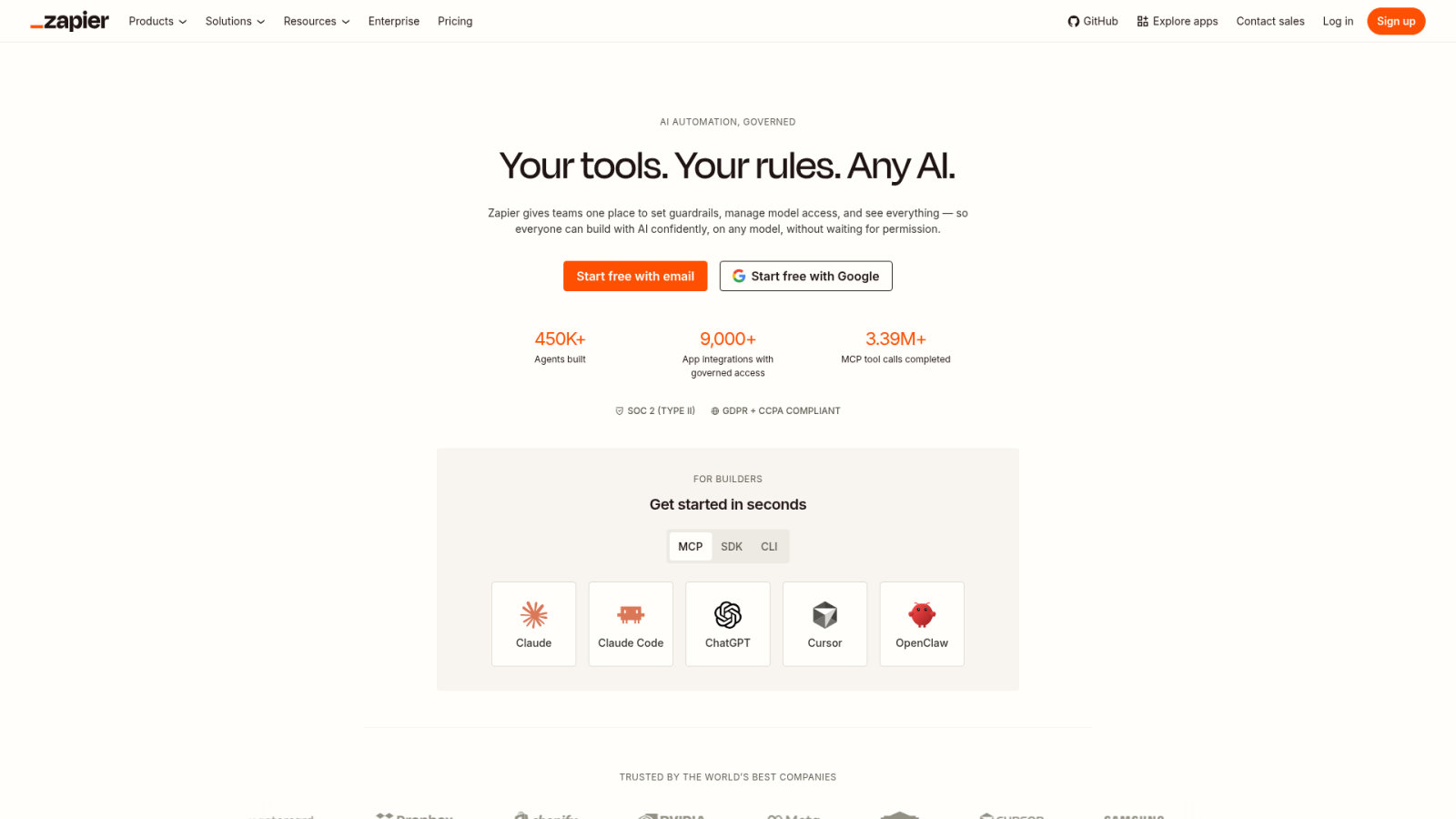
Agents execute tasks in real-time. They operate 24/7 in the background without requiring manual triggers. This continuous operation supports economic efficiency by handling repetitive marketing actions autonomously.
Live Data Synchronization and Context Awareness
Agents access live data sources directly. They read connected spreadsheets and databases in real-time. Up-to-date information ensures that automated decisions reflect the current state of the business.
Context retention allows for sophisticated multi-step workflows. The agent remembers previous interactions and data points within a sequence. This persistence eliminates the need for users to repeat prompts constantly.
Knowledge base retrieval pulls facts from PDF or Notion documents. Agents extract specific information to answer queries or inform actions. Retrieval mechanisms prioritize accuracy by grounded referencing of connected files.
ROI Analysis for Sales and Marketing Workflows
Lead qualification occurs instantly through automated agents. Teams save approximately ten hours weekly by eliminating manual data sorting. Rapid response times improve the overall efficiency of the sales funnel.
Automated synchronization minimizes human entry mistakes. Data integrity improves by forty percent on average when manual transfers are removed. Consistency is maintained across all connected CRM and marketing platforms.
The pay-per-task pricing model facilitates low-cost entry for small businesses. Costs scale linearly based on actual usage and business growth. This structure aligns software expenses directly with operational output.
Automating lead management through natural language agents reduces response times by 80%, directly impacting conversion rates for non-technical sales teams.
Make.com: Visual Logic for Complex Business Operations
While Zapier focuses on conversation, Make.com offers a spatial approach, turning complex operations into a visible map of interconnected bubbles.
Visual Workflow Orchestration for Operations Leads
The canvas-based approach utilizes a drag-and-drop interface. Users connect distinct modules to construct logical sequences. This spatial layout improves comprehension of multi-directional data flows.
Visual filters and routers manage intricate decision paths. Branching logic remains organized through graphic representation. Seeing the process flow simplifies the management of complex conditional execution.
Graphical flows assist non-technical personnel during troubleshooting. Visual clarity reduces friction in cross-departmental collaboration. The interface provides an immediate overview of automated business processes.
Error Handling and Observability Features
Built-in monitoring tools track agent performance in real-time. Visual alerts pinpoint the exact location of workflow interruptions. This immediate feedback loop minimizes operational downtime.
The debugging process allows users to re-run specific modules independently. History logs document every data transformation for precise auditing. Non-technical operators can identify and resolve execution gaps without backend access.
Comprehensive audit trails record every automated action. Transparency ensures operational security and maintains strict accountability. Detailed logs provide a verifiable record for compliance and performance reviews.
Scaling from Single Tasks to Multi-Step Systems
Expansion strategies involve starting with individual tasks before adding modules. The system architecture supports increasing operational complexity. Users scale their automation footprint by layering interconnected functions.
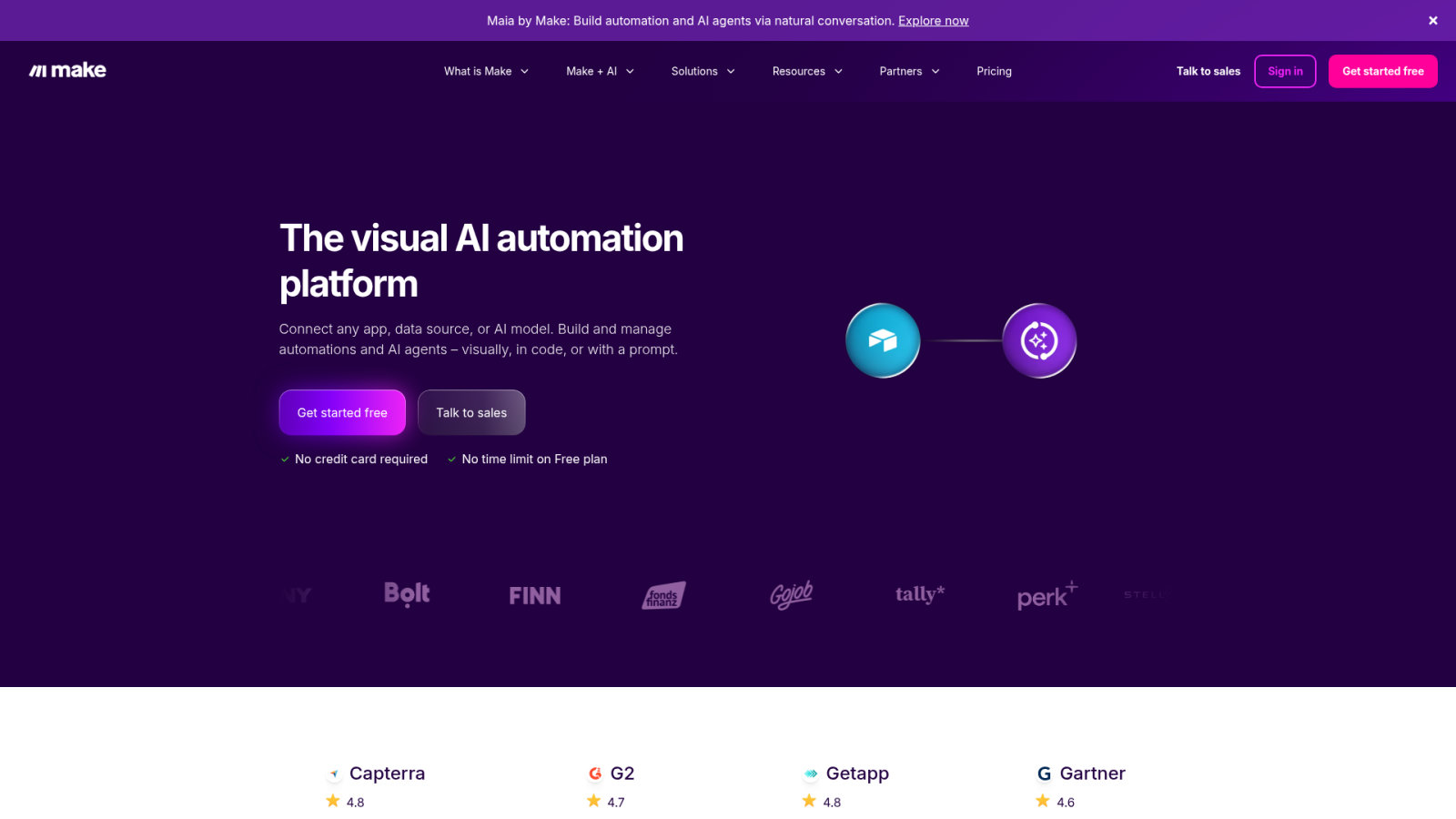
Execution speed remains stable during high-volume data processing. Visual builders manage high-frequency data more effectively than basic scripts. The platform maintains performance integrity under significant operational loads.
Enterprise pricing structures accommodate high-frequency usage requirements. Dedicated support and increased execution limits facilitate large-scale deployment. These tiers provide the necessary infrastructure for institutional automation growth.
| Feature | Starter Plan | Pro Plan | Enterprise |
|---|---|---|---|
| Operations limit | Standard | Increased | Custom/High |
| Execution speed | Standard | Prioritized | Maximum |
| Support level | Help Center | Priority Support | Dedicated Manager |
| Security features | Basic | Advanced | Full Compliance/SSO |
| Custom Apps | Limited | Standard | Unlimited/Private |
Choosing the correct Make.com tier depends on total monthly execution volume. Best ai agent platforms for non-developers 2026 require this level of granular control to ensure reliable scaling across diverse business units.
Relevance AI: Multi-Agent Workforce Orchestration
Beyond individual workflows, Relevance AI introduces the concept of a digital workforce where multiple specialized agents collaborate on a single objective.
A collaborative system where multiple specialized AI agents work under a ‘manager’ agent to complete complex, multi-step projects.
Collaborative Agent Swarms for Process Outsourcing
Agent swarms function through collective action. Multiple agents tackle one project together. This architecture mimics a real human department structure.
Delegation logic drives the system. Specialized personas handle specific sub-tasks. A “manager” agent can oversee the “worker” agents effectively.
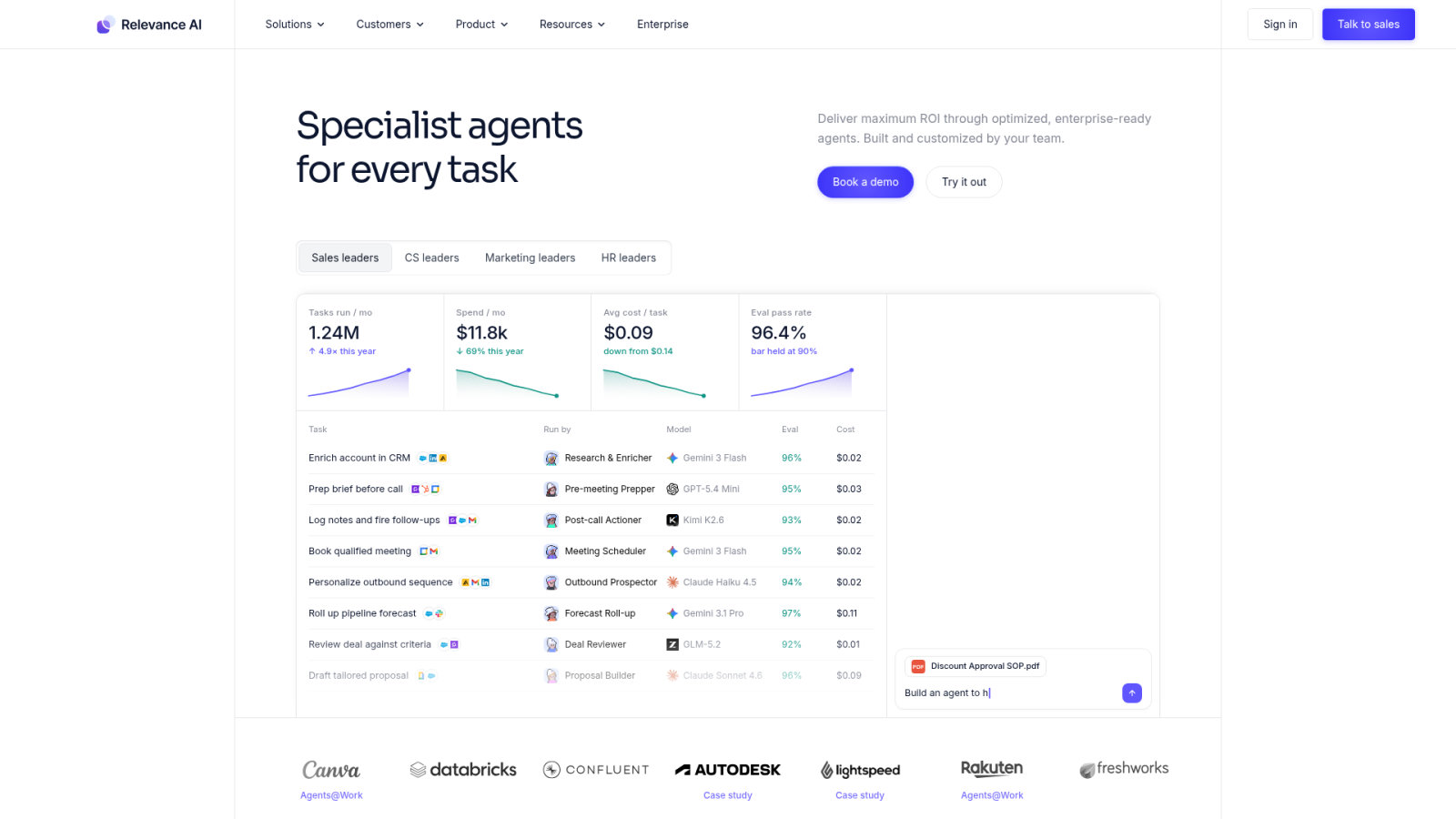
Content production efficiency reaches new levels. Agents can research, write, and edit simultaneously. This reduces the production cycle from days to minutes.
Memory Retention and Context Management Techniques
Information storage ensures continuity. Agents recall facts from months ago. Long-term memory makes interactions feel more personalized and human.
Setup for long-term memory is straightforward. It is essential for customer service agents. No-code users can manage these memory banks easily.
Vector database management organizes data for retrieval. The platform handles the technical complexity behind the scenes. This is a key factor when ChatGPT vs. Claude: Which Should You Use in 2026? for comparing AI models for agent brains.
Performance Evaluation and Prompt-Based Optimization
Prompt refinement tips improve output quality. Small changes lead to better outputs. Testing different instructions is a core part of maintenance.
A/B testing validates agent performance. Run two agent configurations side-by-side. Data-driven decisions improve agent reliability over time.
Consistency metrics track operational success. Measure how often the agent follows instructions perfectly. High reliability is the goal for any business automation.
Fine-Tuner.ai: Prompt-Based Custom Agent Deployment
If Relevance AI is about the workforce, Fine-Tuner.ai is about the specialized expert, allowing for deep customization of an agent’s knowledge base.
Rapid Deployment Without Technical Overhead
The deployment strategy follows a structured 30-day roadmap. Data ingestion commences in week one to establish the core knowledge. A functional agent reaches full operational status by week four.
The zero-code interface eliminates programming requirements. Users connect private data sources like Notion or Google Drive directly. Syncing these repositories requires only a few clicks within the dashboard.
Deployment speed remains a primary performance metric. Conceptual designs transform into functional tools in hours. This agility allows founders to pivot their automation strategies quickly based on real-time feedback.
Proprietary Data Embedding and Residency Options
Safe document uploads ensure data integrity. Internal data stays private during the training and embedding process. Encryption protocols protect intellectual property at all times against unauthorized access.
Users maintain control through geographic hosting options. Organizations choose where their data lives physically. This selection is crucial for meeting local regulatory requirements and data sovereignty laws.
High encryption standards define the platform architecture. Data remains secure while sitting in storage and while moving during processing. These standards satisfy the requirements of cautious IT departments.
Pricing Models and Token Consumption Transparency
LLM backend costs depend on specific architecture choices. Different models have different price points for processing. Choosing the right brain saves significant money during high-volume operations.
Token usage monitoring provides real-time oversight. Built-in tools allow users to predict monthly bills accurately. This transparency prevents “bill shock” at the month’s end by tracking consumption patterns.
Value tiers accommodate various operational scales. Free versions serve for testing ideas and initial prototyping. Professional subscriptions offer the stability needed for customer-facing agents and enterprise workflows.
- Cost factors: Model selection (GPT-4 vs 3.5)
- Data volume requirements
- Frequency of knowledge updates
MindOS: Context-Retention and Memory for Support
While Fine-Tuner focuses on data, MindOS prioritizes the human element, ensuring that automated support remains under strict human supervision.
Designing Human-in-the-Loop Validation Checkpoints
Manual approval steps define the workflow. Agents pause before sending sensitive replies. This architecture prevents embarrassing public mistakes for the brand.
The correction interface enables direct intervention. Humans edit agent drafts in real-time. The agent learns effectively from these human corrections.
Autonomy balance remains the primary objective. Systems find the sweet spot between speed and control. High-risk industries benefit most from this supervised automation approach.
Human-in-the-loop (HITL) checkpoints prevent hallucinations and embarrassing public errors in high-risk industries like finance.
Internal Policy Management and AI Governance
Guardrail creation ensures operational safety. Rules prevent agents from discussing off-limit topics. These parameters are easily updated in the dashboard.
Instruction updates allow for rapid adaptation. Behavior changes as internal policies evolve. Updates take effect across all agents instantly.
Audit trails provide necessary transparency. Compliance teams track every decision made. This level of oversight is required for regulated sectors like finance.
Use Cases for Customer Support and Lead Qualification
Real-world examples demonstrate operational efficiency. Agents handle complex refund requests smoothly. Customer wait times drop from hours to seconds.

Ticketing integrations simplify deployment. Agents work directly inside Zendesk or Intercom. The workflow feels natural for support teams.
Customer satisfaction scores reflect performance. Faster, accurate replies lead to happier users. CSAT scores often rise by twenty percent after deployment.
“Human-in-the-loop systems are the only way to deploy AI in customer service without risking brand reputation through hallucinations.”
AgentGPT: Browser-Based Accessibility for Prototyping
For those not yet ready for deep integration, AgentGPT offers a sandbox to test agent logic directly in the web browser.
Simplifying Agentic AI for Rapid Prototyping
Browser-based setup eliminates technical friction. Users start testing autonomous agents in seconds without creating accounts. This accessibility lowers the barrier for experimentation significantly.
The platform utilizes task decomposition logic. Agents break broad goals into small, actionable steps. Watching the agent “think” through these sequences is educational for beginners.
This approach suits founders perfectly. It allows testing new business ideas without investing in infrastructure. It remains the ideal tool for early proof-of-concept stages.
Evaluation of Free Tiers Versus Enterprise Scaling
Free version limitations impact professional usage. Daily task caps restrict heavy or continuous business operations. This tier serves best for occasional testing or learning.
The transition path remains clear. Paid plans unlock higher execution limits and access to better models. Scaling occurs in a straightforward manner as operational needs grow.
AgentGPT excels at prototyping rather than deep operations. It lacks the complex workflow depth of specialized tools. Users should eventually migrate to Zapier or Make for production.
Strategies for Maintaining Agents During Model Updates
Handling LLM performance shifts is mandatory. New model versions might interpret existing prompts differently. Regular prompt health checks ensure consistent agent behavior over time.
Versioning advice centers on rigorous documentation. Maintain detailed logs of successful prompt versions. This practice prevents losing progress during platform or model updates.
The migration process requires precision. Moving agents between platforms necessitates careful logic mapping. Adopting a platform-agnostic design makes this transition much easier for users.
Security Protocols and ROI Evaluation for Business Agents
To wrap up, choosing a platform is only the start; long-term success requires a clear eye on security and return on investment.
Decision Matrix for Platform Selection
Selection depends on the specific objective. General automation tools manage repetitive tasks efficiently. Specialized agent builders focus on creating distinct personas for complex interactions.
Team technical aptitude remains the primary constraint. Marketing leads require intuitive interfaces. Operations leads prioritize deep integration capabilities over aesthetic simplicity.
Logic complexity dictates the system choice. Visual builders suit linear workflows. Prompt-based systems handle nuanced reasoning better. Implementation success relies on The Coach in the Operating Room regarding expert guidance in technical transitions.
Managing Hidden Costs and Resource Allocation
Maintenance expenses represent a significant budget line. Prompt engineering demands continuous focus. Business agents are dynamic assets rather than static installations.
Scaling impacts financial projections immediately. API and token consumption rates accelerate during high-volume periods. Usage monitoring is mandatory to prevent budget overruns.
Efficiency requires aggressive prompt optimization. Minimal token usage reduces operational overhead. Streamlined logic minimizes execution steps, ensuring monthly cost predictability.
Future-Proofing Workflows Against Technological Shifts
Platform-agnostic design prevents vendor lock-in. Logic should remain portable across different ecosystems. Portable architecture serves as a primary insurance policy.
Logic documentation preserves institutional knowledge. Clear technical notes facilitate smooth team transitions. Shared documentation prevents the formation of isolated automation silos.

Autonomous multi-agent systems define the 2026 standard. Current simple tools build the foundation for these advanced frameworks. Early adoption of basic agents prepares organizations for autonomous scaling.
| Risk Category | 2026 Mitigation Protocol |
|---|---|
| Data Access | IAM Role-based controls and CloudTrail auditing |
| Compliance | Adherence to EU AI Act risk classifications |
| Autonomy | Real-time monitoring of agent communication logs |
Adopting the best ai agent platforms for non-developers 2026 requires prioritizing visual logic, native software connectivity, and SOC 2 compliance. Implement these no-code tools immediately to automate workflows and secure data residency before operational complexity scales. Master conversational orchestration now to lead the autonomous digital workforce transition.
FAQ
How do no-code and low-code AI interfaces differ for business users?
No-code platforms utilize natural language prompts or visual drag-and-drop canvases to eliminate syntax requirements. These interfaces allow non-technical founders and marketing leads to build functional agents without writing a single line of code. The primary distinction lies in the logic structure: prompt-based builders favor conversational instruction, while visual builders support complex operational mapping.
Low-code options typically require a basic understanding of structured logic or webhooks. While they offer higher flexibility for proprietary software integration, the learning curve is steeper compared to pure no-code tools. For rapid adoption in 2026, no-code remains the standard for immediate usability and accessibility.
Which software ecosystems offer the best integration density for AI agents?
Top-tier platforms like Zapier Central and Make.com lead the market with extensive native connections. Key integrations include communication tools like Slack, productivity suites like Gmail, and data management systems such as Salesforce or specialized CRMs. These pre-built connectors significantly reduce deployment time by removing the need for custom API development.
Non-developers can also leverage webhooks to connect proprietary or niche software. The availability of pre-configured templates further accelerates the launch of first agents, minimizing configuration errors. High integration density ensures that AI agents can act across the entire business stack autonomously.
What security compliance standards are mandatory for AI agent platforms in 2026?
Security protocols including SOC 2, GDPR, and HIPAA are non-negotiable for platforms handling sensitive customer data. These certifications ensure that service providers maintain rigorous data residency and protection standards. Leading platforms now offer these compliance features by default to satisfy corporate IT requirements.
Data isolation is equally critical to prevent information leakage into public models. Private instances and encrypted data-at-rest protocols ensure intellectual property remains secure. Internal governance features, such as admin-controlled permissions and detailed audit logs, allow for precise tracking of all automated agent actions.
How does natural language automation improve sales and marketing ROI?
Natural language agents automate lead qualification and data synchronization, saving teams an average of ten hours weekly. By removing manual entry tasks, these tools reduce human error and improve overall data integrity. The conversational teaching process allows users to define complex tasks in plain English, lowering the barrier to entry for sales staff.
The ROI is further enhanced by pay-per-task pricing models, allowing small businesses to scale costs alongside growth. Real-time execution ensures that agents operate 24/7 without manual triggers. This constant background operation directly impacts conversion rates by drastically reducing response times for inbound inquiries.
What role does human-in-the-loop validation play in AI customer support?
Human-in-the-loop (HITL) systems provide a necessary validation checkpoint for automated support agents. These systems allow humans to review and edit agent drafts before they are sent to customers, preventing brand reputation damage from potential hallucinations. This supervised approach is particularly vital for high-risk industries like finance or healthcare.
Beyond error prevention, HITL interfaces serve as a training ground where agents learn from human corrections in real-time. Admins can set specific guardrails within the dashboard to restrict agents from discussing off-limit topics. This balance of speed and control ensures that automated decision-making remains aligned with internal company policies.
How can founders prototype AI agents without significant technical overhead?
Browser-based tools like AgentGPT allow for rapid prototyping and testing of agent logic without complex infrastructure investment. These sandboxes enable founders to decompose large goals into small, executable steps to validate business ideas quickly. The zero-cost entry point makes it an ideal tool for the initial proof-of-concept stage.
While prototyping tools are excellent for testing, they often have daily task caps that limit heavy business use. As needs grow, founders typically migrate these logic maps to more robust platforms like Zapier or Make. Starting with simple prototyping tools ensures that the core automation strategy is sound before committing to professional subscriptions.
