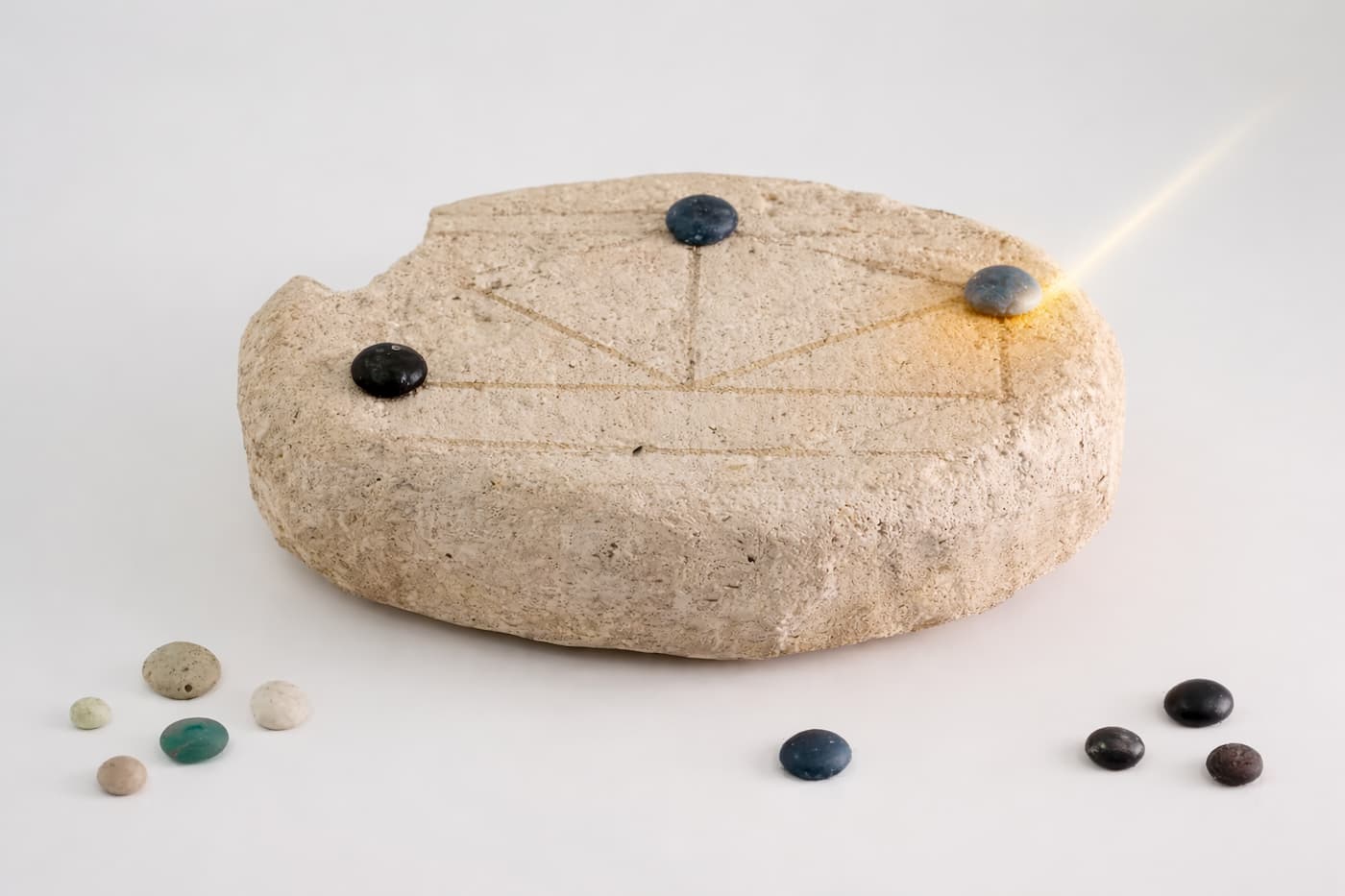
Hidden beneath centuries of dust, a mysterious stone board from the Roman Empire recently became the centerpiece of a groundbreaking investigation. Researchers harnessed artificial intelligence to tackle a puzzle that had eluded explanation since the artifact’s discovery over a century ago. This project not only brought renewed attention to worn grooves carved in stone but also uncovered unexpected links between ancient cultures and modern technology, bridging thousands of years.
The unexpected discovery in a Dutch museum
In the summer of 2020, a scholar passionate about ancient games visited a Dutch museum in search of traces of Rome’s enduring influence in northern Europe. Among seemingly ordinary exhibits lay a remarkable find: a thick slab etched with unfamiliar lines. While most relics from Rome’s occupation tell tales of trade or conquest, this particular object ignited speculation about pastimes enjoyed by Romans during quieter moments.
No comprehensive descriptions of this board exist in surviving Roman texts. Its design did not match any known recreational boards cataloged by historians. The absence of documentation led experts to suspect that it may have been played casually, with rules transmitted informally and eventually lost as generations changed.
Resurrecting ancient rules with artificial intelligence
Without written records to guide them, the research team turned to advanced tools: two AI agents competed on a virtual recreation of the board. Their method was far from random experimentation. Drawing inspiration from over one hundred documented board games spanning antiquity and modern times, each agent tested countless combinations of moves and strategies.
By running thousands of simulated matches, the team searched for meaningful patterns. Every predicted move was compared to areas of visible wear on the original slab, probing whether repeated digital play could mirror the marks left by real players centuries earlier.
How simulations bridge past and present
The logic behind these simulations extended well beyond surface-level comparisons. By tracing wear patterns, researchers identified which sets of moves best matched the authentic grooves. Numerous trial runs, each based on different historical game structures, consistently pointed toward a familiar format in academic circles: the blocking game. In such contests, the main objective is to prevent an opponent from taking further action or completing their arrangement—much like what often happens in tic-tac-toe, where strategic blocking shapes the outcome.
This approach reveals how digital data and physical evidence can interact, providing a new language for interpreting archaeological finds. It demonstrates that AI does not rewrite history, but instead uncovers plausible pathways through which ancient games may have been played.
The variety uncovered by digital modeling
Repeated AI simulations revealed more than just one possible way to play. Instead, they identified nine plausible board layouts, broadening the understanding of how Romans might have sought out varied tactical challenges within a single game framework. The emergence of such diversity suggests that inventiveness and casual adaptation were highly valued, even in leisurely pursuits.
This variability has inspired scholars to revisit overlooked museum collections. Supposedly unremarkable gaming stones could harbor similar complexities, simply waiting for digital analysis to unlock their hidden stories.
A legacy older than first imagined
One finding stands out: while blocking games were previously linked mainly to Scandinavia in the nineteenth and twentieth centuries, this Roman example predates them by many centuries. The study proposes that what was once considered a medieval pastime actually has roots deep in European antiquity. Scholars named the rediscovered game Ludus Coriovalli, highlighting both its ancient origins and specific regional context.
This revelation shifts perspectives on cultural transmission. Games traditionally seen as staples of certain regions now appear to be much older, reflecting vibrant exchanges of ideas and practices across time and geography within Europe.
- The discovery expands understanding of Roman leisure activities beyond what written records reveal.
- AI-powered reconstructions open fresh avenues for decoding ambiguous artifacts.
- Connections between ancient and later European games become increasingly apparent.
- Museum collections worldwide may contain other playable mysteries awaiting similar analysis.
Why studying ancient games matters today
For archaeologists, deciphering lost rules holds significance far beyond mere curiosity. Board games are inherently social—they reflect daily life, competitive instincts, creative problem-solving, and shared enjoyment common to civilizations throughout history. Suddenly, those dusty carved lines transform into bridges linking ancestral traditions to contemporary gatherings around the table.
Exploring these parallels encourages new questions about invention, tradition, and adaptation. Each rediscovered rule revives a fragment of dialogue between distant generations, illustrating that playfulness has always been a part of human culture, long before the arrival of the digital era.
What might be next for ancient game archaeology?
With AI as an invaluable assistant, researchers are reimagining how unintelligible objects from the past should be studied. Technology injects dynamism into traditional detective work, allowing hundreds of hypotheses to be tested rapidly and objectively. As museums continue digitizing their collections and refining analytic techniques, new discoveries are almost certainly on the horizon.
Perhaps the greatest reward lies in glimpsing the timeless nature of fun. Whether in the streets of Rome or in modern living rooms, the drive for mental competition leaves its mark—sometimes quite literally, carved into stone and patiently waiting centuries to inspire human imagination once again.