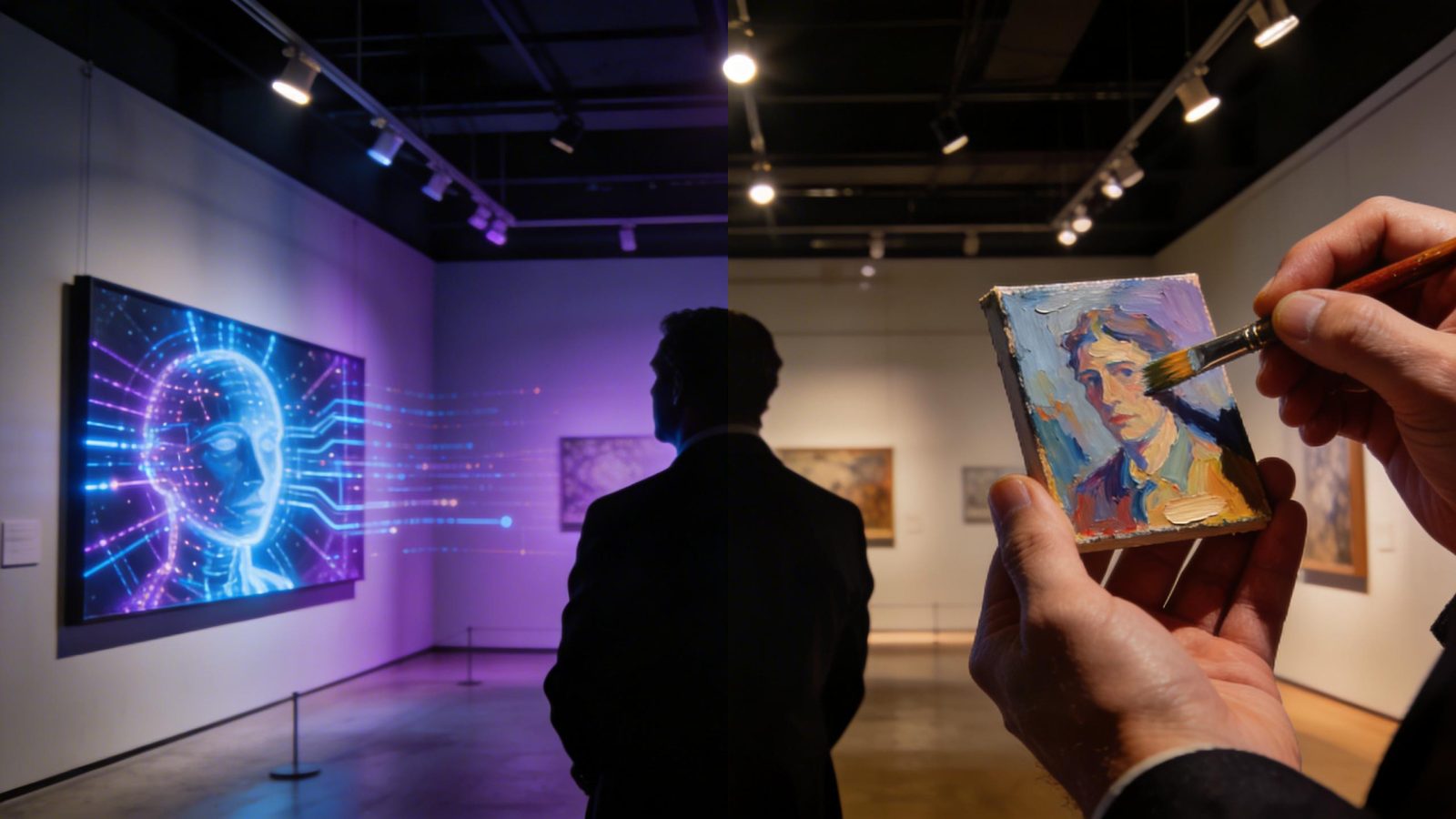
Refik Anadol’s AI-generated pieces sell for upwards of $1 million at auction, and MoMA visitors spend 38 minutes staring at his “Unsupervised” installation — 76 times longer than the typical 28-second gallery glance.
But the same market that legitimized AI art at seven figures is now driving a 66% surge in purchases of small-scale handmade paintings. Both trends are accelerating. Simultaneously.
The art world just discovered it wants two incompatible things.
This isn’t a debate about authenticity or craft versus code. It’s a market correction happening in real time, where institutional validation and cultural rejection coexist without resolution. And the numbers prove collectors are betting on both futures at once.
AI art won at auction but lost the room
The institutional case is airtight. MoMA commissioned Anadol. Christie’s sold its first AI portrait for 60 times the estimate seven years ago. Sotheby’s moved Ai-Da’s painting for $1.08 million in November 2024. The money is real. The museum walls are real.
But so is the backlash.
More than 6,000 artists signed a February 2025 open letter claiming “AI models and companies exploit human artists without permission or payment.” The organizing effort follows broader legal action where 700 major artists launched frontal attacks on AI companies, but the art market’s financial validation complicates the narrative. You can’t dismiss AI art as worthless when it’s hanging in MoMA and clearing seven figures at auction.
The February 2025 letter echoes broader fears about AI targeting high-skill professions, but the art world’s response reveals something unique: organized resistance before displacement. Artists aren’t waiting to lose commissions — they’re fighting the training data problem while still employed.
Meanwhile, global art sales tell a different story. The market contracted to $57.5 billion in 2024, down 12% year-over-year. AI art achieved legitimacy during a plateau, not a boom. It’s a Pyrrhic victory — financial validation while alienating the creative class that gives art cultural meaning.
The craft surge isn’t nostalgia — it’s a market correction
Here’s the surprise: small-scale paintings under 40 square inches saw a 66% purchase increase in 2025, representing 40% of all art purchases. Not despite AI art’s success — because of it.
The craft surge mirrors digital fatigue driving offline behavior across demographics. Collectors want objects that can’t be replicated with a prompt. AI solved efficiency but created infinite replicability — the exact opposite of what drives art value. A Refik Anadol piece can be regenerated with different parameters. A 12-by-12-inch oil painting can’t.
And the middle market proves it. Fine art auction sales hit $4.7 billion in H1 2025, down 8.8% overall, but the $1 million to $10 million band rose nearly 14%. That’s where human craft is winning — not at the Klimt-record level ($236.4 million in 2025) or the Anadol spectacle tier, but in the range where collectors buy art they actually live with.
Christie’s pulled $1.17 billion in 2025 New York sales, dominated by traditional work. AI art gets the headlines. Handmade craft gets the revenue.
The AI valuation problem nobody wants to admit
AI tools promise efficient art appraisal but cause “slip-ups based on misinformation,” according to The Art Newspaper’s December 31, 2025 market analysis. Collectors face bad provenance checks. Artists lose income to training data exploitation with no legal precedent beyond the reportedly $1.5 billion Bartz v. Anthropic settlement in September 2025.
The valuation problem isn’t accidental — it’s AI slop as business model, applied to a market built on trust and provenance. LiveArt’s database holds 11.9 million historical price records from 1,400+ auction houses. Feed that to an AI, and you get efficiency. You also get hallucinated attributions and collapsed confidence in machine-driven appraisals.
The technology legitimizing AI art is simultaneously undermining trust in traditional valuation. This isn’t a bug. It’s the business model.
Refik Anadol calls AI a “50% machine, 50% human” co-creator. The 6,000-artist letter calls it exploitation. Both statements are true, and the art market is betting on both futures simultaneously. The market has already decided.
It wants both.