

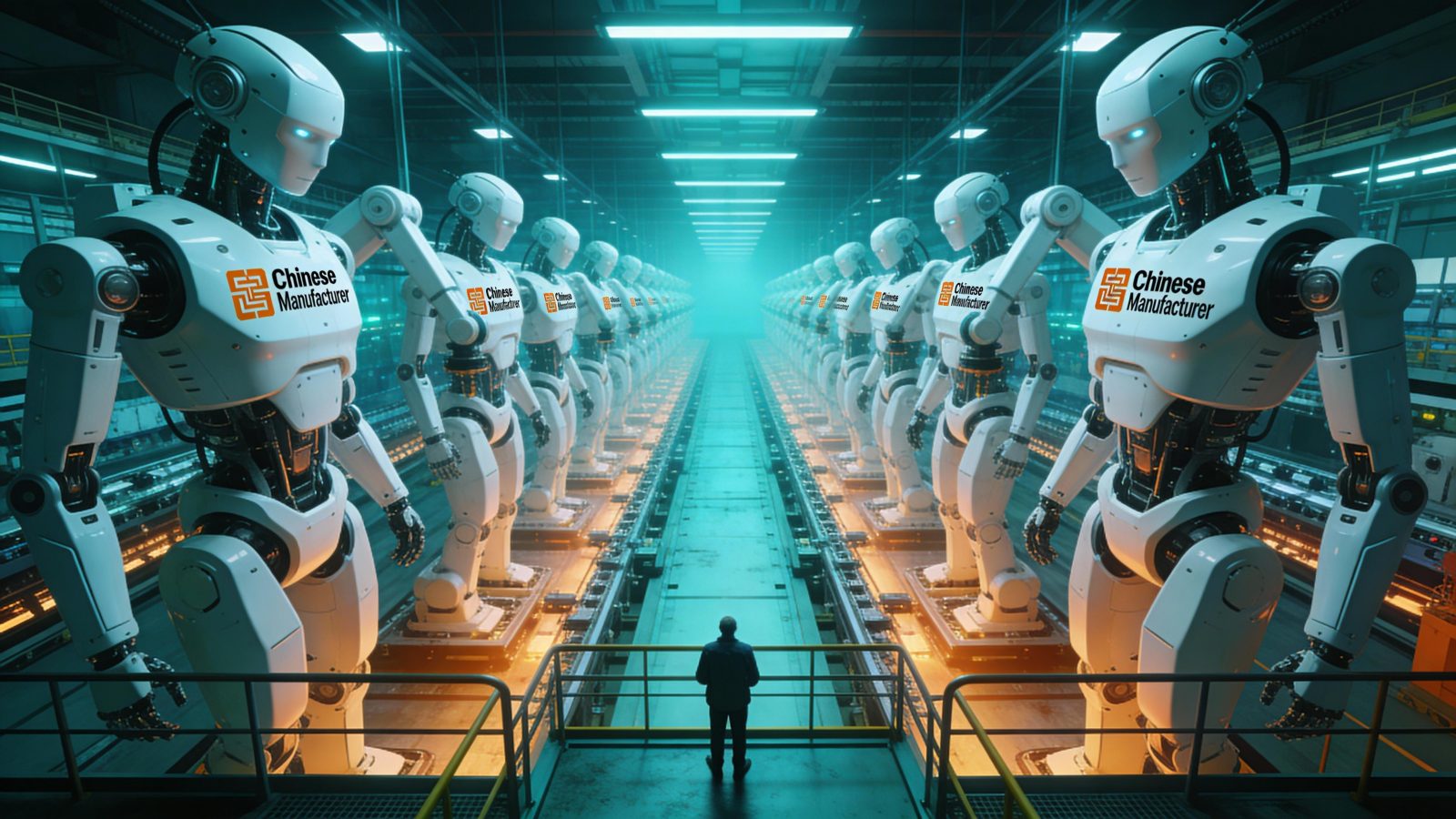
While American tech leaders debate the future of humanoid robotics, China has already shipped 13,000 units and captured over 80% of the global market in 2025. The dominance was visible at CES 2026’s AI hardware showcase, where 21 of 38 humanoid exhibitors were Chinese companies, with Mandarin becoming the dominant language on the show floor. This isn’t a future scenario—it’s the current reality of humanoid robotics in 2026.
The gap between China and the rest of the world isn’t closing. It’s widening. And if you’re planning to integrate humanoid robots into your workplace in the next two years, your options will be overwhelmingly Chinese. Here’s what the data actually shows, why it happened, and what it means for your career and company.
China Shipped 13,000 Humanoid Robots in 2025—America Shipped Almost None
The numbers are stark. Chinese firms shipped approximately 13,000 humanoid units globally in 2025, according to Omdia shipment data. Out of 16,000 total global installations, China accounted for roughly 12,800 units—more than four out of every five humanoid robots deployed worldwide. The rest of the world combined managed barely 3,200 units.
Two companies dominate this landscape. AgiBot (also known as Zhiyuan Robotics) leads with a 30.4% market share and approximately 5,000 units shipped, according to Counterpoint Research.
Unitree Robotics follows closely with 26.4% market share and over 5,500 units delivered by early 2026. UBTech hit a production milestone in January 2026, manufacturing its 1,000th S2 robot at its Liuzhou facility.
Where does Tesla’s Optimus rank in this race? Ninth place in 2025 shipments. Tesla has delayed consumer sales of Optimus to late 2027, focusing only on internal business deployments for now. While Elon Musk claims Optimus will be superior in cognition and dexterity, China has a 2-year head start in actual market deployment. If humanoid robotics were a race, China crossed the finish line in 2025 while America is still tying its shoes.
The momentum isn’t slowing. Industry analysts project global humanoid installations will exceed 100,000 units by 2027—a 6x increase from 2025 levels. And China isn’t just dominating humanoid robots. The country controls 54% of global industrial robot deployments, with 2.027 million units currently operating. In 2024 alone, China installed 295,000 industrial robots, a 7% year-over-year increase and a new record high.
The Patent and Supply Chain Stranglehold You’re Not Hearing About
Raw shipment numbers only tell part of the story. China’s dominance runs deeper—into patents, supply chains, and the fundamental components that make humanoid robots possible. Over the last five years, China filed 7,705 humanoid robot patents compared to the United States’ 1,561. That’s a 5:1 ratio.
These aren’t just paperwork. Patents represent control over actuator designs, motion algorithms, sensor integration—the core technologies that determine whether a humanoid robot can walk smoothly, manipulate objects precisely, or operate safely around humans. China’s patent portfolio gives its manufacturers a structural advantage that competitors can’t easily replicate.
The supply chain advantage is even more decisive. China controls approximately 63% of global humanoid components, particularly actuators and sensors. Actuators—the motors and joints that enable movement—represent roughly 70% of total robot costs. China manufactures these at scale, which translates directly into pricing power.
Consider the cost advantage: Unitree’s R1 model retails for $5,900, a price point industry observers considered impossible before 2030. The more advanced Unitree G1 costs $13,500—still far below what U.S. competitors can achieve. Chinese manufacturers are driving costs down 16% in 2026 alone, and consulting firm Bain projects component prices will drop 70% by 2035. Robot costs are projected to fall from $50,000 in 2024 toward $21,000 by 2050.
| Metric | China | United States | Gap |
|---|---|---|---|
| Patents (5 years) | 7,705 | 1,561 | 5:1 ratio |
| Component control | 63% | <37% | Nearly 2x |
| Lowest-cost robot | $5,900 (Unitree R1) | No comparable | N/A |
| 2025 shipments | 13,000 | Minimal | >90% gap |
No U.S. CHIPS Act initiatives or defense programs have been detailed to close this gap in 2027-2028. The infrastructure advantage China has built isn’t something America can replicate quickly, even with government support.
Why Your First Robot Coworker Will Speak Mandarin (Even If You Don’t)
Industry analysts call 2026 the “year of application”—when humanoid robots move from research labs to real work environments. The data supports this shift. 62% of Chinese firms plan to integrate humanoid robots within three years, primarily for hazardous, dirty, or monotonous tasks. Future deployments will concentrate heavily on practical applications: 72% of installations are targeted for logistics and manufacturing, not research or demonstrations.
But here’s the problem for American companies: despite 21 Chinese firms showcasing humanoids at CES 2026, no confirmed U.S. companies or facilities have been identified deploying Chinese humanoids in production environments. The geopolitical barrier is real. U.S.-China trade tensions, data security concerns, and a preference for domestic functionality over Chinese speed and affordability create significant adoption friction.
Chinese robots are already working in real factories. Galbot humanoids operate at CATL, Bosch, Toyota, and Hyundai facilities. LimX Dynamics, a Shenzhen-based manufacturer, showcased its Oli humanoid at CES 2026 and is exploring U.S. partnerships—but the company is shipping to the Middle East first, where market access is less complicated.
“The U.S. doesn’t have to lead—China innovates too.” — Will Zhang, LimX Dynamics founder, CNBC interview, January 2026
The timeline creates a difficult choice. With Tesla Optimus delayed to late 2027 and Chinese firms shipping 28,000 units in 2026, the head start becomes a 3-4 year gap by the time U.S. options arrive at scale. If you’re a warehouse manager, factory supervisor, or logistics coordinator in 2026-2027, your vendor options will be overwhelmingly Chinese. The question isn’t whether to adopt humanoid robotics—it’s whether to wait years for domestic alternatives or accept Chinese technology now, with all the geopolitical and security implications that entails.
The Limitations Nobody Talks About (And Why Tesla Might Still Have a Shot)
China’s market dominance doesn’t mean Chinese humanoids are technically superior across every dimension. Elon Musk claims Optimus is superior in cognition, hand design, and dexterity compared to Chinese rivals. He acknowledges China leads in mass production and AI awareness, but argues that superior intelligence and manipulation capabilities will matter more than a two-year head start.
The comparison to smartphones is instructive. Apple wasn’t first to market, but it dominated through superior integration and user experience. Musk’s bet is that Tesla’s approach to real-world intelligence will create a similar advantage in robotics. The question is whether Tesla can execute before Chinese competitors close the quality gap.
There’s also an autonomy gap that nobody wants to discuss directly. The transition from data collection and research deployments to full “coworker” autonomy remains uncertain. Hazardous and monotonous tasks are viable today. Complex decision-making in unstructured environments is still debated. Chinese manufacturers are shipping robots that work in controlled factory settings, not general-purpose assistants that adapt to unpredictable office environments.
Integration and reliability bottlenecks persist. Actuators represent 70% of costs, but they’re also the primary failure point. Consolidation pressures in China suggest not all 21 CES exhibitors will survive. The market is moving fast, but that speed creates casualties.
The developer ecosystem gap is significant. No public APIs, SDKs, or English-language communities exist for Unitree, AgiBot, or LimX platforms. AgiBot offers “customizable hardware and software” but provides no specifics on third-party development tools. Tesla’s approach appears to be a closed ecosystem emphasizing proprietary advantages, but at least it’s an ecosystem designed for Western developers. The lack of integration tools mirrors the voice AI integration challenges many companies face—adoption without infrastructure creates friction.
U.S. companies may choose to wait for domestic options that integrate better with existing systems, even at higher cost. That preference for functionality over speed could give Tesla and other U.S. manufacturers a path to relevance, but only if they execute quickly.
What This Means for Your Career, Company, and Industry in 2026
The implications vary dramatically depending on your role. For developers and engineers, the lack of public APIs or SDKs from Chinese leaders means limited customization opportunities right now. AgiBot mentions customizable hardware and software, but no specifics on third-party tools exist. If you want to build on humanoid platforms, you’re either waiting for Tesla or betting on closed Chinese systems with uncertain English-language support.
For founders and startups, the infrastructure play is real. The opportunities exist in integration, training, safety systems, and supervision tools—not in competing with Chinese manufacturing. While AI’s impact on high-skill jobs suggests no sector is immune from automation pressure, the immediate market need is for companies that make humanoid robots more useful, not for companies building competing hardware.
For enterprise buyers, procurement decisions happen now. 28,000 Chinese units shipping in 2026 versus Tesla’s late 2027 consumer timeline means you need to evaluate: Can you wait 18-24 months? Do geopolitical risks outweigh cost savings of 35-40% (Unitree G1 at $13,500 versus projected U.S. options at $21,000+)? What’s your data security posture for robots that may transmit operational data to Chinese servers?
For workers, the timeline is clear. 62% of Chinese firms planning integration within three years signals when job displacement accelerates. The 72% logistics and manufacturing deployment target means those sectors face the highest displacement risk. Focus on skills that complement humanoids—supervision, maintenance, exception handling—rather than tasks they’ll automate like repetitive assembly, hazardous material handling, or basic logistics.
Just as enterprise AI platform decisions increasingly favor established ecosystems, humanoid robot procurement will likely follow similar patterns. Buyers want proven integration, not just hardware specs. But while new jobs AI will create often involve supervising and maintaining these systems, the transition period will be painful for workers in directly affected roles.
If you’re in manufacturing or logistics, request demos from LimX, Unitree, or AgiBot through their U.S. distribution channels like Amazon or Robostore. Pilot small-scale deployments in non-sensitive areas to understand integration challenges before committing to large-scale adoption. If you’re in tech, monitor Tesla Optimus development and consider whether to build integration tools for Chinese platforms or wait for domestic options. If you’re a worker, upskill in robotics supervision, AI training, or adjacent fields now—the deployment timeline is measured in months, not years.
The Verdict—China Won the First Battle, But the War Isn’t Over
China dominates humanoid robotics in 2026 through manufacturing scale, cost advantages, and a two-year head start in real-world deployments. The 13,000 units shipped in 2025 and 80% market share aren’t projections—they’re accomplished facts. The 28,000-unit forecast for 2026 suggests this dominance will strengthen, not weaken.
But technical limitations and geopolitical barriers leave room for U.S. competitors if they move fast. If you need humanoid robots in 2026-2027 for hazardous or repetitive tasks, Chinese options like Unitree G1 at $13,500 or AgiBot’s customizable systems are your only realistic choice. Evaluate geopolitical and data security risks carefully. If you’re building AI or robotics infrastructure, focus on integration layers, safety systems, and training platforms that work across vendors—the 28,000-unit 2026 forecast creates massive service opportunities.
If you’re waiting for domestic alternatives, Tesla Optimus in late 2027 is your earliest option. Expect premium pricing but potentially superior cognition and dexterity per Musk’s claims. Budget an 18-24 month delay versus Chinese options. If you’re a developer wanting to build on humanoid platforms, limited options exist now. Consider whether to bet on closed Chinese systems or wait for Tesla’s ecosystem.
Watch three things in 2026: whether any major U.S. company publicly deploys Chinese humanoids despite geopolitical tensions, Tesla Optimus beta program details and actual versus claimed capabilities, and consolidation among China’s 21+ CES exhibitors—not all will survive, and winners will dominate even more.
Your first humanoid coworker will probably be Chinese not because America lacks innovation, but because China shipped the product while we were still arguing about the future. The question for 2026 isn’t whether to adopt humanoid robotics—it’s whether you can afford to wait for domestic alternatives that may arrive too late.
