


In his video, Liam Ottley frames MoltBot (ex ClawdBot) as a major shift in AI assistance: not another chatbot tab, but an open-source “air traffic controller” that can live in WhatsApp/Telegram/Slack, trigger jobs on a schedule, and execute skills just-in-time.
The upside is leverage: a persistent assistant that can act, not just answer. The downside is risk: you are effectively giving an agent “employee-like” access to systems, files, and credentials, so isolation and permission scoping become non-negotiable.
In Liam Ottley’s video, the “make money” angle isn’t magic—it’s timing. MoltBot creates a short window where.people who can set it up safely, package outcomes, and add skills fast can sell services and products before the market becomes crowded.
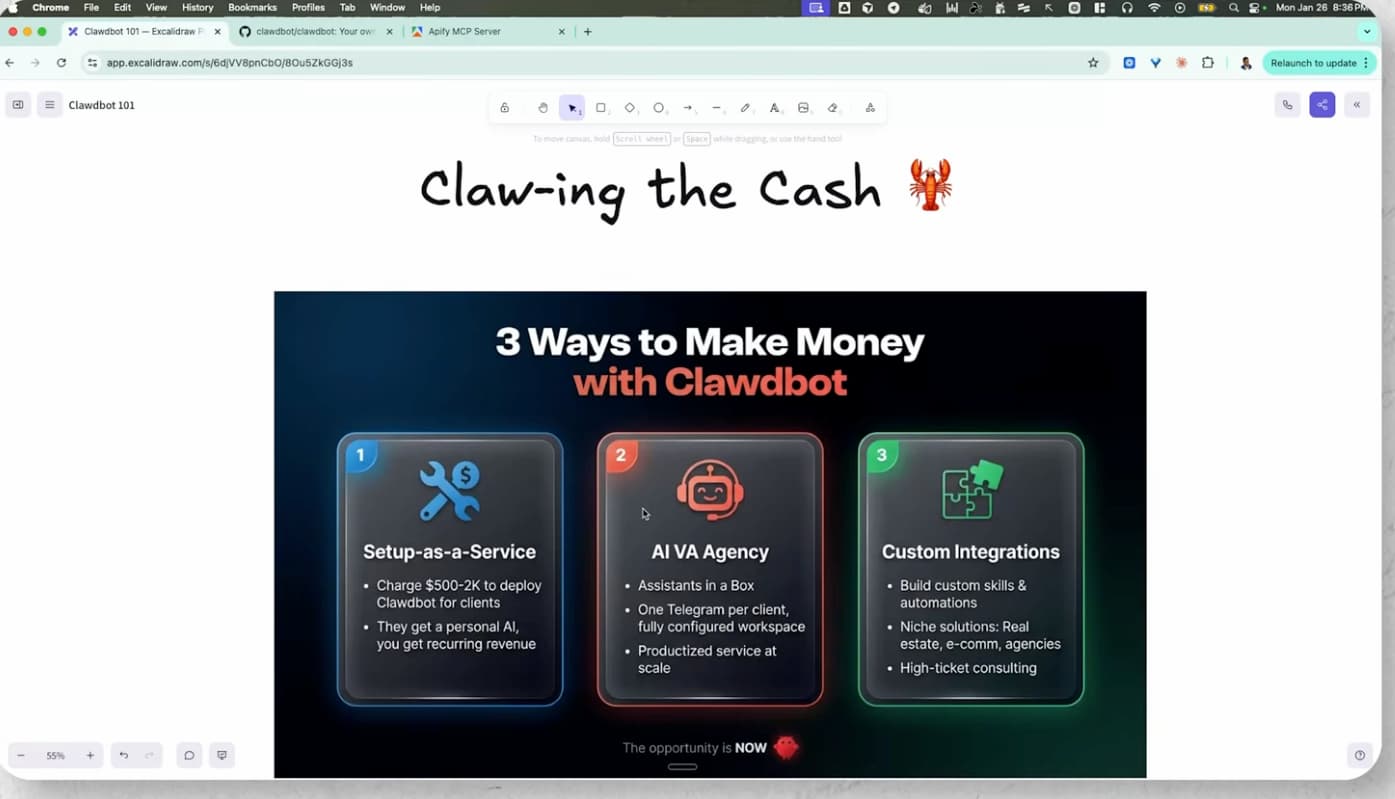
The three clearest plays: setup-as-a-service for founders/teams, education products (guides/courses/templates), and custom skills + ongoing maintenance as recurring revenue.
1) Setup-as-a-Service: “AI Employee” installs for founders and execs
Liam’s most concrete money path is straightforward: businesses won’t set this up themselves, and many shouldn’t. The gap is not “installing software”—it’s turning MoltBot into a reliable assistant without exposing the client’s data.
The offer Liam and his guest circle around is essentially: “I will deploy your assistant, connect it to the right channels, configure the behavior, and make it useful in week one.”
What you actually sell?
In the conversation, the pitch is not technical. It’s outcome-based: daily briefings, inbox summaries, competitor monitoring, internal reporting, content research, task reminders, and lightweight operations support—delivered inside the client’s messaging app.
Why this is valuable early?
Liam highlights an education gap: most clients don’t know what this is, and they don’t want the architecture lesson.
They want “more hours back.” That makes a founder/CEO assistant setup a natural first wedge.
2) Productized “Assistant-in-a-Box”: templates, default stacks, and onboarding kits
Liam’s discussion hints at a productized version of the setup service: a standardized stack of defaults (channels, core skills, safe settings, behavior style), delivered as a repeatable package.
This becomes scalable because you’re not reinventing the build each time—you’re shipping a known-good baseline and customizing only the last 20%.
The “soul.md” product idea
One spicy idea raised: selling pre-tuned assistant behavior files (“souls”) that encode a proven assistant personality, tone, and operating rules. The logic is simple: people have paid for prompts before; they’ll pay again for a ready-to-run assistant profile that feels “executive assistant-grade” out of the box.
3) Education products: guides, courses, and paid playbooks
Liam positions education as a recurring arbitrage: technology adoption lags far behind technology capability. If you can explain MoltBot clearly and teach safe setup, you can sell the knowledge.
When education beats services
The transcript draws a clean line: if you already have distribution (audience, newsletter, YouTube, community), selling a guide or course is often easier to scale than doing one-off installs.
If you don’t have distribution, services may be the faster path—find a few clients, deliver results, then productize.
What “education” can include
Not just tutorials. Liam’s framing suggests buyers want: safe architecture patterns, recommended starter workflows, default skill stacks by role (founder, creator, ops lead), and a “what to connect / what not to connect” playbook.
4) Recurring revenue: maintenance, upgrades, audits, and “future-proofing”
Liam’s guest points out the obvious: MoltBot isn’t a plug-and-play SaaS. It’s infrastructure. And infrastructure needs upkeep.
That creates a recurring revenue layer: monthly check-ins, skill updates, connector maintenance, spend controls, log reviews, and ongoing “make it smarter” optimization.
Where you upsell ?
The conversation name-checks practical add-ons: adding new skills, integrating more tools, building out the assistant’s recurring tasks, and hardening the setup as the client gives it more access over time.
5) Custom skills + integrations: the “new SaaS” surface area
Liam’s broader bet is that chat becomes the interface for software, and skills become the distribution layer. Instead of building a full SaaS product with a fancy UI, you build the backend capability and expose it as a skill.
In that world, there are two money paths: build custom skills for clients (agency model), or build a reusable skill for a common need and sell it repeatedly.
Why “skills” change the economics?
The transcript argues that many SaaS products exist mainly to wrap a narrow function behind an interface. If assistants can call that function directly, the barrier to shipping value drops—and the market for small, focused “capabilities” grows.
6) The high-ticket “hardware” angle: managed Mac Mini deployments
Liam and his guest joke about the inevitable “room full of Mac Minis,” but there’s a real service hiding inside: managed, isolated deployments for clients who want separation and control.
The idea: you charge a setup fee that includes hardware plus installation, then a recurring fee for maintenance. It’s the same business model as managed IT—just applied to AI assistants.
Important assumption note
The transcript doesn’t specify pricing benchmarks beyond casual examples (e.g., a few thousand setup + monthly retainer). Treat those as illustrative, not authoritative. Actual pricing depends on scope, risk, and how much access you manage.
FAQ
What’s the fastest way to earn with MoltBot if I have no audience?
Based on Liam’s logic: sell a high-ticket setup service to 1–3 clients first. Use those installs to build an SOP, then productize the offer. Distribution can come later.
If I have an audience, what’s the cleanest product to ship?
A paid guide or course focused on safe setup + starter workflows, plus templates (behavior profiles, checklists, recommended skill stacks). Liam’s framing suggests “clarity + safety” is what people pay for early.
Where does recurring revenue come from?
Maintenance: adding skills, updating connectors, monitoring spend, security audits, and tuning proactive jobs as clients expand what the assistant can access.
What’s the real differentiator versus everyone else selling “AI automations”?
Security and outcomes. Liam repeatedly stresses blast radius, separation, scoping keys, and safe defaults. “Done-for-you, safely” is the wedge.
Is building custom skills a dev-only opportunity?
Liam suggests you can get far without deep engineering by using tooling and letting the assistant help scaffold skills, but reliable, sellable integrations will still reward strong technical execution.
The money is in packaging the gap
Liam Ottley’s “make money” thesis is basically an adoption-gap play. MoltBot raises the ceiling on what a personal assistant can do, but most people can’t deploy it safely or translate it into consistent outcomes.
If you can bridge that gap—setup, security, starter workflows, and ongoing tuning—you can sell services now, then productize what works into templates, courses, and reusable skills as the market matures.
