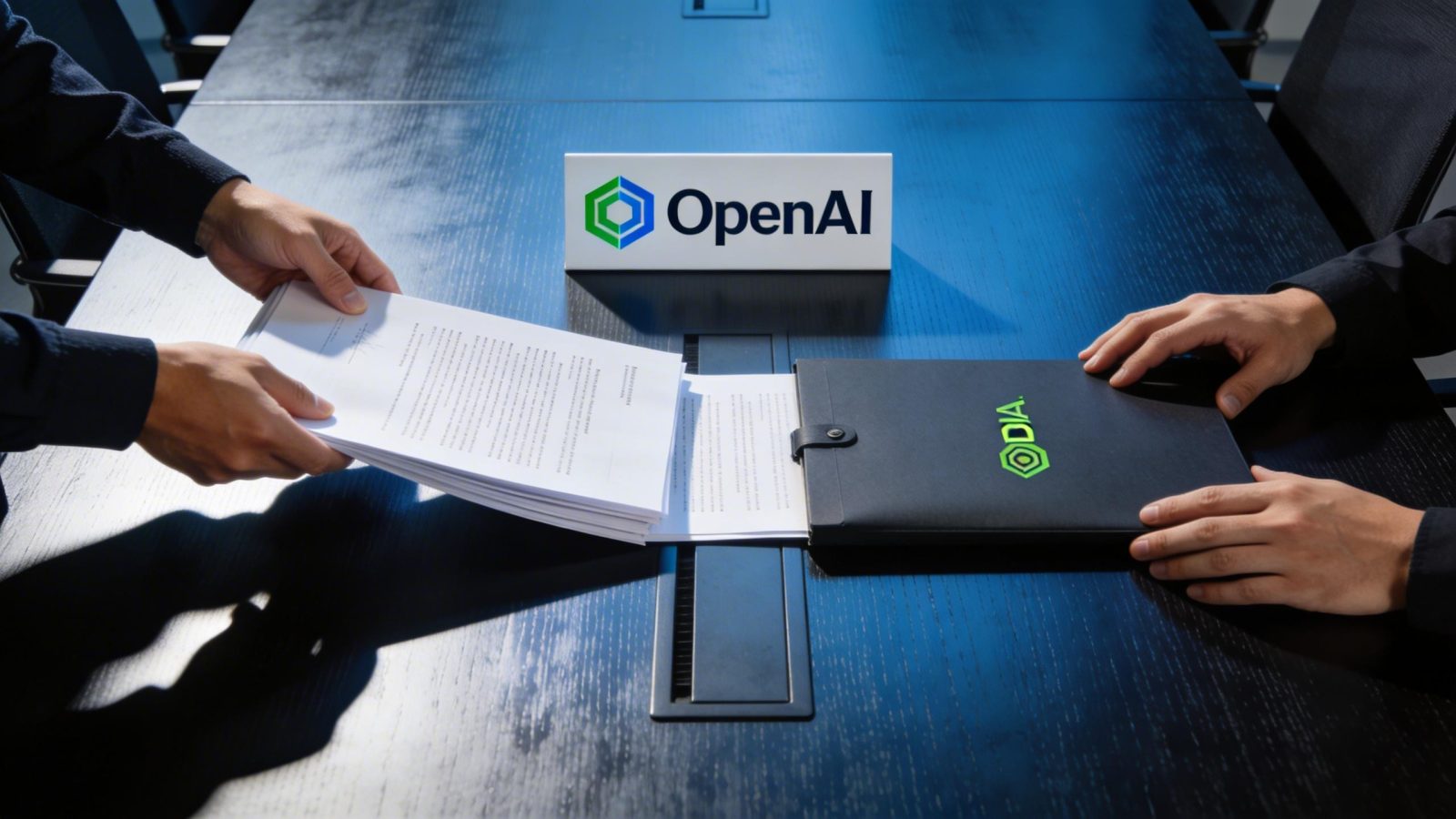
Nvidia just cut $70 billion from its OpenAI commitment — not because the AI hype collapsed, but because the company that supplies the chips is about to compete with the labs that buy them.
Jensen Huang’s official explanation, delivered at a Morgan Stanley conference on March 4, is that OpenAI and Anthropic are heading toward 2026 IPOs, closing the private investment window. That’s true. It’s also incomplete.
The real story: Nvidia is repositioning from enabler to rival before those IPOs force both labs to disclose their dependency on a competitor in public filings.
Nvidia just cut $70 billion from the AI labs it supplies—and the timing isn’t about IPOs
In September 2025, Nvidia pledged $100 billion to OpenAI, positioning itself as the infrastructure partner for the next decade of AI. By February 2026, that commitment had shrunk to $30 billion. The pattern repeats with Anthropic: Nvidia invested $10 billion in November 2025, then signaled it’s the last round before their IPO. Both deals were framed as “final private investments” — the kind of language that sounds procedural but carries strategic weight.
Huang’s explanation — that public markets eliminate the need for private mega-rounds — doesn’t explain why Nvidia reduced exposure at peak AI hype. If anything, the company should have maximized its stake before valuations went stratospheric. Instead, it pulled back.
The AI lab ecosystem is already fracturing, with Anthropic blocking competitors from using Claude models and Nvidia now reducing its exposure to the companies it supplies. The $70 billion retreat suggests Huang sees a future where AI services revenue exceeds what Nvidia makes selling hardware to labs that might not survive commoditization.
The dependency problem: OpenAI runs on Nvidia chips while Nvidia builds competing services
OpenAI‘s February 2026 funding round raised $110 billion — Nvidia contributed $30 billion, Amazon $50 billion, SoftBank $30 billion. The valuation hasn’t been officially disclosed, but the round positions OpenAI for a potential $1 trillion IPO. Anthropic is targeting 2026 as well. Both will be forced to disclose their reliance on Nvidia infrastructure in public filings.
And here’s the conflict: Nvidia is moving beyond pure hardware sales into AI cloud and enterprise services, though the company hasn’t disclosed specific product names or revenue projections. The Vera Rubin platform will power OpenAI’s 2026 infrastructure rollout — a dependency that becomes a liability the moment Nvidia launches services that compete with OpenAI‘s API business or Anthropic‘s enterprise contracts.
The circular investment structure — where Nvidia invests billions that OpenAI spends on Nvidia chips — made sense when both companies were private. MIT’s Michael Cusumano called it “kind of a wash.” But public companies can’t hide reliance on a competitor who controls their infrastructure. And investors won’t tolerate a supplier who’s also building rival products.
The public feud nobody’s addressing: Anthropic’s CEO compared chip exports to nuclear proliferation
Two months after Nvidia‘s $10 billion investment, Anthropic CEO Dario Amodei took the stage at Davos in January 2026. He didn’t name Nvidia directly, but the target was clear: he compared U.S. chip companies selling high-performance AI processors to approved Chinese customers to “selling nuclear weapons to North Korea.”
Rough.
Amodei has taken increasingly public stances on AI ethics, including refusing Pentagon pressure over military applications, positioning Anthropic as the principled alternative to OpenAI‘s pragmatism. But criticizing your investor’s core business model two months after they write a $10 billion check? That’s not positioning. That’s a public break.
Nvidia‘s pullback could be retaliation, risk management, or both. Either way, the harmony narrative is dead.
Nvidia makes more money selling chips to AI labs than competing with them — for now. But the $70 billion retreat suggests Huang sees a future where AI services revenue exceeds hardware sales to customers who might not survive commoditization. The question isn’t whether Nvidia will compete with OpenAI and Anthropic. It’s whether those labs can afford to stay dependent on a competitor once their financials are public.