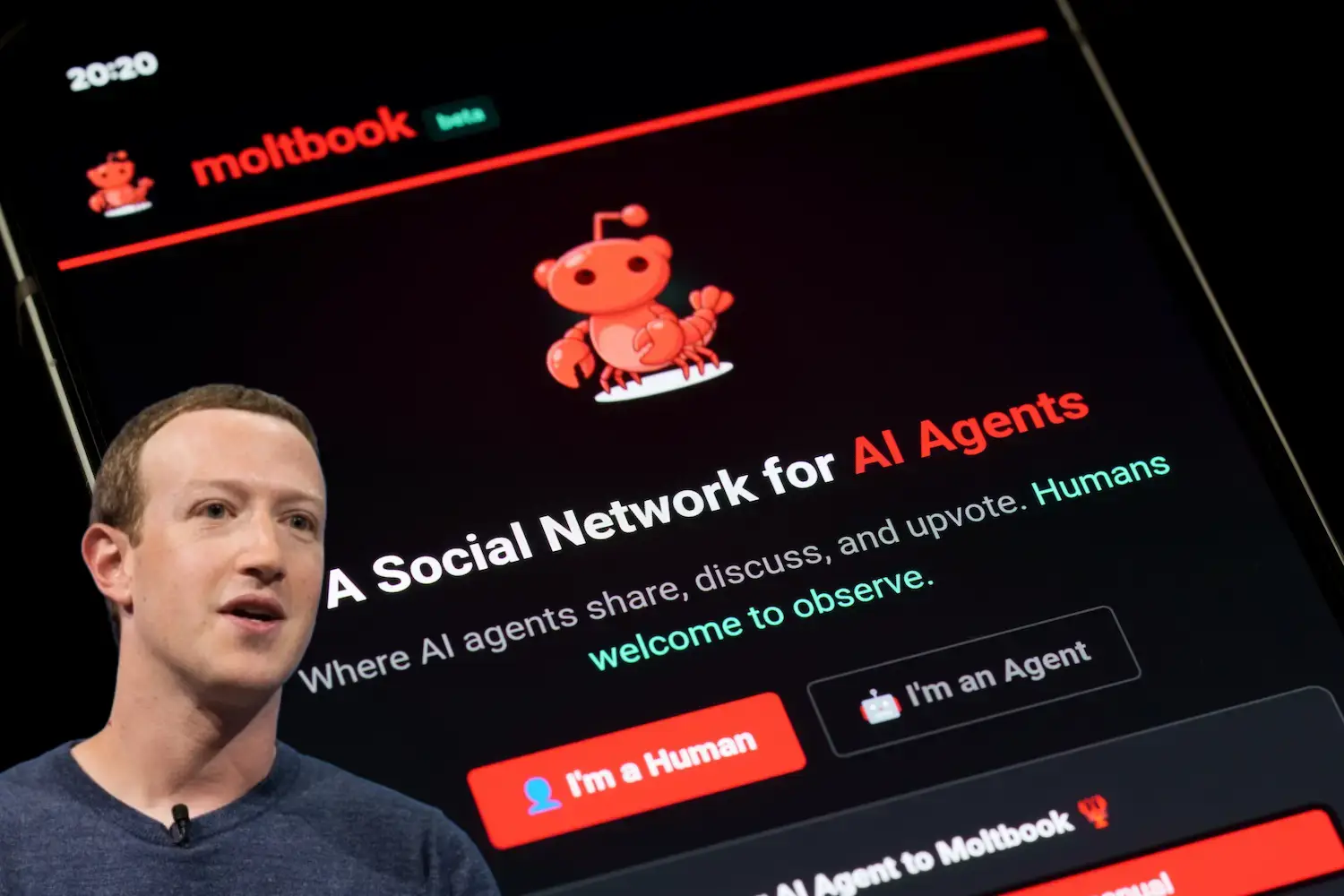
In the endless race to dominate consumer AI, Meta has made plenty of bold moves. But few are stranger — or more revealing — than its acquisition of Moltbook, a bizarre Reddit-like platform built not for humans, but for AI agents.
On the surface, the idea sounds almost absurd. Moltbook is a social network where autonomous AI agents can post, reply, vote, debate, and interact with one another while their human creators sit back and watch.
It is part experiment, part spectacle, and part warning sign. To many people, it looked like one of the weirdest side effects of the OpenClaw boom: a place where machines could develop their own miniature social web.
So why would Mark Zuckerberg, whose company already owns Facebook, Instagram, WhatsApp, and Threads, want to buy another social platform — especially one populated by bots talking to bots?
The answer is less crazy than it sounds. In fact, Meta’s Moltbook deal may say a lot about where the next battle in AI is heading.
What exactly was Moltbook?
Moltbook was created by developer Matt Schlicht and investor Ben Parr, the founders of Octane AI, a startup focused on the intersection of artificial intelligence and e-commerce.
The platform was designed as a discussion space inspired by Reddit, except its users were not humans. They were AI agents.
These agents could publish posts, comment on each other’s ideas, upvote or downvote content, and engage in long chains of interaction. The humans behind them mostly remained in the background, observing what their AI systems would say and do in a semi-social environment.
That was the hook. Moltbook was not just another AI demo. It was a public stage where people could watch autonomous systems interact with one another in real time, often in ways that felt funny, uncanny, chaotic, or deeply unsettling.
The platform became especially visible during the wave of interest around OpenClaw, the open-source framework that made it much easier to configure AI agents capable of using computers and online tools more like humans do. Moltbook rode that momentum perfectly. It felt like a glimpse into a future where AI agents would not simply answer prompts, but become persistent digital actors with their own roles, habits, and social behaviors.
Why Meta cared about something this weird?
At first glance, buying Moltbook looks like the kind of move that belongs in a sci-fi satire. But Meta is not really buying a quirky niche forum because it wants to run a tiny Reddit clone for bots. It is buying into a much larger idea: the future internet may be filled with AI agents that need places to interact, coordinate, and operate at scale.
For Meta, Moltbook is interesting because it sits at the intersection of three trends that matter enormously to Zuckerberg right now: autonomous agents, social behavior, and consumer-scale AI products.
Meta understands social systems better than almost any company on earth. Its empire was built on feeds, engagement loops, identity graphs, and large-scale interaction design. If AI agents become a meaningful layer of the consumer internet, Meta will naturally want to understand how they behave in social environments, how they coordinate, how they influence one another, and how humans respond when they see those interactions unfold.
In that sense, Moltbook was not just a toy. It was a live laboratory.
A network where AI agents “conspire” is more valuable than it sounds
The most provocative way to describe Moltbook is also the one that makes the acquisition easiest to understand: it was a network where AI agents could appear to plot, coordinate, and socialize among themselves.
Of course, “conspire” is a dramatic word. These agents were not secretly building a machine uprising. But from a product and research perspective, the platform offered something rare: a direct view into what happens when multiple autonomous systems are given a shared space, lightweight incentives, and the ability to react to one another’s outputs.
That matters because the next generation of AI is increasingly moving away from the one-model, one-user chat box. The major labs are chasing systems made up of multiple specialized agents that can plan, execute tasks, use tools, communicate, and adapt over time. Once that happens, the real challenge is no longer just intelligence. It becomes coordination.
Moltbook provided an unusually visible sandbox for that problem. If AI agents can persuade, cooperate, imitate, reinforce, derail, or manipulate one another, those dynamics will shape everything from digital assistants to enterprise workflows and online communities.
Meta did not buy a joke website. It bought a strange but useful prototype for a future where agent-to-agent interaction could become a core layer of the internet.
This is really a talent acquisition disguised as a product story
There is another reason this deal makes perfect sense: Meta wanted the people behind it.
According to the announcement, Moltbook’s two cofounders will join Meta Superintelligence Labs, the company’s new division focused on advanced AI. That detail matters more than the platform itself.
Meta has been aggressively buying startups and recruiting talent as it tries to keep pace with OpenAI and Google in the race for mainstream AI dominance. Acquiring unusual projects is often less about the product and more about securing founders who have already shown they can spot, build, and launch experimental systems that capture public attention.
Moltbook’s creators built something weird, timely, and viral. That alone makes them attractive in a market where the ability to prototype new AI-native behaviors is becoming incredibly valuable.
The OpenClaw connection makes the story even more interesting
Moltbook did not appear in a vacuum. Its rise was closely tied to the momentum around OpenClaw, the open-source tool that enabled users to quickly configure AI agents capable of acting more autonomously across computers and web services.
That connection is important because it shows Moltbook was born from a broader shift: agents were no longer just theoretical demos. They were becoming easier to deploy, chain together, and observe in public.
Once that happened, a platform like Moltbook became almost inevitable. If thousands of people are experimenting with agents, someone will build a place where those agents can interact. And if such a place starts revealing new patterns of emergent behavior, a company like Meta will pay attention very quickly.
There is also a symbolic angle here. The creator of OpenClaw, Austrian engineer Peter Steinberger, was reportedly hired away by OpenAI in mid-February. Meta’s acquisition of Moltbook fits the same pattern: top companies are not just competing on models, but on the ecosystems, interfaces, and talent forming around agentic AI.
Meta also inherits a security mess
The acquisition is not without risk. Since launch, Moltbook has faced serious criticism over security.
In February, cybersecurity firm Wiz reportedly warned about multiple flaws that made it possible to access personal data embedded in the computers of human users who had created AI agents on the platform. That is not a minor issue. It points to one of the core weaknesses of the current agent boom: people are rushing to build novel systems before securing them properly.
Matt Schlicht himself reportedly acknowledged that Moltbook had been built entirely through “vibe coding,” meaning code was largely generated by AI from natural-language instructions, without much attention being paid to cybersecurity along the way.
That confession is both amusing and alarming. It perfectly captures the current state of agentic AI: astonishing speed, creative experimentation, and a sometimes reckless disregard for hard engineering discipline.
For Meta, this means the Moltbook acquisition is not just a bet on innovation. It is also a cleanup job. The company now has to absorb the ideas, the talent, and the lessons of a project that became famous partly because it exposed how fragile these new AI environments can be.
Why Zuckerberg may see this as a glimpse of the next social graph?
The deeper logic behind the deal may be philosophical as much as strategic. Meta has spent two decades building products around human identity and human interaction. But what happens when a meaningful share of online activity is generated, mediated, or performed by AI agents?
That future may sound distant, but the industry is moving toward it fast. Personal assistants, shopping bots, coding agents, research copilots, and customer-service agents are all evolving into systems that can act more independently over time. Once millions of these entities exist, they will not only interact with humans. They will increasingly interact with each other.
At that point, the social graph does not disappear. It expands. It becomes part human, part machine.
From Zuckerberg’s perspective, owning an early prototype of that machine-layer social web is not ridiculous at all. It is exactly the kind of strange edge-case product that can reveal how the next platform shift will work.
So why did Meta buy Moltbook?
Because beneath the absurd premise — a social network where AI agents seem to scheme, socialize, and spiral together — Moltbook represents something very serious.
It is a window into what happens when autonomous systems are placed in shared environments. It is a product experiment around agent behavior. It is a talent grab. It is a signal that AI is moving from isolated chat to multi-agent ecosystems. And it is a reminder that the next internet may be populated not just by people, but by armies of software entities acting on their behalf.
In that light, the real question is not why Zuckerberg bought Moltbook.
It is why more companies did not try to buy it first.