

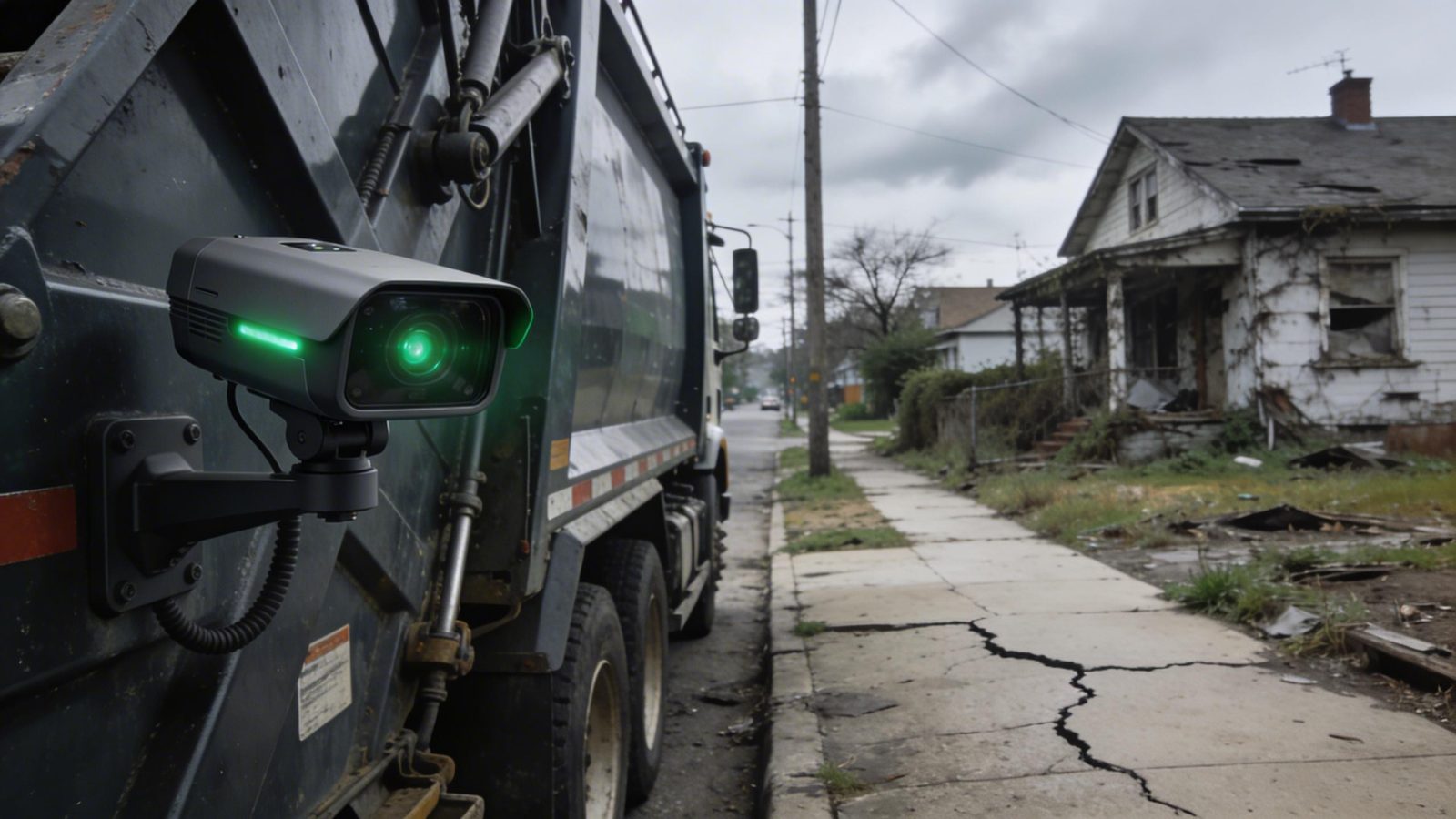
City Detect just raised $13M in Series A funding to turn garbage trucks into roving AI inspectors across 17 US cities. Not one of those cities can tell you if it’s actually working.
The March funding round, led by Prudence Venture Capital, brings the company’s total to $15 million since launching in 2021. Cities including Dallas, Miami, Birmingham, Atlanta, and Stockton are now deploying cameras on sanitation trucks to scan neighborhoods for code violations, storm damage, and infrastructure decay. The timing matters: this AI infrastructure is going live right before the 2026 hurricane season, part of a broader wave of autonomous AI making governments nervous about oversight gaps.
The pitch is simple. AI processes thousands of building observations weekly while human inspectors handle maybe 50. Free up staff for complex cases. Catch problems before they spiral. Transform municipal code enforcement from reactive to proactive.
Here’s what’s missing: any actual proof.
Seventeen cities bet millions on efficiency claims with zero published metrics
City Detect operates in a global smart city market projected to exceed $1 trillion by 2025, where AI-powered infrastructure monitoring is supposedly the fastest-growing segment. Municipal governments are buying the efficiency narrative at scale — cameras on every garbage truck, computer vision scanning every street, algorithms flagging violations faster than human eyes ever could.
But nobody’s publishing the before/after data. No detection rates. No false positive percentages. No cost-per-violation breakdowns. No response time comparisons.
Code enforcement directors love it. “It’s a force multiplier,” Justin Gardiner from Cathedral City told reporters. Harold Roach in Newport News, Virginia, called it revolutionary. CEO Gavin Baum-Blake claims “huge efficiency gains” with blight solved without citations and faster illegal dumping abatement.
Great quotes. Zero metrics backing them up.
The math problem nobody wants to solve
City Detect claims its platform processes thousands of building observations per week, significantly exceeding the ~50 manual inspections city staff typically complete. That’s the entire sales pitch: AI sees more, faster, cheaper.
Except we don’t know the cost. We don’t know the accuracy. We don’t know if “thousands” means 2,000 or 20,000. We don’t know how many of those observations are actionable versus noise.
This pattern should sound familiar. AI adoption without verification has become standard practice, even when public safety and millions in taxpayer dollars are at stake. The same efficiency argument driving AI replacing municipal workers across sectors: trust the algorithm, free up humans for “complex” work, reap the productivity gains.
But recent studies show AI fails at real work when tested against human benchmarks. City Detect’s municipal clients aren’t running those tests. They’re deploying cameras and hoping the efficiency materializes.
What happens when the hurricane hits and the AI misses critical damage
To the company’s credit, they’ve addressed privacy concerns. SOC 2 Type II compliance, face and license plate blurring, U.S.-based data storage owned by municipalities. They’re members of the GovAI Coalition and follow a responsible AI policy.
That’s the easy part. Privacy safeguards don’t tell you if the system actually works.
There’s no public false positive rate. No independent audit of the AI’s accuracy. No contingency plan if the system fails during peak storm season. Cities are freeing human inspectors for “complex cases” — but nobody’s defined what happens when AI flags the wrong buildings or misses structural damage that matters.
The 2026 hurricane season will be the first real-world stress test. And there’s no baseline to measure against, so even if it fails, nobody will be able to prove it.
Seventeen cities are betting millions that AI can spot storm damage faster than humans. By September, when hurricane season peaks, we’ll know if they bought efficiency or just expensive cameras on trash trucks. The problem: there’s no way to tell the difference until something goes catastrophically wrong.
