

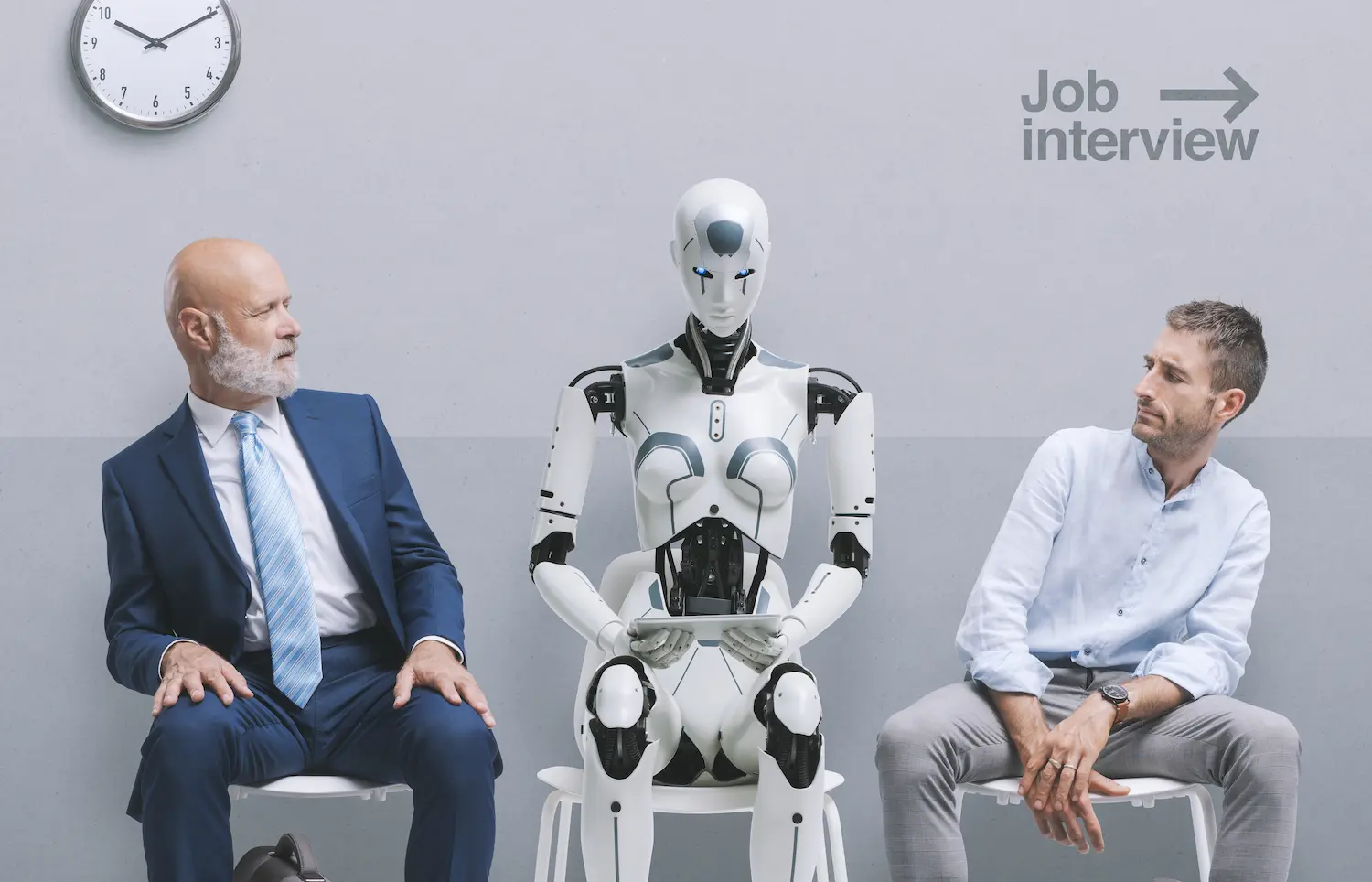
A clinical psychologist in New York reports that patients are no longer coming to talk about relationship problems or work stress. They come to talk about AI. The phrase he hears most often: “I’m afraid of becoming obsolete.” A trauma therapist in Denver describes patients who have already lost jobs to automation — expressing shock, disbelief, and a profound fear of a world where professional skills no longer matter. In Shanghai, an office worker compares his situation to Squid Game: “You can be eliminated at any moment. How can you not be anxious?” His company cut 30% of its workforce in 2025 — those who weren’t adapting fast enough.
This unease has a name in the English-speaking world: the nostalgia of the present. It’s the specific sensation of living at the end of an era while still inside it — like watching a beautiful sunset, already sad because you know it’s disappearing. Except what’s changing isn’t a sunset. It’s how we work, learn, and create. And the data on this anxiety is striking. A March 2026 survey of over 1,000 American workers found that 63% believe AI will make their workplace less human this year. More telling: 57% said their biggest concern isn’t job loss — it’s the erosion of human cognitive skills, the capacity to think independently, reason critically, and create.
The Paralysis Problem
The most consequential number in the research isn’t about job losses. It’s this: 58% of workers in AI-affected sectors say they want to change careers. Only 14% have taken any concrete steps toward doing so. The remaining 44% are frozen — not satisfied with their situation, but unable to identify a clear path forward. They don’t know what to learn, where to start, or whether any of it is worth it. That paralysis, not AI itself, is the more immediate danger.
The anxiety driving inaction is partly a media artifact. Fear-based headlines outperform hopeful ones in clicks — which means the second half of every major AI employment study rarely gets reported. The full picture is considerably more nuanced than the headlines suggest.
What the Actual Studies Say
The World Economic Forum’s Future of Jobs report, published in January 2025 and based on analysis of over 1,000 companies across 55 countries, is routinely cited for a single figure: 92 million jobs displaced by AI and automation by 2030. That number is real. What almost never gets mentioned is the report’s second figure: 170 million new jobs created over the same period. The net result is a gain of 78 million positions — according to one of the largest employment studies ever conducted.
PwC’s analysis of nearly one billion job postings across six continents adds further texture. Since the explosion of generative AI in 2022, productivity in the sectors most exposed to AI has nearly quadrupled. Wages in those sectors are rising twice as fast as elsewhere. And jobs requiring AI skills carry an average salary premium of 56% — meaning that for the same role, a candidate who can work effectively with AI earns more than half again as much as one who cannot. The year before, that premium was 25%. It more than doubled in twelve months.
AI as the Great Equalizer
A 2026 recruitment study adds a finding that complicates the usual narrative about who wins and loses in the AI transition. Researchers sent identical CVs to employers, varying only whether AI skills were listed. The results: older candidates — typically penalized in hiring — saw their callback rates rise significantly when AI competencies appeared on their résumé. Same effect for candidates without advanced degrees. The researchers concluded that AI skills function as an equalizer, shifting recruiters’ attention away from fixed characteristics like age and credentials toward demonstrated, current capability.
No computer science degree required. No age advantage assumed. The labor market premium currently attaches to people who can demonstrate practical AI fluency in their specific domain — whatever that domain is.
A Six-Month Bug Fixed in Minutes — And Why That’s Not the Point
Developer Mitchel Hashimoto recently documented a case that illustrates the collaboration dynamic more accurately than most AI discourse manages to. His software carried a persistent visual bug — a screen flicker triggered by a specific action. For six months, some of the best developers he knew had searched for the cause without finding it. The defect was buried somewhere in hundreds of thousands of lines of code, written by different teams, with minimal documentation.
Hashimoto fed the problem to a frontier reasoning model. Cost: four euros. Time: minutes. The model found the cause — buried in a library no one had thought to examine — and proposed a fix. But Hashimoto didn’t simply merge the output. He read every line. He challenged the model’s choices. He found errors and edge cases the model hadn’t anticipated. He adjusted, corrected, and improved. The final result was better than what the AI produced alone, and orders of magnitude faster than what any human team would have achieved independently in a reasonable timeframe. The AI handled the large-scale pattern search. The human applied judgment, context, and architectural vision. Neither alone produced the outcome.
This pattern — AI amplifying volume and speed of analysis, humans providing discernment and direction — is visible across domains. The accountant who uses AI to process hundreds of documents, then applies professional judgment to interpret them. The teacher who generates personalized exercises at scale, then adjusts based on what they know about the class. The craftsman who uses AI to optimize quotes, then delivers the work. In each case: AI amplifies, human decides.
The divide being created right now is not between coders and non-coders, young and old, or credentialed and not. It runs between people who have decided to engage with these tools — even imperfectly, even while confused — and those who have chosen to look away and wait. That choice is what the 56% salary premium is currently pricing in.
The nostalgia of the present is real, and so is the anxiety behind it. Every major technologist building these systems admits to feeling it. What the data consistently shows, however, is that the transition creates more opportunity than it destroys — concentrated specifically among people who decide to engage rather than wait. The train is moving. The question the numbers can’t answer is a personal one: which side of this shift are you positioning yourself on?
Sources
World Economic Forum, Future of Jobs Report (January 2025)
PwC, Global workforce AI skills analysis (2024–2025)
AI skills hiring experiment study (2026)
