
As AI-powered search tools reshape how professionals discover information, platforms like LinkedIn are becoming central sources for generative AI systems.
Appearing in answers generated by ChatGPT, Google AI Mode, or Perplexity has quickly become a new visibility objective for brands, consultants, and companies seeking influence in the AI search ecosystem.
A large Semrush study analyzing 89,000 LinkedIn URLs cited across 325,000 prompts submitted to ChatGPT Search, Google AI Mode, and Perplexity between January and February 2026 reveals the signals that increase the chances of appearing in AI-generated answers. The results show that LinkedIn is not only heavily cited by AI systems—it actively shapes the content and meaning of AI-generated responses.
LinkedIn has become one of the most cited sources in AI-generated answers
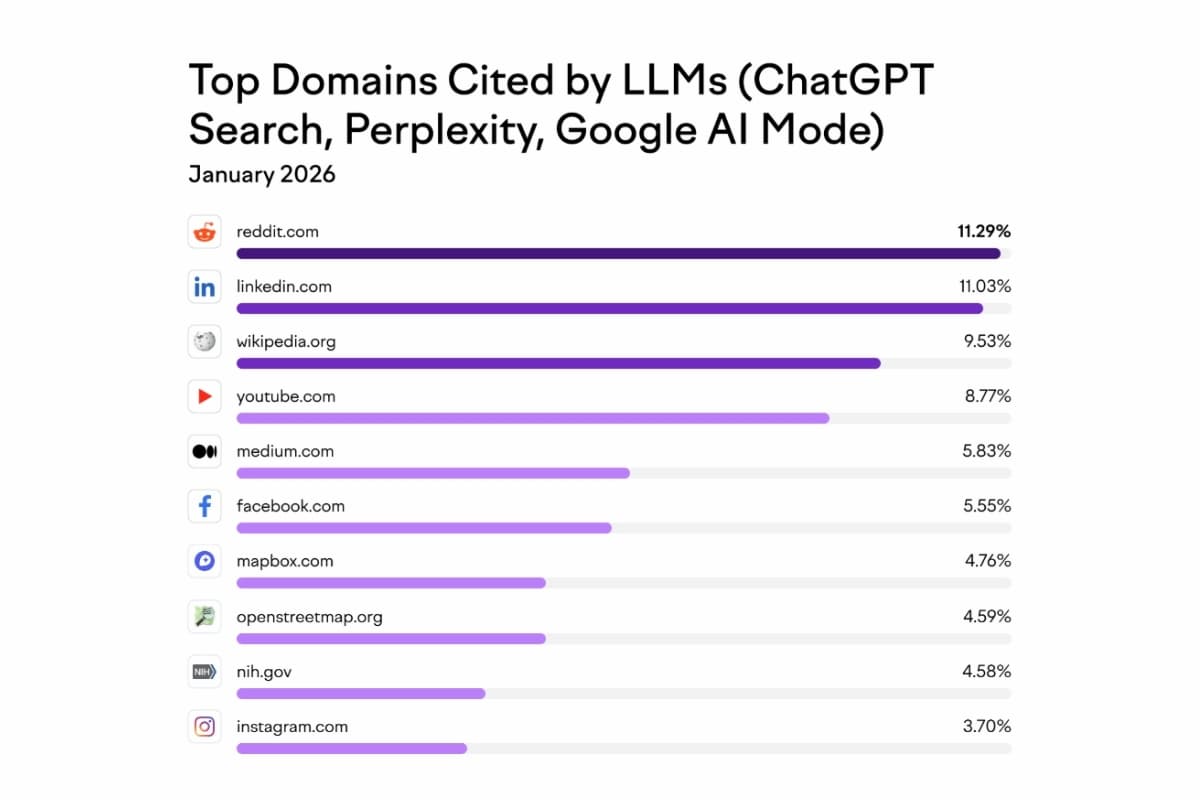
Across the three AI search engines analyzed, LinkedIn appears in roughly 11% of all generated responses, making it one of the most referenced domains on the web for generative AI systems. In some cases, it is cited even more frequently than Wikipedia or YouTube.
The citation rate varies depending on the model:
- Google AI Mode: 14.3% of responses include LinkedIn content
- ChatGPT Search: 13.5% citation rate
- Perplexity: 5.3% citation rate
But citations are only part of the story. Researchers also measured the semantic similarity between AI answers and LinkedIn sources. Scores between 0.57 and 0.60 indicate that generative AI models don’t simply link to LinkedIn content—they actively reinterpret and integrate its meaning into their responses.
In practice, this means that LinkedIn posts can directly influence how topics, companies, and expertise are described inside AI answers.
Which types of LinkedIn content appear most often in AI responses?
The study reveals a clear pattern: long-form LinkedIn articles dominate AI citations.
Depending on the AI model, long-form articles represent 50% to 66% of cited LinkedIn URLs. Short posts come next (15% to 28%), while company pages are also cited in certain contexts.
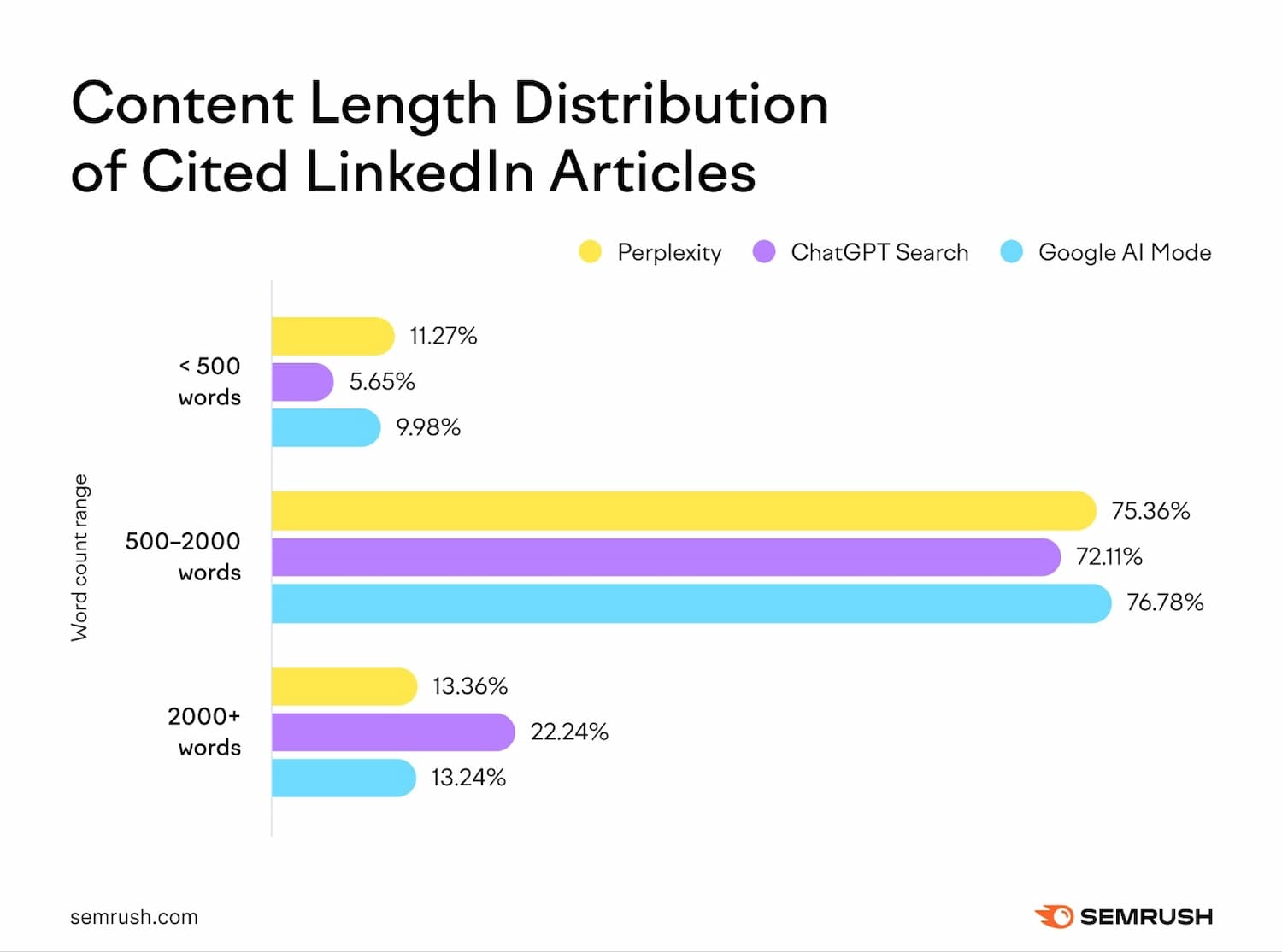
Length plays a critical role. The majority of cited content falls within specific ranges:
- Articles between 500 and 2,000 words account for 72%–77% of AI citations
- Posts between 50 and 299 words dominate the cited short-form content
Another interesting nuance emerges between AI systems. While ChatGPT and Google AI Mode tend to cite posts from individual members, Perplexity references company pages more frequently, accounting for up to 59% of its LinkedIn citations.
This suggests that an effective AI visibility strategy on LinkedIn should combine personal posts and company publications.
Original expertise matters more than popularity
Contrary to traditional social media dynamics, engagement metrics are not the primary factor influencing AI citations.
Posts appearing in AI responses typically receive modest engagement:
- Median reactions: 15 to 25
- Median comments: 0 to 1
This confirms that AI systems prioritize relevance and informational value over virality.
The most important signals identified in the study include:
- Original content – roughly 95% of cited posts are original publications
- Knowledge-sharing intent – 54% to 65% of cited posts provide advice or expertise
- Regular publishing – 71% to 77% of cited authors publish frequently
- Established communities – many cited authors have more than 2,000 followers
Interestingly, creators with fewer than 500 followers are cited at a frequency similar to larger accounts. This indicates that credibility and insight matter more than audience size.
How to appear in AI-generated answers using LinkedIn
Based on the Semrush analysis and observed patterns across AI search engines, several practical strategies can increase the probability that LinkedIn content appears in AI-generated responses.
1. Publish long-form LinkedIn articles
Articles between 500 and 2,000 words are the most frequently cited by AI systems. These formats provide enough context, explanations, and structured insights for language models to reuse.
Long-form content also helps AI models understand expertise and topic authority.
2. Focus on knowledge-sharing rather than promotion
More than half of the LinkedIn posts cited by AI systems contain practical advice, insights, or explanations. Promotional content represents only a small share of AI references.
Educational content that answers real professional questions is far more likely to be reused by AI systems.
3. Publish consistently
The majority of cited authors maintain a consistent publishing rhythm. In the study, over 70% of cited authors posted at least five times in the previous month.
Regular publishing increases the probability that AI systems discover and reuse content.
4. Prioritize original thinking
Reshared posts almost never appear in AI-generated responses. Nearly 95% of cited LinkedIn content consists of original posts.
Unique analysis, commentary, and frameworks are much more valuable than reposting trending discussions.
5. Combine personal posts and company content
Different AI systems prioritize different sources. While ChatGPT and Google AI Mode frequently cite individual posts, Perplexity references company pages more often.
A balanced strategy combining personal expertise and corporate publishing increases visibility across multiple AI systems.
The rise of LinkedIn as an AI knowledge source
As generative AI reshapes search and professional discovery, LinkedIn is emerging as one of the web’s most influential knowledge hubs. Posts published on the platform increasingly serve as raw material for AI-generated answers.
For professionals and companies alike, this shift marks the beginning of a new visibility paradigm. Success is no longer defined by likes or shares alone, but by the ability to publish clear, original, and authoritative insights that AI systems can reuse to answer questions.
In the era of AI-powered discovery, LinkedIn content does not just reach audiences directly—it increasingly shapes the answers millions of users receive from intelligent search engines.