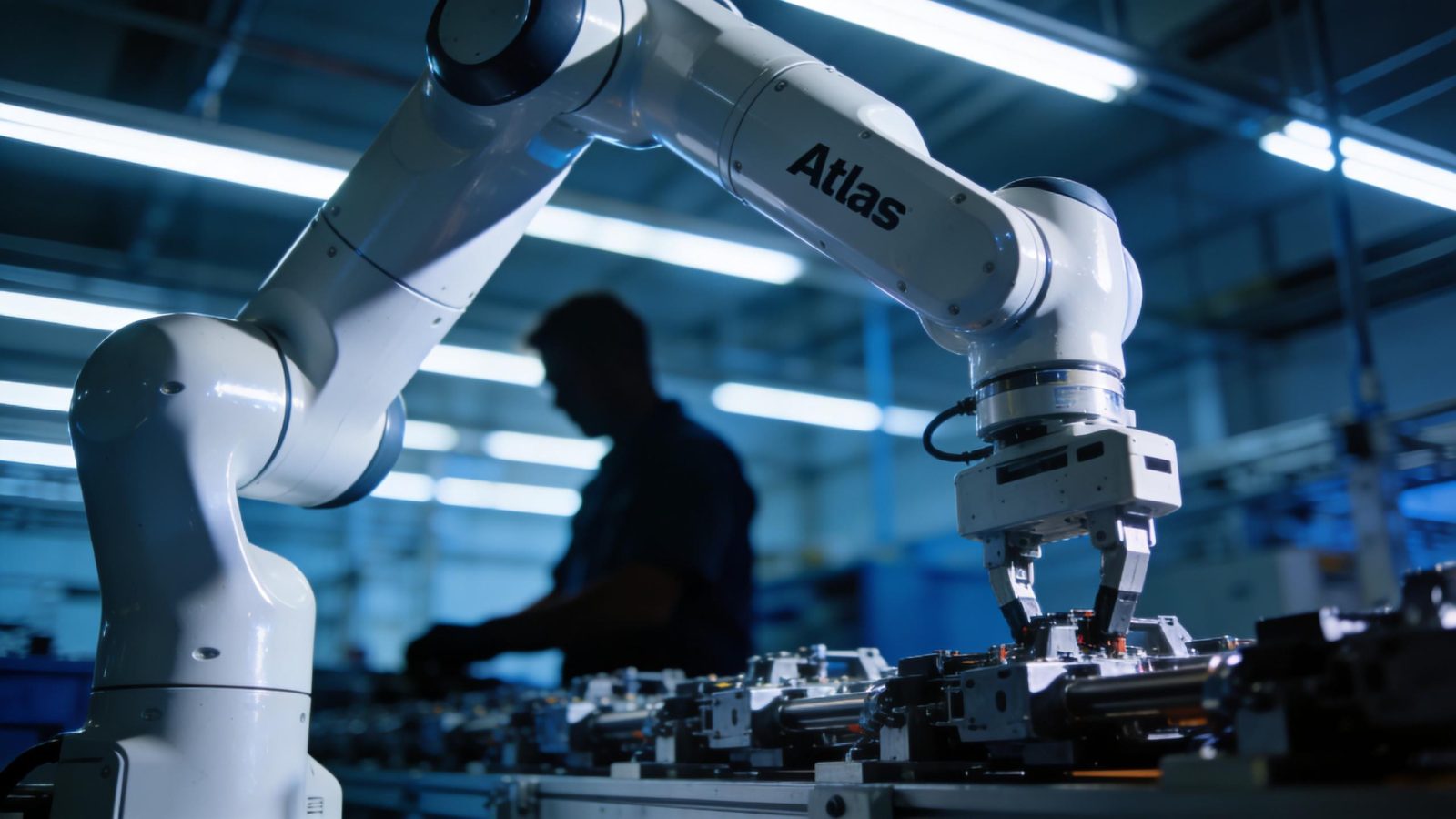
Boston Dynamics started shipping Atlas humanoid robots to Hyundai’s Georgia factory this month, and the workers who’ll stand next to them on the assembly line are posting on Reddit about whether their jobs still exist in 2027.
Atlas went from research prototype to production-ready commercial product at CES 2026 on January 5.
Manufacturing began immediately at Boston Dynamics headquarters. This isn’t a demo anymore — robots are in factories now. But the rollout reveals who gets access to humanoid labor and who doesn’t.
Hyundai and Google got every 2026 robot — you’re locked out until 2027
The grand unveiling of Atlas product—evolved from prototype—took place at the CES Media Day, setting the stage for a bold vision of AI Robotics.
Discover how Hyundai Motor Group is shaping the future of AI Robotics and pushing the boundaries of what’s possible at CES 2026. pic.twitter.com/Ac1VH0Qi4O
— Hyundai Motor Group (@HMGnewsroom) January 6, 2026
Every single Atlas robot built in 2026 is already spoken for. Hyundai’s Savannah facility gets the first batch. Google DeepMind gets the rest for research. If you’re a manufacturer, logistics company, or warehouse operator with capital ready to deploy — you’re waiting 12+ months.
This creates a two-tier system. Companies with Boston Dynamics partnerships get to train Atlas on proprietary tasks right now. Once one robot learns a task via DeepMind’s foundation models, the entire fleet replicates it via Orbit software. By the time competitors buy in 2027, they inherit Hyundai’s task library — not their own innovation. Meanwhile, China shipped 13,000 humanoid robots in 2025 while America shipped almost none.
The exclusivity isn’t about supply constraints. Boston Dynamics announced 30,000 units per year production capacity. They’re demand-constraining on purpose. Early access equals competitive moat. If you’re not in the room now, you’re already behind.
Atlas lifts 110 lbs and learns new jobs in under a day — that’s the part freaking people out
The capabilities aren’t theoretical anymore. Atlas demonstrated 110 lbs instantaneous lift capacity (70 lbs continuous) at CES 2026. It operates in -20°C to +40°C environments. It has 56 degrees of freedom and a 2.3-meter reach — exceeding human upper-body dexterity.
The speed is what changes everything. Google DeepMind’s foundation models let Atlas learn new tasks in under one day. A human assembly worker might take weeks to master a complex sequencing task. Atlas does it overnight, then teaches every other Atlas in the fleet instantly.
Hyundai’s initial deployment focuses on “parts sequencing” — moving components to human workers. The promise: safer jobs, not layoffs. But manufacturing forums are reading between the lines. Parts sequencing in 2026. Component assembly in 2028. Full line automation by 2030? AI is coming for these high-skill jobs — even doctors and software engineers aren’t safe.
The safety claims sound great — until you realize there’s zero field data
Boston Dynamics advertises “human detection and fenceless guarding” as core safety features. The operating range sounds industrial-grade. But these are stated specs, not field-tested results under heavy load in chaotic factory conditions.
Real warehouse data won’t exist until late 2026. One missed edge case — a worker stepping into Atlas’s path during a lift sequence, a sensor failure in extreme heat — and you get injury, liability, regulatory backlash. The entire humanoid industry stalls.
The 4-hour battery life with self-swappable batteries enables “near-continuous operation” in marketing materials. In practice? Factories will need battery swap infrastructure, downtime protocols, and backup units. The operational cost is higher than the purchase price, which Boston Dynamics still hasn’t disclosed.
If Hyundai’s deployment works, every manufacturer panics in 2027
If Hyundai’s 2026 deployment goes smoothly, every manufacturer will panic-buy Atlas in 2027 to catch up. If it doesn’t — if there’s a safety incident, a productivity shortfall, or worker backlash — the humanoid moment stalls for years.
Elon Musk says work will be optional in 10-20 years thanks to AI and robots — but he didn’t mention who decides which humans get to opt out. What happens when the companies that got early access have 18 months of task optimization data that competitors can never replicate? Is this innovation, or just a new way to consolidate industrial power?